
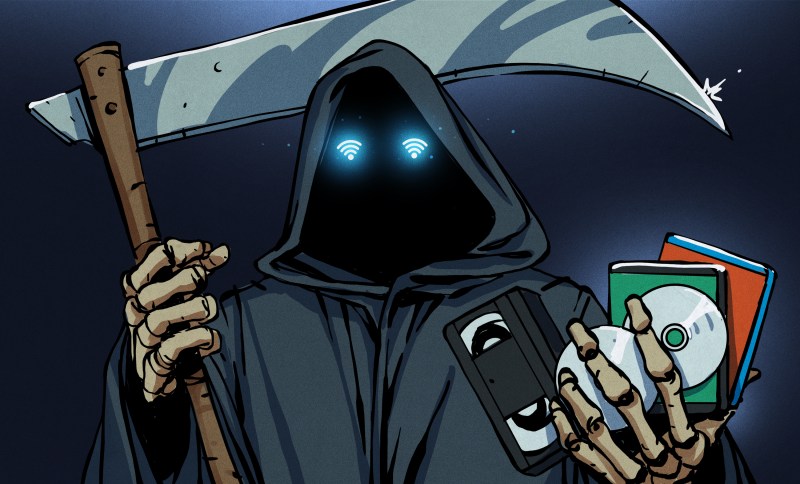
Along with the many displays of outrage, gnashing of teeth and other displays of profound grief at the recent news that Sony will no longer manufacture physical game discs come 2028, we have also heard some voices pipe up with a variety of statements, such as that this decision makes game archiving basically impossible. Of course, the truth of the matter is that software archiving in general has become much harder already over the past decades, while game consoles are just late to the archiving-hostile party.
As an example, one merely has to contrast Sony’s PlayStation with e.g. the Valve Steam store and software by juggernauts like Adobe and Autodesk. Here the former moved after the Creative Suite (CS6) series of Photoshop and other tools fully over to the Creative Cloud (CC) subscription model, where DRM and constant rental software renewals are in order. Unlike that disc copy of CS6 Master Collection that will stay good practically forever, there’s nothing really to archive with Adobe’s CC software.
Similarly, with digital game downloads and their constant patches now put inside a heavily encrypted environment that relies on a special launcher, preserving video games has been turned into into a virtual nightmare for many years now.
Why Archive
 Archiving is about accumulating historical records or materials. The scope and reason for a particular archive can differ, such as a company’s archive with financial records, an engineering department’s archive of technical references, or a museum’s archive of physical artefacts. Whatever the reason, the same goal applies: the maintaining or creating of a historical timeline that can be later referenced as needed.
An essential part of archives is to act as a primary reference source: where possible archives contain only the original documents and artefacts, making them as close to an objective source of history as possible. This is both extremely useful for a company when the tax office does a surprise inspection, but it is also for anyone who wishes to do any kind of historical research. This includes research into the development of a certain kind of software over the centuries and all types of related hardware.
Within the world of software archiving not much changes about this primary mission, except for the digital aspect that earns it the title of digital preservation. At least until fairly recently this meant mostly making copies of physical storage media and any associated physical media like documentation and manuals, but increasingly the subject of such preservation and archiving entails digital data that never was bound to or accompanied by any kind of physical media.
Such digital preservation is a big part of organizations like the Internet Archive, whose archives contain copies of software and games that might otherwise have been lost to the ages. The cases of retro enthusiasts coming across a floppy disk or CD containing some obscure game or set of drivers and uploading a copy to the Internet Archive are both numerous and an excellent example of digital preservation.
Other archives like the Video Game History Foundation (VGHF) have a more narrow focus, as their name implies. Their basic mission is no different, of course, with creating an archive that preserves history. Here the best part about digital preservation is that it makes it possible to create virtually infinite bit-perfect copies of the materials, making it incredibly easy to share and enjoy multimedia, gaming, and other content from these archives.
Digital Restrictions

Of course, if that was all that there is to be said about digital archiving and preservation then this is basically where we could conclude merrily that all is well, and that whether software is distributed digitally or on some kind of physical storage media is of no concern. In this scenario said software can be copied around to one’s heart’s content, burned to optical media and so on without restrictions, ensuring its preservation.
With distributors of software having had fits about how easy it is to copy and distribute said software since at least the 1980s, it’s little wonder that they haven’t seen fit to rely on the fact that copyright infringement is illegal, and instead sought to make it impossible to copy the data of software. This led to a wide variety of copy restriction implementations, including on floppy disks, such as Electronic Arts’ Interlock system, while Nintendo’s game cartridges mostly relied on this more obscure format to keep people from creating their own cartridges.
In the face of these hurdles, the US Library of Congress notes that, for some software, it’s not enough to have the software on some medium, but also the console or hardware to play it on.
These copy restriction mechanisms are a form of digital restrictions management (DRM), euphemistically called ‘rights management’, since DRM only removes rights. As software became decoupled from physical media by the late 90s along with multimedia content like MP3 music, alternate DRM schemes were developed that restrict copying, generally through encryption and a convoluted decryption scheme that even includes hardware-level encryption such as High-bandwidth Digital Content Protection (HDCP).
The upshot of all these copy restriction schemes is that you have to jump through many hoops to still create a copy, whether it involves breaking a floppy copying scheme, using an HDMI splitter that accidentally forgets to re-apply HDCP before sending the content off to a capture card, catching a lucky break with a leaky DVD CSS implementation, or using the analog hole to create that ‘good enough’ copy.
Nobody buys games on DVDs anymore, however. When a digital game is provided via an online store service, how can this be preserved in a digital archive? Since all of these rely on an internet-dependent DRM scheme which fails the moment there’s an issue anywhere in the chain, or if said authentication servers are turned off in N years from now, all preservation schemes here are by definition flawed or at least legally awkward.
A Digital Void
When EA created its Interlock copy restriction scheme it was likely not concerned with whether or not copies of their games would survive into the 2020s, never mind whether anyone would still be using FDDs. It does however indicate the central problem here, one that goes far beyond a black-and-white physical media vs digital-only show-off. Especially since physical media could be argued to be flawed enough that it deserved it to die.
In today’s inevitable march towards a future in which we’re all consuming content using ‘our’ Smart Terminal Devices that rely on any number of paid subscriptions to gain access to the actual content stored on the servers of our benevolent Content Overlords, what probably rankles people the most about the PlayStation physical media announcement is less the demise of physical media and more a reminder of how much has already been taken from us.
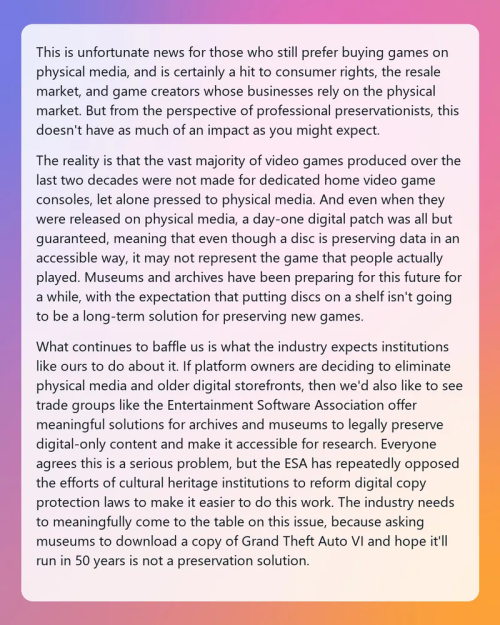
In a statement made by VGHF director Frank Cifaldi on the end of physical PlayStation discs – and the concurrent announcement of the shutdown of the PlayStation 3 and Vita online stores – this is put in the broader context of the digital void that we’re facing, in which a large part of video game history simply cannot be legally preserved.
The Legal Conundrum
Here we have to address the rather sizeable elephant in the room, in the form of copyright infringement. Here we see large groups of very nice people in friendly online communities who carefully strip any offending DRM that may even prevent the game from working, while ensuring that the freely provided bundle is kept up to date with only the best patches and anything of relevance.
Within these communities you can find entire swathes of video game history preserved for the enjoyment of connoisseurs, including tutorials, manuals, carefully curated collections of mods and extensions, plus everything else that would make a professional digital archivist salivate.
But these ‘shadow archives’ are definitely illegal according to copyright law, ergo the only option available to VGHF and other organizations that are trying to stay on the light side of the law might be to wait a few decades, see which games enter the legal grey zone of ‘abandonware‘ and see whether they’ll still get hit by a DMCA takedown request in 2050 for a game that ceased being offered for sale in 2026.
C’est la vie.












Is server emulation illegal? I don’t believe it is, and there is one for steam and it’s old drm, so that’s always an option because you arent modifying the game
BeamNG directory from
C:\Program Files (x86)\Steam\steamapps\commoncan be zipped and ran anytime, anywhere without Steam. Game is DRM free and Steam is only used to provide updates. They literally state it in their FAQ.There’s a backup facility built into Steam. Don’t know if people even use it, but it’s there. And of course, GoG has their own way. Now the other digital stores there may be an issue.
A lot of noise has been made lately about Sony discontinuing the production of physical game discs, but as this article points out, the real enemy to the software ownership that is a pre-requisite to archival is DRM schemes with server-dependent licensing requirements.
Disc or no disk is just a distraction.
Gamers might go up in arms today because they won’t be able to buy discs to keep on their shelves, without sparing a thought for the cartridges/discs they have been putting on their shelves this past decade, often containing little more than a license key to download the game from the publishers’ servers.
If they are lucky, the discs they buy do contain a game inside, but only a broken alpha release that requires downloading another game’s worth of patches to be playable.
Console gamers though that owning a physical copy of their favorite games was a given up until Sony’s announcement (even though the majority had voted for a digital only model with their wallets) but didn’t realize they had been boiled like frogs in a pot for years in this DRM, mandatory hotfix, and online dependency era.
“Gamers might go up in arms today because they won’t be able to buy discs to keep on their shelves, without sparing a thought for the cartridges/discs they have been putting on their shelves this past decade, often containing little more than a license key to download the game from the publishers’ servers.”
There’s more. A physical copy, along with the bill from the seller can prove that someone had legally aquired the product.
In some countries this might matter a lot when it was being found out that the user had applied a no-CD patch or something.
Because, if the producer or vendor doesn’t provide any help at getting the paid software to work,
the user maybe has the right to help out himself/herself and apply workarounds.
Having a proper physical copy always helps on the legal side, basically.
It’s also relevant that Sony, an entertaonment company, is a big producer of commercial Blu ray discs, maybe.
This new direction might worry fans of BDs and UHD BDs movie discs, as well.
Just like plain DVDs and music CDs, they’re still very relevant and better than any online streaming (higher bitrate).
So in a bigger scope, it’s not just a random game company’s decision of ending game production.
It’s rather about a major optical media producer’s increased withdrawal from market of optical media as such.
And that’s even more worrying than some silly mainstream slop that based on the umpteenth re-release of a genre classic.
The Computer has a gargantuan EULA menace to overcome.
Things like MASgrave…. Only soften the hit as the people that PAID for the entire industry have to contend with terms like ‘END OF LIFE’ or ‘END OF SUPPORT’…
How many time have you paid for SOFTWARE…. Only to have it FAIL out and become useless because the miscreant that SOLD it decided that he was not willing to SUPPORT his work and once they have the CASH…. You as the consumer have to put up with all the DRM and CLOUD tricks they can fathom… Until that day.
Well Mr Software Provider… COPYRIGHT and DRM are not going to be used to thieve from us anymore.
We are going to GANG UP on the software men and SUE them into the POOR HOUSE.
You can’t stop US…. We are far from happy.
“How many time have you paid for SOFTWARE…. Only to have it FAIL out and become useless because the miscreant that SOLD it decided that he was not willing to SUPPORT his work and once they have the CASH…. You as the consumer have to put up with all the DRM and CLOUD tricks they can fathom… Until that day.”
Nice thing about open source is one can be their support, and keep up the needed skills to do so if the world ever needs an apocalypse coder.
For want of a Nail, A Shoe was lost….
I will offer WARNING…
Two terms utterly DEVASTATED the modern media environment….
They killed Radio.
They killed Movies.
They killed Theatre.
Like a wild fire burns….These two terms combined completely ended Per copy media industries…
Not one of them was untouched, All of them took heavy damage in peoples CUSTOM…
Those two terms….
“Metallica” + “Napster”
Even Microsoft was brought down.
While I generally also lament the genuine difficulty of archiving digital content, I have to point out not everything is worth preserving. I have a 3 volume bound copy of Feynman’s Lectures on Physics. That’s worth preserving. I have a hardbound version of Gelfand and Fomin’s Calculus of Variations. Also worthwhile. I’m not too worried about whether or not my son gets to experience Duke Nukem or see Saturday Night Fever or much else produced by the weapons-of-mass-distraction industry.
Given my many years of experience with folks that think like you, I would bet my last dollar that your kid won’t want anything to do with Fieynman’s lectures or calculus…
I’d argue there isn’t a concept of media worth preserving, because to someone, something you deem unworthy might be very important, vice-versa, AI slop and content mills are another case however, since they only exist to draw attention but don’t contain information worth saving.
For other pieces of media, you can either preserve everything or preserve nothing.
“Since at least the 1980s”? Writer covering his bases? Fair Enough though I would have gone with “latest”.
Bill Gates’ “An Open Letter to Hobbyists” 1976.
People stop stealing my ill-gotten software.
What is this bumbaclot? He didn’t steal, he bought, licensed and otherwise legally acquired. If you have a distaste for him I will cast no stones but it’s a hard pass on the Sour Grapes Buffet.
About that letter: People often forget about its context in history!
In the early 70s, in the US, it was still common practice that software was written in universities and shared for free.
It was educational material, in simple words! It was legal.
There was no commercial software for hobby software yet, either!
And microcomputers were hobby computers! They were “sold” as do-it-yourself kits, mainly.
Electronic hobbyists and radio amateurs built them on kitchen tables.
That way they became so-called “computer enthusiasts”.
Though some small shops did the assembly for a fee, to make money.
That letter was published shortly after US copyright law was updated.
Computer hobbyists didn’t do piracy on purpose in the 70s, thus.
At a large they just weren’t up-to-date and continued to behave like they used to.
They acted reasonable and in good faith, in short.
And I read that Mr. Gates himself searched the paper bins for useful code, by the way. For inspiration. So much about morals.
Gates’s letter was first published Jan. 31 1976. The copyright laws were changed on Oct. 19 1976.
It wasn’t all quaint tinkerers as hobbyists in 1976. The HP2000E at my high school ran both BASIC and Fortran. There were four other schools in our consortium each with their own closet sized HP; I know one had the HP2000F. A few years later in college it was CDCs and Primes. At no point were any of those machines housed in a garage of kitchen table. As President Bartlett said, “See the whole board.”
“garage” or not “of”. HaD continues to prefer not to have an edit function.
My bad, thank you for the information! 🙂👍
I’m not from the US, so I may lack some details about now and then.
Hi, that HP2000E seems to be a minicomputer. Cool never the less! 😎
What I was thinking of were early 70s micro computers such as Cosmac VIP, the Sharp MZ40K or KIM-1. They’re very 70s.
Or more serious S100 systems such as Altair 8800, IMSAI 8080.
There were more like them, too. Such as the Mark-8. But time forgot about them.
Older issues of 73s magazine, QST, Popular Electronics, Radio Electronics or Elector had articles about DIY computers, I remember.
Some were made with RTTY in mind, but could be expanded to general purpose computers.
Some models are mentioned here: http://www.quadibloc.com/comp/his07.htm
PS: Integrated BASIC computers like the Wang 2200 were more like smart/programmable glass terminals, rather than home computers.
Their BASIC dialekt was made with professional use in mind, comparable to the later AH BASIC of the 8052 microcontroller series.
I explicitly mention this, because they look a bit like a Commodore PET or Sharp MZ-80K but they’re their own category of professional desktop computers.
Due to being programmable in BASIC they were used for batch work, automatisation or controlling things, maybe.
Some had a CPU built from discreet parts and contained many PCBs with their own purpose.
“you wouldn’t download a car” – yes I would if I could! And particularly if didn’t cost anyone anything for me to do it!
One way to bypass tariffs.
I feel we™ should generally and finally agree on that goods and products must, after purchase, work independently of the cooperation, goodwill or existence of those creating and selling it. Make it a law. Punish those who don’t follow, make a public institution/trust handle it so it works when some entity vanishes before they can be forced to
YES, and a bit more, products that rely on a server to function MUST be sold with that requirement clearly stated on the package. There should be a clear date that the product is going to work at least to (the servers will operate until) and a method developed for server access to be continued after the entity that sold the item (physical goods OR software / digital media) is terminated, for any reason, be it simply disintrest in continuing the server, company bankruptcy , mergers, take overs, what ever if some purchased product needs that software or utility function, code, manual, sdk editor ect. for the uninterupted use or product function that server stored or function must be passed to the care of preservationist and availabe with links allowing digital dependant or paid for media to remain available and useable by the purchaser or who ever bought the item from the original buyer of the goods.
I think any purchased goods can be sold and resold like a car or a article of clothing many many times NOT replicated or copied but not forbidden to be profited from say due to popularity or rarity something older goes up in value it can be sold to a new owner at a higher price but not copied for profit or to increase the number of items in the market.
I second that AND make a provision that non-profit entities (average Sam’s family included – as public trust entity it truly is) are NOT to be chased after using unenforceable laws meant to protect for-profit entities from other for-profit entities.
“…the title of digital preservation. At least until fairly recently this meant mostly making copies of physical storage media and any associated physical media like documentation and manuals,…” Even with pure data, physical media /per-se/ is only a part of preservation. All physical media “degrades”, both physically and logically. Magnetic media degrades faster than an optical discs, but even if the media is intact, do you have a way (hardware and software) to access (read) the bits? Do you have the software to understand (decode) the bits? Finally, do you have a way (software, perhaps hardware) to utilize the bits? Long term digital media needs to be periodically refreshed, at least a bit-for-bit copy to maintain media integrity, if not read-reformat-write to maintain logical integrity.
As a concrete example, my first job after uni included reading 7-track tapes produced on CDC equipment. By that time, 7-track tapes were deprecated, but we had a 7-track tape drive. The problem was the record length, which exceeded our hardware’s maximum record length. We had to write our own device driver that initiated a read and then reset the record length counter mid-read to prevent an overflow. While that meant the reported record length was invalid, we were able to validate the record in-memory. Writing the record to a 9-track drive was then trivial.
The real issue isn’t physical media it’s control. DRM, subscriptions, and always-online requirements have turned ownership into a fading memory. Shadow archives might be illegal, but they’re doing the preservation work that legal institutions can’t or won’t do. Pretty sad when piracy becomes the only reliable archive.
The capitalisation of the internet basically means that history is only as relevent as the monetary value inherent within it or the value that a position of control can afford.
Everything as a Service is the only logical outcome for the internet in its current guise and it is now a clearly self-fulfilling prophecy because of the the current and potential monetary value streams.
…that is unless the consumer changes where they spend their money however if you don’t have a choice then what can you do?
I love hackaday. But I feel like we’re totally forgetting the original hacker ethos and quite a bit of our history. In 1984 at the world’s first hacker convention, Stuart Brand laid it out pretty plainly. “Information wants to be free.” That was not an insanely revolutionary idea at the time- the real revolutionary idea to users was software writers making millions off of their code. The folks that really built the information revolution thought what was happening to software was insane. The point was sharing what could be done with these new amazing devices, not chasing megascale profits. It’s not like you can’t make a living off free software (libre, not gratis – free as in freedom to use and change, not free to purchase). Plenty of people have been made millionaires from open source software, but I can’t think of a single multibillionaire. That only comes from egregiously abusing the law or lobbying to create your own protectionist regulations.
When companies get too controlling someone else will be along to fill the void. People will always have a dollar to spend on something. There’s one born every minute. Many old timers tried to warn the youngsters about buying vs renting. There are cases for both. When the physical media hardware is gone it will be tougher to use physical media, and that will be the next step. Just look at cuba and see how many cars exist that are newer then 1965. And the older ones drop off and become part of the supply chain for the ones still running. Since the beginning of computers it was always controlled access, until the personal PC came along. And we now have lawyers trying to make those illegal. The control effort is real.