
Modern video games are nothing short of amazing. My son and I were playing through the one of the latest Zeldas, which involve a mix of combat and puzzle-solving that’s pretty much the hallmark of the franchise. But the most recent open-world Zelda is simply massive. Made by around 1,000 people at a development expense of $150,000,000, it takes probably 60-80 hours to play through if you’re not rushing, and more if you’re taking it easy. It has layers of game mechanics, and worlds in the sky, on land, and underground. It’s big in every way.
Contrast the games of my youth, which were a lot smaller. Written by a pair of people or maybe a handful, with playtimes in the single-digit hours, and of course fitting in the limited computing resources of the time. But the low-stakes nature of the early phases of the industry meant that software developers could take risks, and many of the games were consequently kinda idiosyncratic in this more innocent time.
I think there’s something to be said for small games. They don’t require a lifestyle commitment just to get through. They can still be fun, without taking all of your time. And honestly, when you’re done with a game quickly, you have more time for other stuff. Granted, some of this spirit lives on in the small indie games of today, but even so, game developers have the big studios’ products in the backs of their minds when they are working on their smaller oeuvres.
We were talking about preserving old games for posterity around Hackaday and on the podcast, and our conversations reminded me of a couple of educational games that, despite their rudimentary graphics, are still pretty good today. Both were electronics related, and both are still playable today thanks to efforts on emulation and software preservation. To get a feel for the 1980’s, give Rocky’s Boots a try. (I like the TRS-80 Color Computer version the best, but that may just be nostalgia.) Most of you grownups out there will get through it in an hour or so.
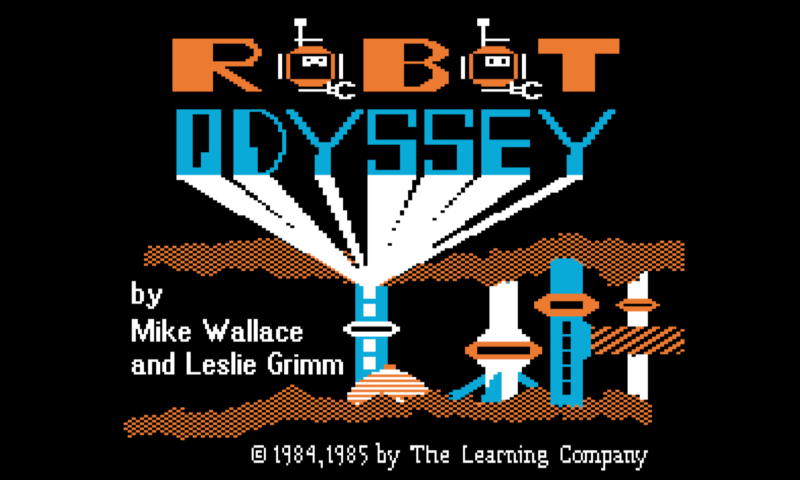
And if you want a challenge, try Rocky’s harder sequel: Robot Odyssey. If you already have a background in digital circuits, you’ll find it doable. Younger me hit a wall about two-thirds of the way through.
Both of these games stick with me because they taught me something, but also because they were simply quirky in a way that a game can only be when it’s written by a small team of folks who are just having fun programming it. If you pitched “a puzzle game about a raccoon who builds logic circuits to activate robot boots”, the boardroom would look at you like you’re out of your mind. But it’s just exactly the quirkiness and individuality of some of these early games that I cherish the most.
If you find yourself knee-deep in an endless modern game, take a side-quest off into a more naive time, and you’ll appreciate why people are putting efforts into archiving them.









Something I have been thinking about lately, re: modern gaming – Why is extreme photorealism the Holy Grail? Why?
For an imaginary world, or any piece of fiction, to ‘work’ inside your head, there has to be some amount of suspension of disbelief. Making it as realistic as possible makes that harder and it feels less real because it will never be 100%, and that less-than-100% portion stands out more and is more distracting. Do the majority of other people not know this? Apparently they do not.
It’s the same reason that millions (or “billions”) of dollars are spent on special effects in movies every year: to aid the audience with their “willing suspension of disbelief”, as you point out. And if they can’t currently get to something that is 100% perfect, we still have the picture being worth a thousand words. And, the truth is, that since your optical system can only “see” so many “pixels”, there WILL come a time (if we’re not there already) when a movie/game/simulation WILL be indistinguishable from reality.
Until we get there, each improvement in CGA is a step in the “right” direction. I suppose the alternative is that when Luke Skywalker was about to blow up the original Death Star, they could have cut the scene and shown him getting out of his X-wing saying “Wow, did you see that?? It went KA-BLOOEY!”. I suspect most people would rather have the best attempt available at making it look good.
There’s two cents for ya.
Story and narrative will eventually but always triumph over graphics and special effects. Look at the MCU — the graphics (mostly) keep getting better, but the stories keep getting worse (or at least more repetitive and derivative) and Hollywood is losing billions and seems to think that more graphics == better. The special effects of the original 1954 Godzilla are laughable today and were eclipsed by Matthew Broderick’s “remake”.
One is a wrenching brilliant commentary on war and nuclear weapons. The other is the film equivalent of badly flavored cardboard.
Godzilla minus one is such an amazing movie because it combines story with convincing effects but the effects don’t drive the story.
Verisimilitude will always be important but great movies or games are not made by the graphics. There was never a bad movie saved by the special effects and there was never a good movie ruined by missing special effects. For bad special effects, maybe, but for missing effects, such as Jaws? Never.
But… all of those things you point to as positives make for a worse game (or movie) that is superficially more realistic, but less engaging because the brain of the player (viewer) isn’t being switched into whatever mode it is that lets us feel the imaginary world/story/character. Looking at a thing is not the same as feeling it. It’s simple-minded products being made for an audience that is assumed to be simple-minded, so that’s all we’re ever gonna get so might as well take your lumps and play along.
Have you never read a particularly engaging book and then the next night some element of that book shows up in a dream? How about for a symbolic video game? How about a movie? And finally one of the triple-A ‘photorealistic’ video games, ever dreamed yourself into one of those? Those are listed in that order for a reason.
Because you have to cross the Uncanny Valley. There’s two ways you can go: completely unrealistic, or completely realistic. A compromise in between is worse than either extremes, because it results in dead-eyed plastic zombie dolls that move in disturbing ways and require the viewers to become desensitized to accept the illusion.
Of course that’s never been a problem for shut-ins who live their lives in video games. No matter how janky it is, that becomes the accepted normal.
There’s also an art style/theme that is related to this. Liminal spaces.
It’s scary, yet fascinating same time.
This video can explain it better, perhaps: https://www.youtube.com/watch?v=OEtTpkzv50c
–>[b]anon[/b], so – uncanny valley more or less?
Good point. I never understood that photorealistic aim, either.
To me, video games and computer games were a distraction from boring real life.
I wanted things to explicitly not to be the same as dull reality.
If I wanted photorealistic graphics, I just needed to go outside.
No seriously, it was about escaptism.
That’s why I liked virtual worlds that looked like StarFox on SNES,
StarFlight on Sega Genesis/MD, or a 3D rendering done with POV Ray on a 486.
Or I enjoyed text adventures on a C64/Amiga and point&click games on a DOS PC.
Even those early, eerie looking VR games like Myst or Pyst. ;)
Unfortunately, the mainstream has other interests. And operates on a different mental level, it seems.
Just like it does now on the internet in general. The www is filled with hot pictures and cat videos.
There’s no room for depth. Who still enjoys reading a book these days?
There for sure are still some weird people left, but the mainstream?
Cause not even 20 years ago it was impossible
I think if you look at the large number of recent text and terminal and ascii games and then add in intentionally (but not ironically) low graphics games you will see there are many in the gaming community who agree with you.
It’s fascinating because gaming was a mostly cottage industry, it tried to become Hollywood and then absorbed all of Hollywood’s worst habits and excesses and suffered. The hiring and layoffs in gaming are appalling as is the quality of most of the “AAA” slop.
What’s interesting though is that especially for low-fi games, the barrier to entry for small teams is almost nill. Free or dirt cheap tools, massive amounts of low cost or free assets and few barriers to market if you look at channels like itch.io.
Perfect environment for both a reckoning for the greedy and a renaissance for the true believers.
Gaming industry revenue is larger than movie industry revenue. Somebody is operating at more than the cottage industry level.
Most of that revenue goes towards IP costs like licensing and royalties, the PR and advertising, then the distribution channels, and in the last place you have the actual game development.
Which then costs twice as much because of clueless management and is half as good and 10x as big & hw req., because the dev costs too much/had too less time allotted.
There are many awesome indie games at itch.io, for example.
The site brings back memories of browsing Caiman.us in the 2000s.
Unfortunately, since a while, some of the commercial +18 games can nolonger be displayed on itch.io.
Because they way I undersood it, money institutions refuse to be involved with anything “filthy”.
So funny, but slightly erotic pixel art games in the style of the 1987 era classic “Leisure Suit Larry”
can’t be available anymore if the developer decides to earn any money with it (name your own price).
To make it appear on the site, it would have to be entirely free of charge.
But even then some filters must be set to show adult games.
That’s why some existing games are nolonger seen on the main page.
I was never that interested in computer games.
But then Lemmings came out, and I had to go into work at the weekend to get it out of my system so I could actually do some work at work (not having a PC at home).
I said Never Again. But then Doom came out…
.. and Commander Keen, too.
Wolf3d, doom and then into quake, i wasnt even a fps-head but I am quite competent given Ids training camp
A lifetime ago, in the days of 4MB Gateways and Packard Bells, I worked at Maxis, the SimCity people. We didn’t call our products “Games”, that you win or lose, but “Software Toys”, something you play with, something you explore. That I think is something that is sort of lost with photorealistic first-person shooters on GPU’s. Though having orders of magnitude more capacity does mean you don’t need to make boot disks. :D
FPS shooters are not thr only game genera around and holy freaking crap even back in the day a city sim took a super computer to expand more than a couple dozen blocks … what do you think it takes today
There’s Network Addon Mod to lift some networking & simulation restrictions in SimCity 4000 (which actually crippled some features like realistic traffic propagation), because the PCs back then weren’t powerful enough.
edit: And today, well, there’s dwarf fortress…
I worked at a computer camp in the late 1970’s early 1980’s. When Robotwar (https://en.wikipedia.org/wiki/RobotWar) was released for the apple ii, we world spend many many hours having Robotwar competitions. It was a good game to play as well as watch. You could always improve your design so it was a never ending game
Interesting! Reminds me a bit of RoboSport..
And the RobotWars TV show, of course! :D
https://www.mobygames.com/game/12059/robot-war/
https://www.mobygames.com/game/1834/robosport/
https://www.youtube.com/playlist?list=PL5A4nPQbUF8D2p5l8wJMagmHFZsP6deGd
If you haven’t yet (or even if you have), go play Chrono Trigger! Easily my all-time favorite game.
If you are intetested in modern small and simple games (story ones take at most an hour to play through) and usually made by a single person, check out PICO-8 virtual console (https://www.lexaloffle.com/pico-8.php)
That’s a fun idea, but none of them seemed very interesting? Any suggestions?
I ported the old Apple II game Lemonade Stand to Pico-8 if that might interest you. You can find it at https://www.lexaloffle.com/bbs/?pid=108827#p
I often joke that I stopped playing games when they started taking more than two (880k) floppies – they became a bit too involved for me. Along with controllers with lots of buttons. I have installed all the emulators to play these old games, but haven’t got back into them.
That being said – I have no issues super advanced graphics – to me, it was one of the reasons to move from the C64 to A500 – it makes sense to me to take it as far as it can go.
When I build my last PC, in 2021, I decided to build one that could play modern games. I got a handful on Steam, tried XBox Game Pass – nothing really stuck, until…. This year, I started playing Civ VI, turn based, with the friends I played those old games with – works well across world time zones – we’ve had a blast.
The same was true of Flash games in the early Internet. They had to be relatively small because most people didn’t have broadband, and they were usually made by individuals or small teams.
I thought the e Flash era was awesome, but once the iPhone killed Flash, all that disappeared without remembrance.
In the “early internet”?
When Flash games got popular (or had their heyday) in mid 2000s,
I already missed the “old internet” (www) of the 90s and early 2000s.
And I remember how the Flash Player 10 got 3D acceleration by ca. 2010, which I thought was overdue at the time.
But yes, I think same about the iPhone. It ruined things on some many levels. 😢
It gets worse though– gaming industry has spent way too much time innovating output (the graphics) and not enough on input (controllers) which is why I personally rejoiced when the Wii came out. However, many never stayed on that train despite there being accelerometers in many modern controllers and progress really didn’t continue with the exception of VR. Dual stick controllers only exist for convenience and are an inferior method of input. I’ll be excited when I can get my hands on the steam controller 2 (still using a 1 for flat gaming) /end rant
Having a game that starts high resolution that “decays” into TRON like trips into the past might be interesting
When I was in graduate school, I installed Galaxy (a pbem turn-based wargame) on my Unix workstation and invited some of my research group to play. Within a day, the entire group wanted to play, and to make it faster (e.g. more fun) I updated the scripts so that a new turn would be emailed whenever all of the previous turns were submitted. No graphics other than a printout of where your worlds were located.
ALL of our productive work halted for 3-4 days, until my advisor (who was also playing) told me I had to limit the script to only update once per day or all our research was doomed… memorable fun that I remember fondly to this day; no graphical interface whatsoever.