
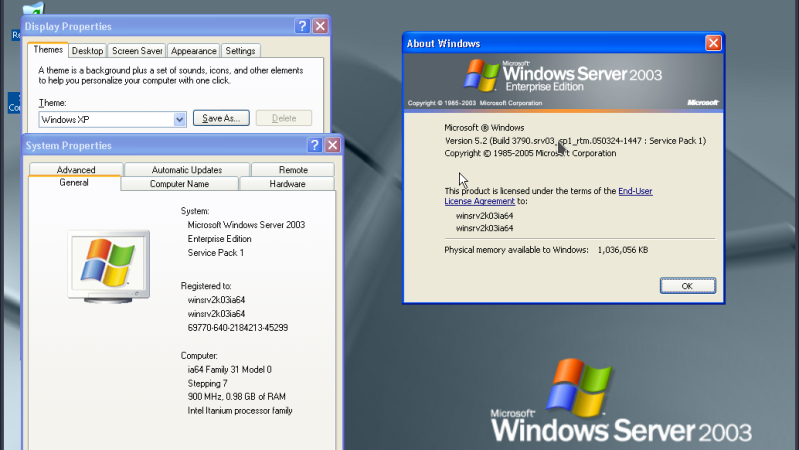
Intel’s Itanium architecture was an interesting experiment, but it has gone down in history as one of the chip giant’s bigger flops, so much so that it earned the name “Itanic” in the tech press. This is perhaps unfair, considering it did limp on until a quiet EOL in 2020. We didn’t know anyone missed it, but perhaps it was more the technical challenge than nostalgia for obsolete server hardware that led [Yufeng Gao] and [gdwnldsKSC] to spin up an instruction-set translator for the late, lamented, IA-64 architecture.
Note that it’s very much in alpha, version 0.1, so don’t expect all the things. Neither HP-UX and OpenVMS will boot, which is a pity since Itanium’s great success was arguably winning those OSes and thereby killing the bespoke architectures HP and DEC had at the time. Gentoo can get to a shell, as long as you use Kernel 6.6 or older, and Windows Server 2003 and XP-64 both apparently boot.
It’s not incredibly performant, with 486-level speeds when running on Ryzen 5000 series hardware, but then, it is a 64-bit hardware being emulated here, and pretty weird hardware at that. Itanium’s Very Long Word Instruction architecture was notoriously hard to program well. Specifically, it was hard to compile optimized programs for, so we expect optimizing an emulator is going to be similarly difficult. That’s why this is so impressive, even at this early stage.
The late, unlamented Itanium is probably one of the few systems not in the Virtual OS Museum, but perhaps eventually this project will change that.
via Raymii.org












I wish there was a port of Tibia for Itanium CPUs when their were popular. Sadly CipSoft was so incompetent back then.
I remember being on the test team for RHEL 4.3 on IA64. I wonder if it will boot on this emulator….
I just rebuilt one to try and use. Hey it was cheap and came with a bunch of core duos. I elected to use the quad core based on the duo instead. It wasn’t as fussy about memory.
x86 is cursed; somehow, Intel and AMD will surpass Apple and Qualcomm’s ARM processors in both battery life and performance, and they’ll still be around 30 years from now. This isn’t wishful thinking, it’s a prediction.
Provided that Intel doesn’t try to etshablish another X86S.. 😟
Intel already did take away BIOS compatibility by writing CSM out of UEFI specification.
Once 8086/80286 compatibility, Segmentation Unit (MMU), Rings 1&2, V86 Mode and Real-Mode instructions are removed from silicon,
it will be even more difficult to run classic x86 software without using full emulation.
X64 OSes (X86_64) and 32-Bit applications (-Win32 EXE files on Windows x64-) might still run, but not something such as Windows 98 or XP anymore.
(They can still be run by running an external BIOS layer payload from UEFI.)
https://www.tomshardware.com/pc-components/cpus/intel-terminates-x86s-initiative-unilateral-quest-to-de-bloat-x86-instruction-set-comes-to-an-end
https://www.intel.com/content/www/us/en/developer/articles/technical/envisioning-future-simplified-architecture.html
https://www.phoronix.com/news/Intel-Legacy-BIOS-EOL-2020
Keep in mind that during 1990s and 2000s computing power increased exponentially. Only around 2010s progress stopped and they went for adding more cores. In the long run it makes sense to implement legacy features in CPU-as-a-service model because it can save silicon space, reduce thermal footprint and simplify core design. It’s a proven model anyway. For example Nintendo Switch doesn’t have DMG chip from Game Boy, they run software in the CPU as Nintendo Classics. If it works then it works, simple.
Hi, how about providing all the legacy circuits to first CPU core, at least?
So that at least classic operating systems can be booted, but without having SMP support?
The whole transistor count of a whole 286 to 586 CPU die is tiny compared to the vast die space used in an current intel CPU.
And most of the big SIMDs are part of x64, anyway.
The only despensable SIMD legacy blocks are x87 FPU/MMX, maybe.
Good point. But the Game Boy Micro lacked the DMG CPU and could only run Gome Boy Adance games.
Which in turn made many players rather buying an older GBA SP with DMG compatibility or even an newer DS.
Despite the possibility that some DS/GBA flash carts had emulators for GBC.
Another idea would be to have an programmable CPU block in the die.
Like an FPGA, basically. Or in the style of NX586 or Transmeta Crusoe architecture.
Both were implementing x86 in very creative ways.
https://en.wikipedia.org/wiki/NexGen
https://en.wikipedia.org/wiki/Transmeta_Crusoe
Another one. Some Thin Clients emulate an entire PC/AT compatible mainboard in software.
Example: The Virtual System Architecture (VSA) https://tinyurl.com/4c45kfsa
Maybe that technology could be used as an emulation inside an x64 CPU or in an x64 motherboard’s managment engine?
It could go a step further an emulate a comple 486/586 PC.
I have one of the Itanium development systems. It was definitely a good platform, but failed to gather momentum. If anything it shows how difficult getting critical mass can be.
Its just a fork with no additions. Shame on you for bot linking the real creator.
HP – not Intel – developed the Itanic, to persuade customers there was an upgrade path fron the very successful PA-RISC series. Look at the instruction set and virtual memory architecture, and you will see the correspondence.
HP realised that, unlike the PA-RISC chips, they could not fabricate the IA64 chips in house. So, in order to keep existing customers on board, HP gave Intel the rights to sell the chips, with HP having “most favoured partner” status.
Itanic was doomed for a traditional reason: hardware engineers presumed that it would be possible to develop compilers that could take advantage of the parallelism. Oops.
That makes sense, thanks a lot! 😎
Btw, I think we should also not forget that the idea for an x86 successor wasn’t new at the time.
A few years earlier, in the 90s, there were several RISC platforms being around.
Alpha AXP, MIPS R4000, PowerPC..
And Windows NT 3.5x and NT 4 had ports to those platforms.
OS/2 Warp had an unfinished PowerPC port, too, if I remember correctly.
There also was the PowerPC Alliance trying to establish a PC standard (WinNT, MacOS etc).
The Handheld PCs (HPCs) and Pocket PCs (PPCs) running Windows CE 2.11 and up had ports to MIPS, SH3 and StrongARM (pre XScale).
SH4 was supported by Windows CE 6 or something.
I don’t mean to sound smart or something, but this wasn’t exactly mainstream knowledge, I think.
The average user rather knew about Intel PCs running Windows, PowerMacs with MacOS and PDAs (PalmOS, Windows, niche OS).
So in retrospect, to many users it may look like as if there was always x86 until Itanium suddenly appeared out of thin air in early 2000 for no apparent reason.
That’s why I’m mention it. To PC fans or developers, that’s old news, likely.
Saying hp developed the itanium and gave it to Intel to sell it because they couldn’t make it is an oversimplification.
In reality, hp was developing the PA-WW architecture using very long instruction word, VLIW, to shift instruction scheduling away from the CPU and onto the compiler. Unfortunately, hp realized that laying out the physical architecture, setting up the software tools (compiler) and spinning up a new fab was beyond their financial reach at the time.
Add on the fact that hp was actually spinning down their current PA-RISC fabs to eventually leave the actual manufacturing of chips altogether and you see quickly that HP had little more than a concept on paper with no real means to actually build it and bring it to market without going bankrupt.
What actually happened was HP brought their conceptual architecture over to Intel and offered to enter into a CO development program. Intel did all the legwork like actually engineering the physical architecture, creating the entire fab process, even setting up the instructions so they they could bake in some sort of x86 compatibility. HP helped guide the process so they could more easily design the compiler stack and adapt their own HP-UX operating system to the new architecture.
You also have to remember Intel wasn’t just sitting there focusing entirely on x86 when HP walked in with this paper concept of EPIC. They were actively designing their own new architectures because they wanted to get out of the court enforced licences they had with AMD and others with x86. They saw it as an opportunity to bring a promising concept to life while ho did the marketing and software legwork for them.
Yes, it was a simplification – but the whole story is (of course) much longer than you have given!
HP always[] believed that a compiler would be possible and could extract the necessary parallelism. [] I never heard them state otherwise; I did ask some relevant people and did observe the lack of progress from the sidelines.
You elaborate my point that HP knew it couldn’t afford to fab the chips.
The “it will run x86 code” always struck me as stupid; I presume that originated in Intel.
There were other reasons the Itanic failed, e.g. context switch time due to many hidden registers, and throwing energy into doing unneeded computations just as total power dissipation was becoming critical.
Maybe experiment with an FPGA?
https://iccd.et.tudelft.nl/Proceedings/2004/22310288.pdf