
There was once a race to put out cameras with ever higher numbers of megapixels to snare customers eager to take the highest quality digital photos. These days, we know that things like optics, processing, and finer qualities of an image sensor are all very important beyond pure resolution. But, for a time, companies behaved as if megapixels mattered over all else.
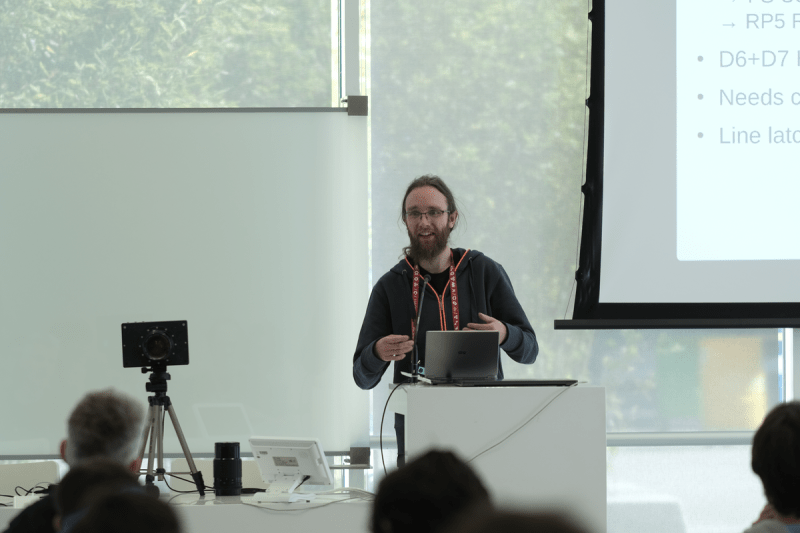
But what if you could go farther—shooting not millions, but billions of pixels in a single image? That’s precisely what [Yannick Richter] came to Hackaday Europe to talk about, covering his Project Gigapixel build.
More Pixels
When it comes to building a consumer camera with higher resolution, manufacturers achieve this by creating an image sensor with a greater number of sensing elements. This, of course, can get expensive and difficult the farther you want to scale, particularly if you’re trying to fit more sensing elements into a given standard sensor size.
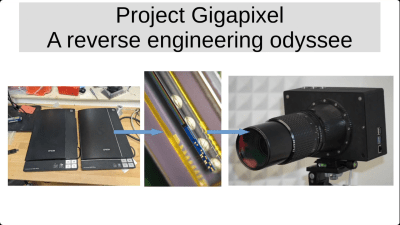
However, there are other ways to capture images in greater resolution that don’t require a larger image sensor. Namely, you can actually use quite a simple image sensor of limited resolution, and simply move it to various positions, capturing light all the while. Then, all you need to do is stitch the output together and you have a remarkably high resolution image. It might sound complicated, but as [Yannick] explains, it’s a perfectly cromulent way to build a gigapixel image.
[Yannick’s] project began with an old Epson flatbed scanner. This made the perfect donor for such a project, as it came with a linear image sensor with quite good resolution for scanning photographs and documents. The only problem is that it needs to move in a straight path in order to capture a full image. The goal was to build it into a scanner-style camera that was truly portable, which required some reverse engineering and creative design to make it into a practical tool for real-world photography. [Yannick] didn’t want to just stuff the existing scanner in a bodged-together camera body, either. He wanted to interface the sensor directly and build a custom linear-scanning camera from the ground up, with the high-resolution linear sensor mounted behind a nice medium-format Pentax lens.
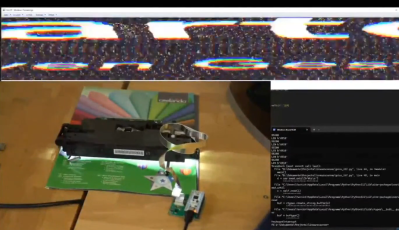
The talk covers all the work that [Yannick] did to make this a fully functional camera. That included doing a deep dive into Epson documentation to figure out how to interface the sensor at all. Thankfully, service manuals provided enough detail on how the 12-line RGB sensor works to get the project over the line. Interfacing the sensor was achieved via reusing the ADC and timing generation hardware from the scanner itself, hooked up to a Raspberry Pi 5 and a RP2350.
Plenty of work was required to figure out how to properly offset all the R, G, and B pixels to line up properly into a coherent color image. [Yannick] also dives into the mechanical design, regarding how the sensor was assembled on a 100-millimeter linear drive to scan it behind the lens assembly to capture images. There were also issues generating a live preview that you’d get on any other digital camera, which is not exactly practical to generate from a scanning image sensor. Instead, a standard Raspberry Pi camera was included in the build for live preview to help with lining up a shot.
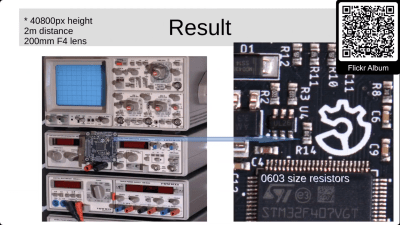
Perhaps the best part of the talk is when [Yannick] shows off the final results. The simple fact is that 3.2 gigapixel images capture a ton of detail when they’re taken well and focused correctly. A simple shot of some benchtop instruments doesn’t look like anything special, until [Yannick] shows that cropping in will let you read the codes off a 0603 SMD resistor. Obviously, the camera is limited when it comes to speed and it can’t really capture moving objects well. However, when it comes to grabbing very high resolution shots of still scenes, it’s a great performer. If taking gorgeously detailed landscapes or stunning architectural shots is your thing, you might find such a build an appealing proposition for your own needs.












Gigapixel photography by stitching images together was all the rage 20 years ago.
http://news.bbc.co.uk/1/hi/technology/4022149.stm
This was also a major project driven by CMU’s Create Lab back in the early 2010’s (Called GigaPan back then):
https://www.ri.cmu.edu/create-lab-releases-new-gigapan-time-machine-data/
Hasselblad Moment : – ]
I love that the Simpsons made “cromulent” into a real word. It embiggened the word.
Same operating principle as the Soviet cycloramic cameras back in the 60’s: http://mentallandscape.com/V_Cameras.htm
My personal favorite is https://www.gigapan.com/galleries/11077/gigapans. Multiple fixed position but independent focus sensors behind large SPHERICAL lense.
The stock Epson V750 upstairs will do a ~4.5 GPx scan of the full bed, but you’d better be prepared to wait a LONG time.
The real utility there of course is that you can get a good picture out of a single 8mm movie frame or a really good one out of 110 stills or 16mm movies.
Film rules
https://petapixel.com/2018/06/08/film-photography-at-70000-feet-in-the-u-2-spy-plane/
https://airandspace.si.edu/collection-objects/camera-aerial-hycon-73b/nasm_A19771125000
Video
https://techxplore.com/news/2026-07-ouroboros-ai-edge-devices-video.html
https://blog.st.com/world-largest-cinema-image-sensor/
Gigapxl in the early 2000’s was amazing. Film-based but nothing digital is even remotely in the same league. Site is defunct, but some of the articles have examples of the photos.
That was the way…
The late Doug Trumbull had a site called UFOTOG.
He was a UFO true believer, and had a truck with different types of cameras in it. (I hope a storm chaser got it.)
A good project for UFO debunkers would be to write a book called “A Skeptics Guide to Camera Artifacts.”
Doug’s approach seemed to be if he captured something that registered on videotape, digital, and film all three–it would be real.
If there is anything to ball lightning, however, it might look different on all three.
Having different cameras look at one thing could make for a Hackaday worthy article.