
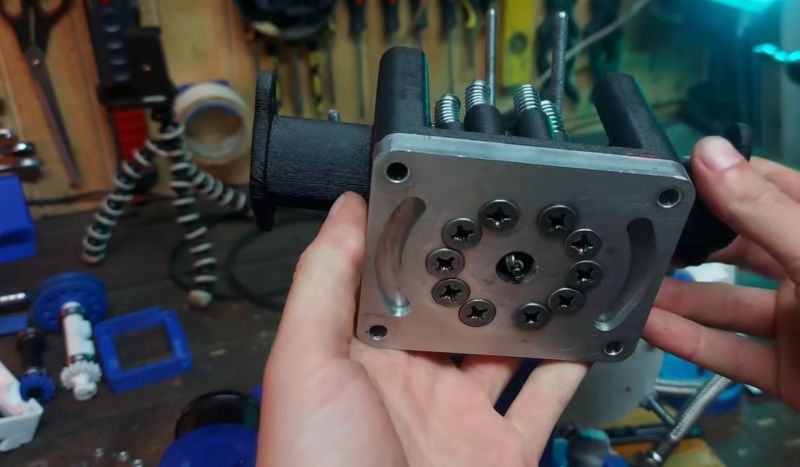
When it comes to internal combustion engines (ICEs), it’s generally accepted that each cylinder doesn’t have more valves to let in a fresh fuel mixture and to exhaust the aftermath than absolutely necessary. You could argue in favor of this also because it reduces the amount of valve seat surface and thus the potential for leaks, but there is historical precedent for higher valve counts. Hence [Alexander’s Laboratory] had to give a ten-valve engine a shake, just to see what effect adding more valves has.
 A cited historical example is the Yamaha FX750, which features a four-cylinder engine that has three inlet and two outlet valves per cylinder, making for a 20-valve design that is claimed to improve performance, also because each valve can be smaller and lighter than with a single valve per side. Other motorbike manufacturers would also try such configurations, with some fascinating examples shown in the video.
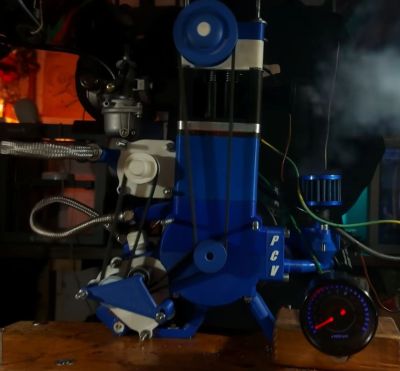
What [Alexander] tries here is to create a 10-valve version, for a symmetric five valves intake and five for exhaust. Rather than building an entire engine from scratch, the largely 3D-printed ICE that was featured in previous videos will be modified with a new cylinder head, replacing the current four-valve one.
For the custom valves large wood screws are used, after making sure that they can take the heat of the combustion. Making even ten of these small valves fit was a challenge, but ultimately got squeezed into a CNCed aluminium and nylon-printed hybrid cylinder head. The existing camshaft was reused by using an adapter that simply drives five valves at the same time.
After some troubleshooting and tuning the engine actually runs pretty well, though sadly no comparison metrics were provided versus the four-valve version of the cylinder head. Hopefully we’ll see this in an upcoming video.












Where is the 20-valve figure coming from?
( 3 + 2 ) * 5 = 25
Ah, I guess it is because the Yamaha FX750 is really a four-cylinder engine.
Yeah, I was about to say… The number of five-cylinder engines out there you can basically count on two hands, and I don’t remember one from Yamaha.
Yup, I got my fours and fives mixed up while writing and accidentally gave it an extra cylinder. Should be fixed now :)
Now, that would be a hack! :)
The fabled Yamaha Genesis range (including the FZR100 in my garage) had a 20 valve arrangement… it was not unique to one model.
btw, the author has fixed the five cylinder fopar in the article 👍
I think the mistake is that the engine actually has four cylinders, not five.
(At least, as far as a few minutes checking wikipedia etc. could tell me. Also, five cylinders would be pretty unusual for a motorbike, and difficult to fit.
I’d be interested to see how this compares not only to the 4 valve design this engine previously used, but an even simpler 2 valve design. Ideally you’d make the valves as large as possible in each configuration.
it’s been tested by the auto industry and 4 valves is the most efficient. 5 valves and up tends to restrict breathing.
My understanding is that for geometric reasons, 4 or 5 valves per cylinder are the ideal number and have roughly equivalent flow – it has to do with the combined area of how many smaller circles you can fit into a larger circle. With performance being a toss-up and mechanical simplicity favoring 4 valves per cylinder, that became the industry standard.
I guess it would be a lot harder to get a good seal, but I wonder if anyone has tried non-round valves?
many alternatives have been tried and worked at higher rpm but all had a short life, because the poppet valve sinks into its valve seat and rotates, it grinds itself a better seal during operation and has low mass.
it would be less of a technical challenge to change the piston shape to fit more valves, but then you end up with a design that is uneconomical to produce.
One reason for more than 2 valves is that the valve circumference matters as much as area for gas flow – especially when partially open. Multiple valves for intake and exhaust help with this.
“The existing camshaft was reused by using an adapter that simply drives five valves at the same time.”
kinda bummed, Id hoped they would have taken the camless koenigsegg freevalve approach and used hydraulic mediated electropneumatic actuation.
Doesnt that neccessitate a flux capacitor for optimal triglyceride interaction?
Or a desmodromic design with one cam follower for inlet and one for exhaust.
Is that like a turbo encabulator 😀
No its a compound actuator which uses an electrically controlled valve to direct pneumatic pressure to drive a piston which opens the valve and a spring to retract the valve back into the closed position. This alone would be sufficient on a very low pressure system but within a high compression engine it the system would fail to maintain valve closure. The fix, Hydraulic mediation, by designing the actuator such that the upper section is pneumatically driven, and the lower section is flooded with hydraulic fluid which is pushed out during the OPEN stroke, drawn back in during the CLOSE stroke. The incompressibility of this fluid allows the cylinder to be hard locked with valves making the system rigid and controllable, where pneumatics alone would result in an unacceptable flexibility due to gas compressability. Essentially the hydraulic portion acts as an electrically controllable brake system to lock the valve in position
Didn’t Honda Siamese two pistons together to make a 4 “cylinder” 32-valve motor in the late 1980s?
Turbines would be my choice
https://up-ship.com/blog/?p=46219
Tesla battery atop a full frame. Turbo-electric
I used to drive a tuned Toyota Corolla GT-Apex Levin with the 20-valve 4AGE engine. (Also had a heavily modified supercharged GT-Z).
That thing would sing through the quad throttlebodies at 8000 RPM.
Audi experimented with this as early as 1988 and by the mid nineties had it in production in multiple cars along the VAG group. I used to drive an Audi A4 with 20 valves.
one advantage not mentionned is that you can control valves differently… with blocks like some VTEC using either 2 or 4 valves depending on the RPM for better efficiency at low rpm, more power at high rev…
Meh, LOX is used only to go up, “in pieces” is undesirable but usually asociated with that.
The old Detroit Diesel 2 strokes could be specified with 4 actual valves per cylinder. But being 2 stroke, all of those valves were just exhaust, and intake was done through a cylinder port. So I guess you could call that an 8 valve setup?
They also all had superchargers, some had turbochargers, and they could be specificified as up to a V24 by bolting multiple blocks together to make one massive engine.
Kind of no wonder why pretty much everything from semi trucks to individual train cars to vietnam patrol boats ran a Detroit lol