
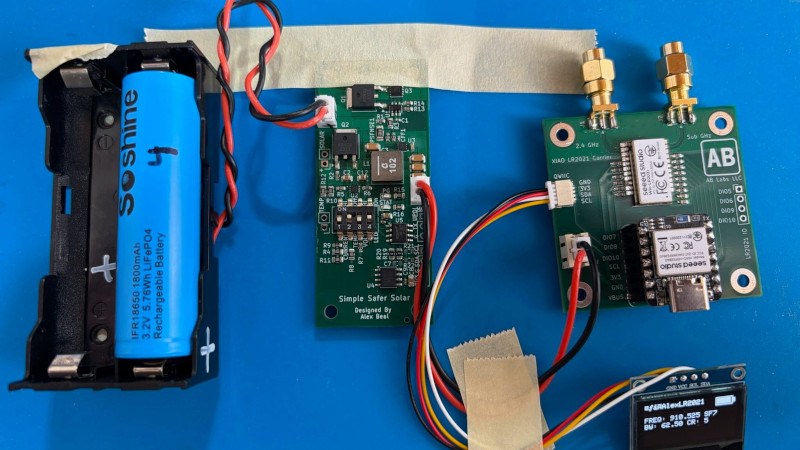
If you’ve ever done anything with LoRa, the chances are you’ve used a LoRa chip or module as a peripheral for a microcontroller, and left it at that. But that’s not always the case. Rather than being a pre-programmed ASIC under the hood, the Semtech LR2021 has its own on-board microcontroller whose firmware can be updated. [Alex Beale] has managed to unlock its secrets.
The use of LLMs can elicit strong opinions at times, but in this case we agree with him that the task of reverse engineering this hidden microcontoller would have been a near-impossible task without their help. Having done so though,he can write custom firmwares, which he’s able to demonstrate. Running the required FFTs for a waterfall display on-chip for example is now possible, as is running your mesh network node on the chip itself.
This work continues a streak of recent discoveries unlocking software-defined radio functionality inside dedicated radio chips, with both WiFi and LoRa chips falling prey to reverse engineering. It’s an interesting time, if SDR is your thing.
Thanks [Notbasa] for the tip.












Bang for the buck is this eras mantra. Practically everything costing more needs to be countered with more usefulness.
it’a MICROCONTROLLERS ALL THE WAY DOOOOOOOOWWWWWWWWN!
Yeah, I have been poking at the firmware on my 8821 realtek chip in a cheap wifi dongle and I’m trying to see if I can get it to decode zigbee, wish me luck.
I wonder how long it’ll take before LLM disclaimers recede into the rearview mirror
When LLMs cure mental illness. Anyone that makes another person feel uncomfortable for their mathematics utilisation choices is insane.
we waiting for https://reticulum.network/
Wow what an exciting thing to wake up to. I’m Alex Beal. I’m happy to answer any questions about this. The substack post was written with MeshCore and Meshtastic hobbyists in mind, so if it feels like I jump in without explaining some things, that’s why. But if you’re reading a post about LoRa chip hacking, you’ve probably heard of these projects.
And yes, I’m happy to admit that this is something I couldn’t have pulled off without the LLM. I’ve been a professional programmer for over 15 years, and these tool amaze and terrify me. I reflect on this a bit at the bottom of linked post.
I also want to give a shout out to https://github.com/SAMS0N1TE/lr2021-sdr, who inspired this work. He then went on to use some of the ideas here to pull off some really cool stuff in his LR2021-based SDR project. A very exciting time to experiment with RF.
This is neat. One note: if, like me, you were hoping this could lighten your drone’s payload on an airborne mesh, the custom code is written to volatile memory. Still, as the author points out, battery life should benefit, since the companion MCU can drop out after loading the LR2021.
If all you’ve got to do is write to its memory over spi you don’t need much more than an Attiny, on power up it transmits your memory patch. Feed it the data over spi, put the pins in high impedance mode, and sleep.
The writeup is a bit fuzzy on the details. The CPU in the chip itself can’t do everything. Alex himself writes that he has just transmitted pre-encoded messages.
The chip could do additional filtering of valid meshcore packets, before waking up the mcu. I.e. checking the scope or similar. But as far as I understand the text it is unable to completely run as a node itself. Most importantly it does not do bluetooth (or wifi, or USB) to act as a companion.
I wonder if Semtech is going to have its own ESP8266 moment sometime in the near future.