
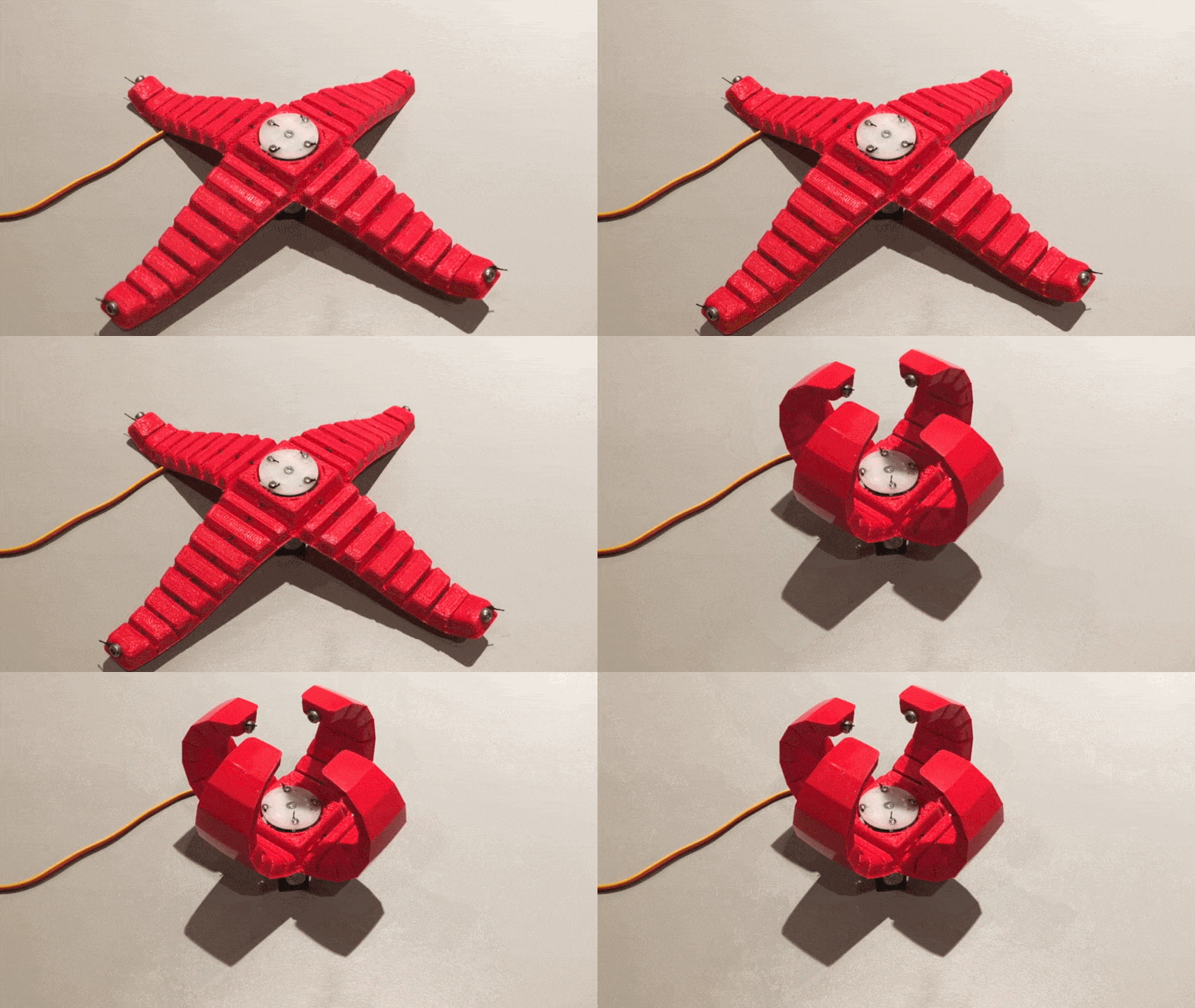
[XYZAiden]’s concept for a flexible robotic gripper might be a few years old, but if anything it’s even more accessible now than when he first prototyped it. It uses only a single motor and requires no complex mechanical assembly, and nowadays 3D printing with flexible filament has only gotten easier and more reliable.
The four-armed gripper you see here prints as a single piece, and is cable-driven with a single metal-geared servo powering the assembly. Each arm has a nylon string threaded through it so when the servo turns, it pulls each string which in turn makes each arm curl inward, closing the grip. Because of the way the gripper is made, releasing only requires relaxing the cables; an arm’s natural state is to fall open.
The main downside is that the servo and cables are working at a mechanical disadvantage, so the grip won’t be particularly strong. But for lightweight, irregular objects, this could be a feature rather than a bug.
The biggest advantage is that it’s extremely low-cost, and simple to both build and use. If one has access to a 3D printer and can make a servo rotate, raiding a junk bin could probably yield everything else.
DIY robotic gripper designs come in all sorts of variations. For example, this “jamming” bean-bag style gripper does an amazing, high-strength job of latching onto irregular objects without squashing them in the process. And here’s one built around grippy measuring tape, capable of surprising dexterity.











sick! I love it.
face hugger!
No, this is Patrick.
I printed one of these a few years back and it picks up small/medium sized objects pretty well.
Obviously, I’m providing the lifting force behind the gripper so all it has to do is hold onto it.
Link to demo video:
https://drive.google.com/file/d/1V3SR4IQhucV3xt5QaTwgYqNrEhYMJtJL/view?usp=sharing
It reminded me of the grippers on the ends of the robot arms of Alfred Molina’a version of Doctor Octopus, except they only have three “petals” instead of four.
3 is the magic number. A gripper with 3 claws could be more tight than with 4. In the same ways that a chair or table designed for use with 3 legs never wobbles, but with 4 it might wobble on uneven ground. 3 is less complicated and the funny thing is, it looks futuristic, although anything with robotic claws looks futuristic, so skip that point.
Anyway, cool project which could also be nice for making mechanical/automated flower like sculptures that can open close.
I would add cable tubes to those cable channels in finger segments to slide with less drag when gripping, and add a steeper gear ratio.
oooo! That’d be a nice gripper vor my little Mitsubushi robot arm!!
This is exactly how human fingers work. The fingers themselves have no muscles. Tendons run from forearm muscles through the wrist into the fingers.
I am biased since I recognize my nephew Aidan in the video. I like to try moving the motor away from the gripper, since it just pulls all the strings the same. Then all the strings could attach to the motor at one place, maybe a linear actuator could even be used. It would be easier to change the number of fingers, cut it down to 3, or maybe increase to 8 and have a sphere that opens and closes. Are they “fingers” or “petals”?
I am an Amazon Vine reviewer, and today in the mail is arriving a tracked robot with a gripper. It’s a “Lego” set, more for kids than me, but I couldn’t resist because “robot”. (it’s really for my cat).
Maybe I’ll switch out the gripper for this one…..
What kind of weight capacity does it have? Have you tested it picking up different weights to see its limit? This would be cool as an alternative to claw machine claws.
That’s what I used it for! I made a claw machine and this gripper worked great even with the tiny servo it uses. Good grip is all about getting the strings the right length for the grip… mine lost strength over time and I think the strings were slipping because I didn’t secure them well enough. I tested it with a 66 gram box of screws and it held it well.
This looks like a perfect low-cost gripper for an underwater ROV (like SeaPerch). Instead of a servo, using a syringe plunger that is hydraulically operated using tubing and a second syringe above water at the operator.
A single cable that loops to each finger tip would let the fingers close asymmetrically. As soon as one finger has an opposing force, it will stop moving, and the other fingers would continue to move until they hit an equal resistance.
To fix the grip strength problem you could use a motor and drum instead of the servo, with a gearbox too. A small drum that it wraps round multiple times would make it stronger and you could move the motor and drum away from the gripper and just have longer cables.
Another idea would be to use a linear actuator (or possibly a motor and drum or servo again) and have the strings from each finger mount to a disc at the edges of the disc, then have that disc only supported in the middle. That would allow the length of the strings to change as it grips something by the disc tilting or flexing. One side of the gripper could have longer strings whilst the other has shorter. Might be better for gripping irregular objects.