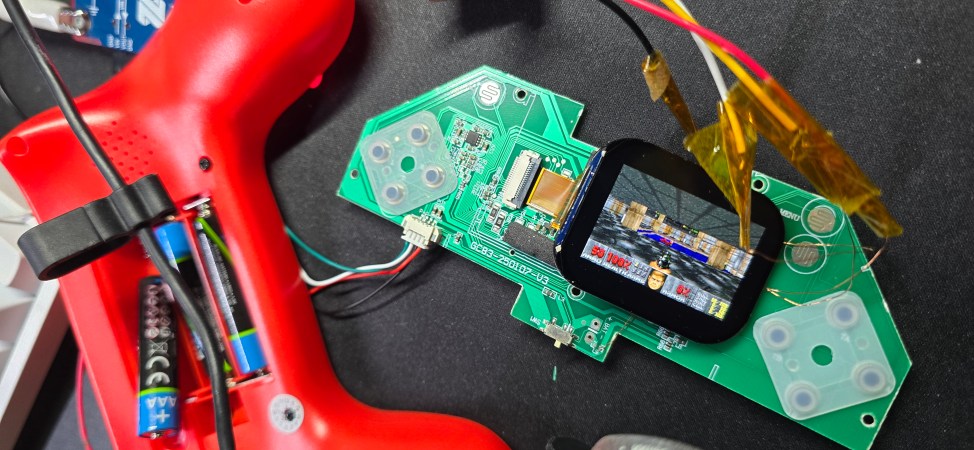
Taking a break from putting DOOM on devices that absolutely were never conceived for use as gaming devices, [Aaron Christophel] recently got enticed by some cheapo handheld gaming systems at his local Action budget store. One is a controller-shaped ‘mini game console’ with 104 games from the 1980s and 1990s, while the other is simply a Pac-Man handheld in a more typical rectangular form factor. Although this brings to mind basic blob chips and limited hacking potential, as it turns out they’re actually quite nice inside.
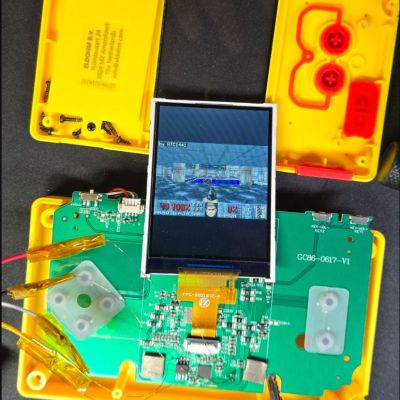
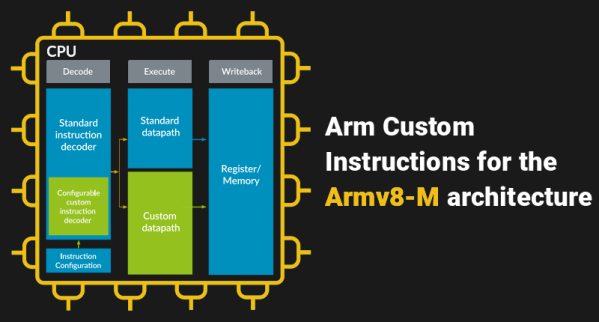
As also covered in the demonstration video, rather than said nasty blob chip, both handhelds turned out to use the same unmarked MCU in QFN48 packaging. Some prodding and poking confirmed that it’s a typical ARM core, specifically a Cortex-M33 compatible STAR-MC1 ARMv8-M from an unknown manufacturer. Without a datasheet to go by, its limitations had to be discovered experimentally.
Of those, the biggest were a clock speed of 62 MHz – instead of the typical 194 MHz – as well as a lack of sound. This latter issue might be fixable with a better understanding of what appears to be a quirky DMA-fed DAC. Beyond this you’re also dealing with limited memory and of course just 4 MB of flash, though the chip for this might be upgradable if the MCU can map more. You do get a 320×240 display and a lot of buttons, which is admittedly nice.
As for the price difference of around $8/€7 for the Pac-Man version, this appears to be due to it running an officially licensed Bandai Namco arcade emulator as firmware, while the 104-in-one unit runs FlyThings/ZKSWE with a NES emulator.
Continue reading “Running DOOM On A Cheap 104-in-One Handheld”