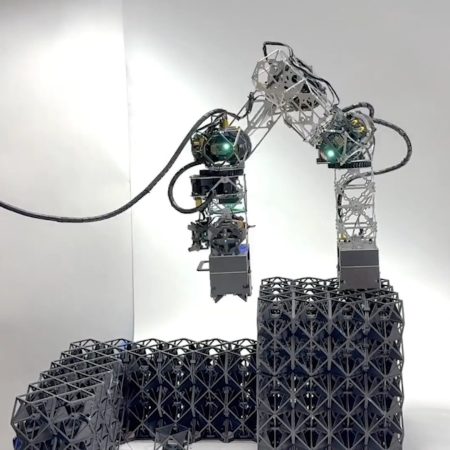
Well, it depends when you’re going to be househunting– if it’s anytime soon, Betteridge’s law applies, but if your time horizon is a ways further out, [Miana Smith] at MIT wants to make it happen. She’s got a paper out with an open-source inchworm robot designed to assemble structures from voxels– and what is a voxel but a giant, LEGO-esque brick?
There’s a demo video below, and it’s easier to understand the motion of this thing when you see it in action. The 5 degree-of-freedom MILAbot has actuators on both ends, and no traditional base– that’s the inchworm part. It grabs a brick while anchored to one part of the structure, then stays anchored to the new brick to keep building from that locale, so on and so on.
Note that we’re not talking about concrete bricks here, though conceivably you could use an inchworm-style actuator to assemble those. The ‘voxels’ in the study are engineered space-frame blocks which come together very easily, though admittedly would make for a very drafty home– you’d want to fill them with spray foam as a finishing step. So it’s more of a framing technique than a one-and-done thing. Still it is a technique that has something to recommend it compared to the 3D-printed concrete houses that get so much hype— and are already being torn down.
For instance, the researchers find that weather the voxels are plywood, PLA, or metal, the resulting structure has less embodied energy than any concrete structure, with 3D printed concrete being worst option by that metric– though the balloon-frame stick-build we in North America consider “conventional” is still the lowest of all. On the other hand, that balloon-frame building takes a crew to put together, and labour is expensive compared to robots. At the moment, however, the study admits balloon-framing wins on price, but that doesn’t mean it always will, and it’s a fun hack regardless.
So while your next house might not be made of LEGO by a robot inchworm, we’re still grateful to [Miana] for the tip.
Most building hacks we see here are of the 3D printed variety, but don’t count out plain old dirt. For that matter, as long as someone is willing to live in it, anything can be a house– even an airliner. Continue reading “Could Your Next House Be Built From Giant Lego By An Inchworm Robot?”