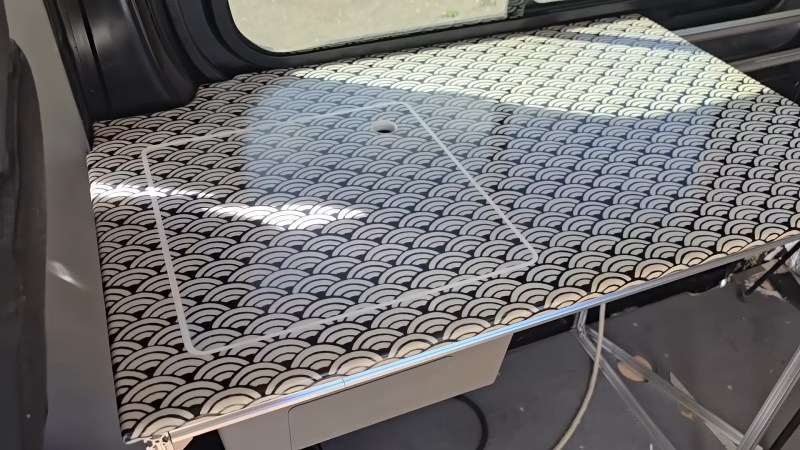
The countertop in its natrual habitat: a van.

Cotton-Fiberglass Composite Makes Lightweight RV Countertops

You’ve seen fiber-reinforced-plastic before, no doubt, but perhaps never quite like in this video by [Whitburn Studio]: it’s still got the usual resin, but instead of glass or carbon fibers, he’s using printed Japanese cotton to create strong, lightweight and good looking parts for the interior of his RV– specifically the countertops.

The technique is very similar to the sort of moldless composite work Burt Rutan pioneered in aircraft use. The fiber-reinforced plastic is formed around a positive ‘buck’ that remains inside the final part, adding stiffness and some backing. Unlike Rutan’s designs, which used pure Styrofoam inside, [Whitburn] is using a sandwhich of two layers of thin ply (3.6 mm) with XPS foam in between. Adding plywood means you don’t need many layers of fiber– again, that’s a decorative cotton, here– to get a surface that won’t dent into the styrofoam when you drop a coffee cup on it.

Indeed, with the plywood providing much of the strength, he’s only using a single layer of cotton and a second of fiberglass– though the glass fibers are really there to protect the pretty print from oopsies while sanding, rather than for their mechanical properties, by the sounds of it. Everything is held together with clear epoxy resin, which also fills the weave of the fabrics. Multiple coats of that are required to get the smooth, shiny surface he shows off at the end, but all that sanding and buffing really pays off. That’s also where you have to be really careful to avoid oopsies– go through the cotton and you have to start over.

Aside from the aesthetics, since this is going in a vehicle the weight is an important consideration– the bigger of the two counters he makes, pictured here, weighs in at only 2.4 kg or 5.2 lb including the cutout covering the sink. That’s pretty good all things considered– a lot lighter than a cement countertop, or even one made of DIY resin tiles.

Continue reading “Cotton-Fiberglass Composite Makes Lightweight RV Countertops”
Turning A Problem Around: The Whitney Cotton Gin

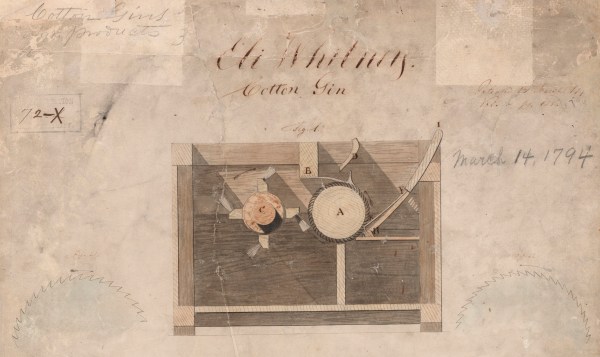
If you went to elementary school in the United States, you no doubt learned about Eli Whitney’s cotton gin as an example of how the industrial revolution took previously manual processes and replaced the low-efficiency of human labor with machines. The development of the cotton gin — patented in 1794 — involves an interesting lesson about solving engineering problems.

Farmers in the southern United States had a big problem. Tobacco was a cash crop, but it eventually left your fields barren and how to solve that problem wasn’t understood yet. Indigo was valuable for dye, but the British were eating away that market with indigo created in its colonies. Rice requires a lot of water and swamp, so it was only suitable for certain areas.

There was one thing that grew very readily in much of the land: cotton. Unfortunately, the cotton had little seeds you had to remove. A single person could clean — maybe — a pound of cotton a day. In the late 1700s, plantation owner Catharine Littlefield Greene introduced Whitney to a group of farmers were trying to decide if there was a way to make cotton a more profitable crop.

Continue reading “Turning A Problem Around: The Whitney Cotton Gin”

Filling The Automation Gap In Garment Manufacturing

Even in this age of wearable technology, the actual fabric in our t-shirts and clothes may still be the most high-tech product we wear. From the genetically engineered cotton seed, though an autonomous machine world, this product is manufactured in one of the world’s largest automation bubbles. Self-driving cotton pickers harvest and preprocess the cotton. More machines blend the raw material, comb it, twist and spin it into yarn, and finally, a weaving machine outputs sheets of spotless cotton jersey. The degree of automation could not be higher. Except for the laboratories, where seeds, cotton fibers, and yarns are tested to meet tight specifications, woven fabrics originate from a mostly human-free zone that is governed by technology and economics.

Continue reading “Filling The Automation Gap In Garment Manufacturing”