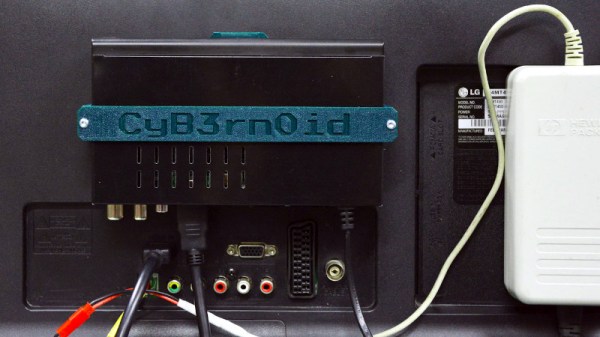
When the analog TV signals were turned off in most places around fifteen years ago, their replacement took the form of a set of digital multiplexes. ATSC for North America, and DVB-T for Europe and other places. This would deliver a multi-channel broadcasting solution for the future, and this would be how those not on a cable would consume their telly. It’s a surprise then to find that some governments are already looking at turning off digital TV broadcasting, with the UK in particular wanting to put a date on the switch-off of 2032.
It’s been no secret for many years that linear broadcast TV is being overtaken by streaming services, and this move projected to come at the end of the transmitting contract was always likely to come eventually. Even with increasingly few younger people watching traditional TV though, it still comes as a bit of a shock that it’s happening so soon. The replacement will be an online service for which initially a set-top-box will be required. We’re guessing there will be a storm of protest, but since it’s still quite a few years away and broadband coverage is now near-universal, there’s a good chance it will peter out as the time approaches.
Aside from the end of analog TV, we’ve seen a steady decline in AM and Long Wave transmission across Europe. What makes this surprising then is that instead of being a legacy analogue system, the one facing the turn-off is the future-proof replacement, and one that still sees plenty of use at that. A major shift in consumer electronic technology is taking place, but will anyone notice it?
Header: Carlos Adampol Galindo, CC BY-SA 2.0.