The Brits Made A Rocket. What Happened To It?

Like many long-established broadcasters, the BBC put out a selection of their archive material for us all to enjoy online. Their most recent may be of interest to Hackaday readers and has more than a bit of personal interest to your scribe, as it visits the Spadeadam rocket test range on the event of its closure in 1973. This marked the final chapter in the story of Blue Streak, the British intercontinental missile project that later became part of the first European space launcher.

It’s possible citizens of every country see their government as uniquely talented in the throwing away of taxpayer’s money, but the sad story here isn’t in Blue Streak itself which was obsolete as a missile by the time it was finished. Instead it lies in the closure of the test range as part of the ill-advised destruction of a nascent and successful space industry, just as it had made the UK the third nation to have successfully placed a satellite in orbit.

We normally write in the second person in our daily posts here at Hackaday, but for now there’s a rare switch into the first person. My dad spent a large part of the 1950s working as a technician for de Haviland Propellers, later part of Hawker Siddeley, and then British Aerospace. He was part of the team working on Blue Streak at Spadeadam and the other test site at RAF Westcott in Buckinghamshire, and we were brought up on hair-raising tales of near-disasters in the race to get British nukes flying. He’s not one of the guys in the video below, as by that time he was running his metalwork business in Oxfordshire, but I certainly recognise the feeling of lost potential they express. Chances are I’ll never visit what remains of the Spadeadam test stands in person as the site is now the UK’s electronic warfare test range, so the BBC film represents a rare chance for a closer look.

In a related story, the trackers for the same program in Australia were saved from the scrapheap.

Continue reading “The Brits Made A Rocket. What Happened To It?”

934 MHz: When The Government Really Doesn’t Want You To Have CB

In the mid 1970s there were a spate of movies depicting the romance and lifestyle of truck drivers in the southern half of the United States. Over on the other side of the Atlantic these were naturally received not as works of drama but as documentaries, and thus began a craze for British drivers to do up their Ford Capri so in the right light and with your eyes nearly closed, it almost looked like Burt Reynolds’ Pontiac Trans Am from Smokey and the Bandit.

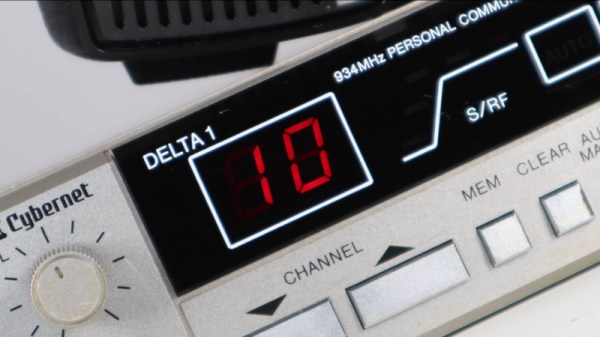
Such a fine automobile was of course incomplete without a CB radio, highly illegal at the time, which led to an underground CB craze and its eventual legalization in 1981. [Ringway Manchester] is here with a tale from that era, of 934 MHz CB, an odd and underused allocation that was eventually phased out for commercial services.

When UK CB was eventually legalized by the government, it was very obvious that they really didn’t want to. Brits got 27 MHz as FM only with meager power and a weird set of frequencies that nobody else had, and a second band way up in the UHF range, at 934 MHz. We remember they originally tried to make a UHF band the only allocation on purpose because it was nearly useless for mobile operation, and Brits only got 27 MHz by fighting back in the political lobbying space.

The video below tells the story of the band, with relatively scarce and expensive equipment leading to it being an exclusive band more similar to the amateur bands, with little resemblance to its raucous 27 MHz counterpart. How much activity there was depended very much on where in the country you were, which of course wasn’t where your Hackaday scribe was as a teenager even if it had been affordable. Eventually the government saw the little flashing pound signs and grabbed it back for a mobile radio service that never materialized, and now the frequencies are part of the mobile phone spectrum.

Have a watch for an odd bit of UK radio nostalgia and some 2020s illegal CB’ers, and if you want more it’s a subject we’ve touched on before.

Continue reading “934 MHz: When The Government Really Doesn’t Want You To Have CB”

The EFF Nails It: What’s Wrong With UK Digital ID

It sometimes seems as though we are in a constant tussle over privacy between governments and the governed, with each year bringing fresh attempts to extend surveillance, and consequent battles. For Brits the big news at the moment comes in a new digital ID scheme, something that will be required for anyone wishing to work in the country, as well as for certain government services. It’s something that has attracted a lot of opposition, and now the EFF have produced an analysis  of why they think it won’t work.

From the perspective of a British writer it would be easy to write screeds about the flaws in the scheme, the way it over-reaches, and about the historical distrust of Brits for their government’s bureaucracy. With the parliamentary petition opposing it approaching three million signatures, there’s no shortage of people who don’t support it. Perhaps the most obvious thing for most of us is how unnecessary it is for its stated aim of preventing illegal immigrants from seeking employment, it neglects that we already have to show proof of right to work before being hired, and that if crooked employers ignore that they will surely also ignore the digital ID.

If you’re reading this elsewhere in the world from where this is being written then it’s still of relevance, because governments like to point to other countries to justify these measures. Follow the EFF on this matter, and take note.


Art: British Passport SVG by Swapnil1101, Public Domain

The Inside Story Of The UK’s Great CB Petrol Scam

Looking at gasoline prices today, it’s hard to believe that there was a time when 75 cents a gallon seemed outrageous. But that’s the way it was in the 70s, and when it tripped over a dollar, things got pretty dicey. Fuel theft was rampant, both from car fuel tanks — remember lockable gas caps? — and even from gas stations, where drive-offs became common, and unscrupulous employees found ways to trick the system into dispensing free gas.

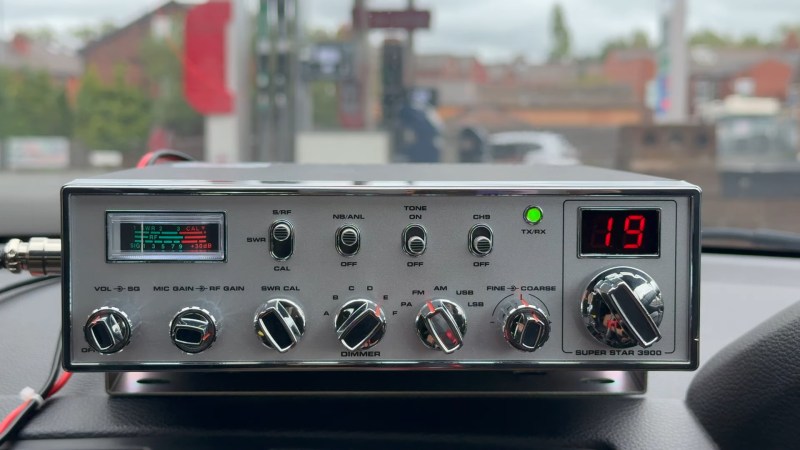
But one method of fuel theft that escaped our attention was the use of CB radios to spoof petrol pumps, which [Ringway Manchester] details in his new video. The scam happened in the early 80s, only a few years after CB became legal in the UK but quite a while since illegal use had exploded. The trick involved a CB transceiver equipped with a so-called “burner,” a high-power and highly illegal linear amplifier used to boost the radiated power of the signal. When keyed up in the vicinity of dispensers with digital controls, the dispensing rate on the display would appear to slow down markedly, while the pump itself stayed at the same speed. The result was more fuel dispensed than the amount reported to the cashier.

If this sounds apocryphal, [Ringway] assures us that it wasn’t. When the spoofing was reported, authorities up to and including Scotland Yard investigated and found that it was indeed plausible. The problem appeared to be the powerful RF signal interfering with the pulses from the flowmeter on the dispenser. The UK had both 27 MHz and 934 MHz CB at the time; [Ringway] isn’t clear which CB band was used for the exploit, but we’d guess it was the former, in which case we can see how the signals would interfere. Another thing to keep in mind is that CB radios in the UK were FM, as opposed to AM and SSB in the United States. So we wonder if the same trick would have worked here.

At the end of the day, no matter how clever you are about it, theft is theft, and things probably aren’t going to go well for you if you try to pull this off today. Besides, it’s not likely that pumps haven’t been hardened against these sorts of attacks. Still, if you want a look inside a modern pump to see if you can find any weaknesses, have at it. Just don’t tell them where you heard about it.

Continue reading “The Inside Story Of The UK’s Great CB Petrol Scam”

When Online Safety Means Surrendering Your ID, What Can You Do?

A universal feature of traveling Europe as a Hackaday scribe is that when you sit in a hackerspace in another country and proclaim how nice a place it all is, the denizens will respond pessimistically with how dreadful their country really is. My stock response is to say “Hold my beer” and recount the antics of British politicians, but the truth is, the grass is always greener on the other side.

There’s one thing here in dear old Blighty that has me especially concerned at the moment though, and perhaps it’s time to talk about it here. The Online Safety Act has just come into force and is the UK government’s attempt to deal with what they perceive as the nasties on the Internet, and while some of its aspirations may be honourable, its effects are turning out to be a little chilling.

As might be expected, the Act requires providers to ensure their services are free of illegal material, and it creates some new offences surrounding sharing images without consent, and online stalking. Where the concern lies for me is in the requirement for age verification to ensure kids don’t see anything the government things they shouldn’t, which is being enforced through online ID verification. There are many reasons why this is of concern, but I’ll name the three at the top of my list.
Continue reading “When Online Safety Means Surrendering Your ID, What Can You Do?”

How Powerful Should An Electric Bike Be? The UK Is Asking

As electric drives sweep their way to dominance in the automotive world, there’s another transport sector in which their is also continuing apace. Electric-assisted bicycles preserve the feeling of riding a bike as you always have, along with an electric motor to effortlessly power the rider over hill and dale. European electric two-wheelers are limited to a legal top speed of about 15 miles per hour and a 250 watt motor, but in a post-Brexit dash for independence the British government are asking whether that power should be increased to 500 watts.

The Westminster politicians think such a move will make electric bikes more attractive to consumers, and along with a move to motorcycle-style throttles rather than pedal-to-go throttles they want it to accelerate the take-up of greener transport in a country with plenty of hills. Meanwhile cycling groups and safety groups are concerned, the former whether the move is needed at all, and the latter over the fire risk from more powerful battery packs.

The Hackaday electric bike stable gives us a bit of experience on the matter, and our take is that with a 15 mile-per-hour limit there’s little point in upping the motor power. There’s a 350 watt European limit for three-wheelers though, which we could see would really benefit from a raise if applied to cargo bikes. We can however see that a readily-available supply of cheap 500 W motors would be worth having.

The UK Online Safety Bill Becomes Law, What Does It Mean?

We’ve previously reported from the UK about the Online Safety Bill, a piece of internet safety legislation that contains several concerning provisions relating to online privacy and encryption. UK laws enter the statutes by royal assent after being approved by Parliament, so with the signature of the King, it has now become the law of the land as the Online Safety Act 2023. Now that it’s beyond amendment, it’s time to take stock for a minute: what does it mean for internet users, both in the UK and beyond its shores? Continue reading “The UK Online Safety Bill Becomes Law, What Does It Mean?”