Pickle Diodes, Asymmetric Jacobs Ladders, And Other AC Surprises

While we’re 100 years past Edison’s fear, uncertainty, and doubt campaign, the fact of the matter is that DC is a bit easier to wrap one’s head around. It’s just so honest in its directness. AC, though? It can be a little shifty, and that results in some unexpected behaviors, as seen in this video from [The Action Lab].

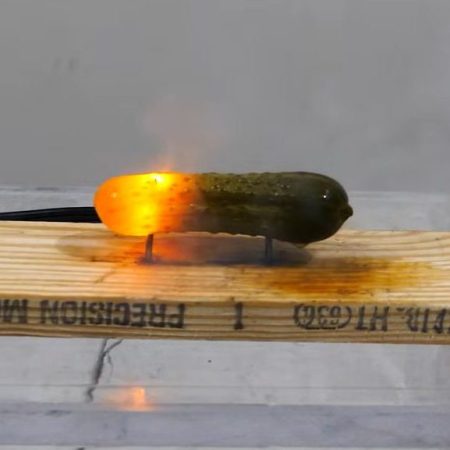
He starts off with a very relatable observation: have you ever noticed that when you plug in a pickle, only half of it lights up? What’s up with that? Well, it’s related to the asymmetry he sees on his Jacobs ladder that has one side grow hotter than the other. In fact, it goes back to something welders who use DC know about well: the Debye sheath.

The arc of a welder, or a Jacobs ladder, or a pickle lamp is a plasma: ions and free electrons. Whichever electrode has negative is going to repel the plasma’s electrons, resulting in a sheath of positive charge around it. This positively-charged ions in the Debye sheath are going to accelerate into the anode, and voila! Heating. That’s why it matters which way the current goes when you’re welding.

With DC, that makes sense. In AC, well — one side starts as negatively charged, and that’s all it takes. It heats preferentially by creating a temporary Debye sheath. The hotter electrode is going to preferentially give off electrons compared to its colder twin — which amplifies the effect every time it swings back to negative. It seems like there’s no way to get a pure AC waveform across a plasma; there’s a positive feedback loop at whatever electrode starts negative that wants to introduce a DC bias. That’s most dramatically demonstrated with a pickle: it lights up on the preferentially heated side, showing the DC bias. Technically, that makes the infamous electric pickle a diode. We suspect the same thing would happen in a hot dog, which gives us the idea for the tastiest bridge rectifier. Nobody tell OSHA.

[The Action Lab] explains in more detail in his video, and demonstrates with ring-shaped electrode how geometry can introduce its own bias. For those of us who spend most of our time slinging solder in low-voltage DC applications, this sort of thing is fascinating.  It might be old hat to others here; if the science of a plain Jacobs ladder no longer excites you, maybe you’d find it more electrifying built into a blade.

Continue reading “Pickle Diodes, Asymmetric Jacobs Ladders, And Other AC Surprises”
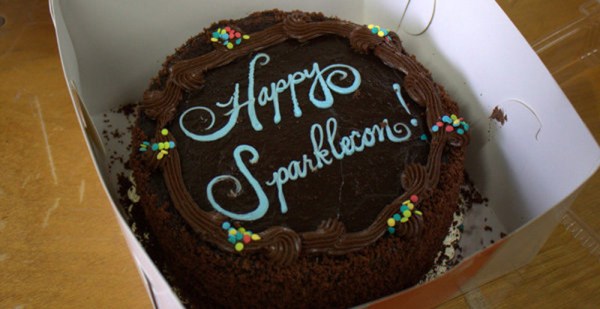
Sparklecon: Crappy Robots, Better Robots, Hammer Jenga, Tesla Coils

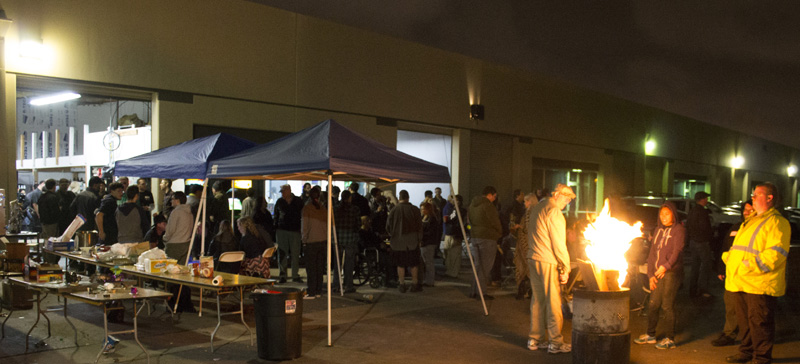
Last weekend was Sparklecon, the premier meetup in Southern California of dorks dorking around, fire, electricity, welding, and general mischief. Just imagine a party of a hundred or so like-minded individuals at a hackerspace. Now imagine the entire party is the after party. That’s a pretty good idea of what happened.

The event was held at the 23b shop in Fullerton, a true hackerspace tucked away in a small industrial park. The people at 23b are using their location to their advantage: no one in the neighborhood really cares what happens after 5pm on a Friday. This allows for some very loud, very bright, and very dangerous hijinks.

IMG_4358

There weren’t many pages missing from the Hackaday Omnibus donated to the 23b shop. Oddly, the only pages missing were the articles written by Benchoff.

There was something for everyone at Sparklecon, including:

  • Electric Pickle. Take a stick welder, and put a few hundred amps through a pickle. First, the pickle turns into a sodium light. Then, it turns into a carbon arc light. Best done after dark.
  • FPV drone racing. Flying around and crashing into trees in an abandoned lot. FPV from a few quads were projected onto the side of a building
  • Live music! Analog synths and Game Boys!
  • Tesla coils! This was a 300 amp monster, and completely analog. The spark gap was impressive by itself, but it gets really cool when you steal a fluorescent light from a fixture and stand 20 feet away from the Tesla coil.
  • Hammer Jenga! Cut some 2x4s up and make a tower of Jenga. Get a hammer, some colorful commentators,  a dozen people, and make some competition brackets. Hackaday’s own [Jasmine] was the first champion of the night.
  • Sparklebot Death Battle! It’s like BattleBots, only things break more often and we don’t have [Bil Dwyer].
  • Hebocon! Battling robots, but much crappier than the Sparklebot Death Battle. These robots broke more often.

The main event was, of course, Sparklecon’s own version of Battlebots. There were only four competitors the entire night, but the competition was fierce.

Three of the bots were wedge designs, in keeping with the ramp-ification of battling robots. The lone exception to this was [Charlie]’s Slow Bot, a cube design equipped with a spinning steel blade. The blade moves fast, but Slow Bot doesn’t. It’s a purely defensive design, meant to destroy bots trying for an easy kill. The test video of Slow Bot can be seen here:

The first fight of Slow Bot did not live up to the hype, unfortunately. After Slow Bot’s primary weapon got up to speed, the opposing bot moved in for the kill. The bolts on Slow Bot‘s blade sheared, ending the match, and leaving five or six people looking around the 23b shop for M5 bolts, or some larger bolts and a tap.

Is it all hilarously unsafe? Well, there were some plexiglas shields in front of the crowd, and most people viewed the fights on the projector beaming against the wall, anyway.

Is it worth it to go to Sparklecon? If you like dangerous experiments, soldering wires directly onto AA batteries, fire, electricity, electromagnetic fields, broken robots, and hanging out by a fire, yes. It’s a party at a proper hackerspace, making it the best kind of party ever. If history repeats itself, there will also be an afterparty at 23b following the LayerOne conference in May.