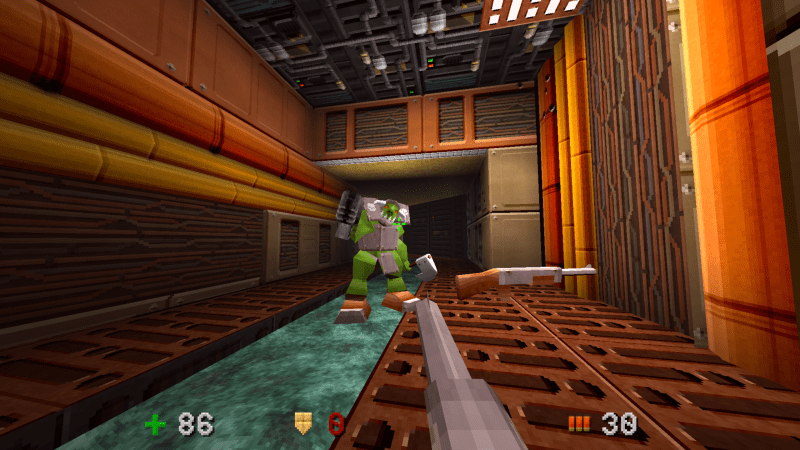
The demoscene is still alive and well, and the proof is in this truly awe-inspiring game demo by [daivuk] : a Quake-like “boomer shooter” squeezed into a Windows executable of only 64 kB he calls “QUOD”. We’ve included the full explanation video below, but before you check out all the technical details, consider playing the game. It’ll make his explanations even more impressive.
OK, what’s so impressive? Well, aside from the fact that this is a playable 3D shooter in 64kB, with multiple enemies, multiple levels, oodles of textures, running, jumping et cetera–it’s so Quake-like he’s using TrenchBroom to make the levels. Of course he’s reprocessing them into a more space-efficient, optimized format. Yeah, unlike the famous .kkrieger and a lot of other demos in the 64kB space, this isn’t all procedurally generated. [daivuk] did make his own image editing program for procedurally generated textures, though. Which makes sense: as a PNG, the QUOD logo is probably half the size of the (compressed) executable.
The low-poly models are created in Blender, and all created to be symmetric–having the engine mirror the meshes saves 50% of the vertex data. . Blender is just exporting half of a low-poly mesh; just as he wrote his own image editor, he has his own bespoke model tool. This allows tiling model elements, as well as handling bones and poses to keyframe the model’s animation.
Audio is treated similarly to textures and meshes: built up at runtime from stored data and a layered series of effects. When you realize all the sounds were put together in his sound tool from square and sine waves, it makes it very impressive. He’s also got an old-style tracker to create the music. All of these tools output byte arrays that get embedded directly in the game code.
The video also gets into some of his optimization techniques; we like his use of a map file and analyzing it with a python tool to find the exact size of game elements and test his optimizations thereby. One thing he notes is that his optmizations are all for space, not for speed. Except, perhaps, for one thing: [daivuk] created a new language and virtual machine for the game, which seems downright extravagant. It actually makes sense, though, as the virtual machine can be optimized for the limits of the game, as he explains starting at about 20 minutes into the video. Apparently it saved a whole 2kB, which seems like nothing these days but actually let [daivuk] fit an extra level into his 64kB limit. Sure, it’s still bigger than Quake13k–and how did we never cover that?–but you get a lot more game, too.
So, to recap: [daivuk] didn’t just make a game with an impressively tiny size on disk, he made the entire toolchain, and a language for it to boot. If you think this is overoptimized, check out Wolfenstien in 600 lines of AWK. Of course in spite of the 1980s file size, this needs modern hardware to run. You can get surprising graphics performance from a fraction of that, like this ATtiny sprite engine.
Thanks to [Keith Olson] for the tip, which probably took up more than 64kB on our tips line.