Emulating A Hard Drive With The Raspberry Pi

[Chris] recently moved a vintage IBM 5150 – the original PC – into his living room. While this might sound odd to people who are not part of the Hackaday readership, it actually makes a lot of sense; this PC is a great distraction-free writing workstation, vintage gaming machine, and looks really, really cool. It sat unused for a while, simply because [Chris] didn’t want to swap out piles of floppies, and he doesn’t have a hard drive or controller card for this machine. After reviewing what other retrocomputer fans have done in this situation, he emulated a hard drive with a Raspberry Pi.

The traditional solution to the ‘old PC without a hard drive’ problem is the XTIDE project. XTIDE is a controller card that translates relatively new IDE cards (or an emulated drive on another computer) as a hard drive on the vintage PC, just like a controller card would. Since a drive can be emulated by another computer, [Chris] grabbed the closest single board computer he had on hand, in this case a Raspberry Pi.

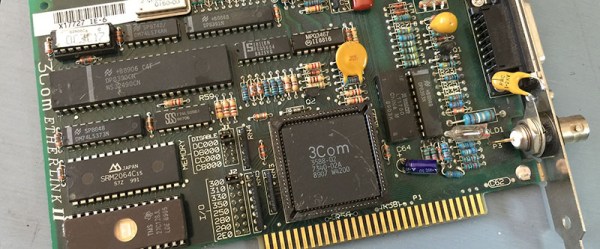
After burning an EPROM with XTIDE to drive an old network card, [Chris] set to work making the XTIDE software function on the Raspberry Pi side of things. The hardware on the modern side of the is just a Pi and a USB to RS232 adapter, set to a very low bitrate. Although the emulated drive is slow, it is relatively huge for computer of this era: 500 Megabytes of free space. It makes your head spin to think of how many vintage games and apps you can fit on that thing!


Demoing An 8088

The demoscene usually revolves around the Commodore 64, and when you compare the C64 hardware to other computers of a similar vintage, it’s easy to see why. There’s a complete three-voice synthesizer on a chip, the hardware allows for sprites, a ton of video pages, and there are an astounding sixteen colors, most of which look good. You’re not going to find many demos for the Apple II, because the graphics and sound are terrible. You’re also not going to find many demos for an original IBM PC from 1981, because for thirty years, the graphics and audio have been terrible.

8088 MPH by [Hornet], [CRTC], and [DESire], the winner of the recent 2015 Revision Demo compo just turned conventional wisdom on its head. It ran on a 4.77 MHz 8088 CPU – the same found in the original IBM PC. Graphics were provided via composite output by a particular IBM CGA card, and sound was a PC speaker beeper, beeping sixty times a second. Here’s a capture of the video.

Because of the extreme nature of this demo, it is unable to run on any emulator. While the initial development happened on modern machines with DOSbox, finishing the demo needed to happen on an IBM 5160, equivalent to the 5150, but much easier to find.

Despite the meager hardware and a CPU that reads a single byte in four cycles, effectively making this a 1.19 MHz CPU, the team produced all the usual demoscene visuals. There are moire patterns, bobbing text, rotated and scaled bitmaps, and an astonishing 1024-color mode that’s an amazing abuse of 80×25 text mode with NTSC colorburst turned on.

Below you can find a video of the demo, and another video of the audience reaction at the Revision compo.

Continue reading “Demoing An 8088”