Hard Drive Speakers Crank Out Classic Demo

Second Reality is a legendary demoscene release by Future Crew, which won Assembly 1993 with its technical and artistic mastery. [Niv Singer] decided to give the classic demo a spin on a rather unconventional sound system with a particuarly techy twist.

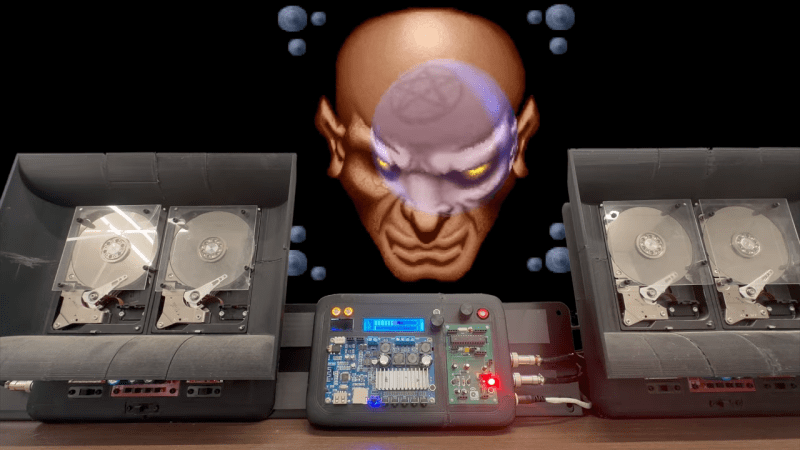
Hard drives are great for storing data. They’re designed for this purpose. What they’re not designed for is acting as speakers, but you can hack them into acting that way if you’re so inclined. For this project, [Niv] pulled apart a whole stack of drives, so they could be repurposed in this way. The principle is simple enough—just feed audio to the coil driving the head, and it will vibrate and wiggle around, creating soundwaves in the air. It’s not particularly effective, and you get limited volume with a terrible frequency response, but that’s half the fun. [Niv] actually took some of this into account, too. Four Western Digital Caviar 500GB drives were chosen for this build, two for the left channel, and two for the right. Each channel had a crossover, allowing one drive to handle low frequencies while the other handled higher ones. For a further nice touch, the platters spin with the beat as well, with [Niv] providing a great explanation on how this was achieved with the use of some nifty PWM tricks.

Files are on Github for the curious. We’ve featured plenty of hard drive speakers before, too. Video after the break.

Continue reading “Hard Drive Speakers Crank Out Classic Demo”

Pi Pico Demos, Therefore It Is

A good demo, like [Linus Akesson]’s Sum Ergo Demonstrato, looks like magic to the average hacker. To normies who don’t know the limitations of the RP2350, they don’t see the big deal. To anyone who has spent any time with the chip, though, it’s a series of tricks you cannot help but be amazed by. Fortuanately for us, [Linus] isn’t actually a magician, because while a magician never reveals his tricks, [Linus] has an hour-long video explaining exactly how his demo was accomplished. We’ve embedded both the demo and the explanation below.

Even if you aren’t into YouTube, you should check out the demo video, and again– remember this is all on a Pi Pico with only the extra passives required for video-out. Then you can watch [Linus] explain how he did it, which is really best heard in his own words. There are a couple of bleeding-edge tricks on the RISC V core and peripherals that we would hate to misrepresent– especially the clever hack with the interpolator that he uses for 3D acceleration.

If this sounds a bit familiar, it’s because we were equally impressed by his Kaleidoscopico demo last year. From demos like this to 3D engines on the ESP32, its amazing what you can do on modern micros if you’re willing to hit the limits of the hardware.

Thanks to [Stephen Walters] for the tip!

Continue reading “Pi Pico Demos, Therefore It Is”

Amiga? Arduino? AMeagerBall Gets The Uno Bouncing

When the iconic “Boing Ball” first debuted 40 years ago, it was a wonder to behold. There was nothing like it in the home compuing world upto that time, and it showed that Commodore’s new “Amiga” was a powerhouse sure to last the test of time. Forty years later, the Amiga as we knew it then might not be with us anymore, but [Mark Wilson] is recreating its iconic demo on a microcontroller– but not just any microcontroller. “AMeagerBall” is an Arduino Uno exclusive, and it even tells the time.

Like the original “Boing Ball”, the demo is running at 320×240, though on a touch LCD shield instead of a CRT. Unlike some microcontrollers, the Uno doesn’t have the horsepower to just brute-force emulate a 1980s home computer, so [Mark] has had to recreate the boing ball from scratch. He’s not doing it with any graphics libraries, either. On the Uno that would be too slow, so [Mark] is driving the LCD directly to its appropriate registers, to stay close enough to the metal to make it work. That means if you’re going to try the code on his GitHub repository, you’ll need to be sure to use matching hardware or be prepared to port it.

One of the things about Amiga’s demo that was so impressive is that it hardly made use of the CPU, allowing the Workbench to be pulled up while the ball bounced. That’s not the case here, as the UNO doesn’t have any extra graphics chips. Still, [Mark] was able to squeeze enough horsepower out of everyone’s favourite ATmega to present us with an Amiga-styled clock– either analog, digital, or in the workbench title bar in that iconic blue-and-white. To keep the clock accurate, he’s squeezed an RTC module in, too. Lovely! The different clocks can be accessed via the touchscreen.

Oh, did we forget to mention that the touchscreen is implemented? This certainly stretches the hardware far enough to be considered a demo. If just a bouncing ball doesn’t work the UNO hard enough for you, try booting Linux.

This isn’t the first bouncing ball demo we’ve seen on a microcontroller:  here are four of them bouncing in an ATtiny85.

Continue reading “Amiga? Arduino? AMeagerBall Gets The Uno Bouncing”

Remembering Chiptunes, The Demoscene And The Illegal Music Of Keygens

We loved keygens back in the day. Our lawyers advise us to clarify that it’s because of the demo-scene style music embedded in them, not because we used them for piracy. [Patch] must feel the same way, as he has a lovely historical retrospective out on “The Internet’s Most Illegal Music” (embedded below).

After defining what he’s talking about for the younger set, who may never have seen a keygen in this degenerate era of software-by-subscription, [Patch] traces the history of the jaunty chiptunes that were so often embedded in this genre of program. He starts with the early demoscene and its relationship with cracker groups — those are coders who circulate “cracked” versions of games, with the copyright protection removed. In the old days, they’d embed an extra loading screen to take credit for the dastardly deeds that our lawyer says to disavow.

Continue reading “Remembering Chiptunes, The Demoscene And The Illegal Music Of Keygens”

Amazing Oscilloscope Demo Scores The Win At Revision 2025

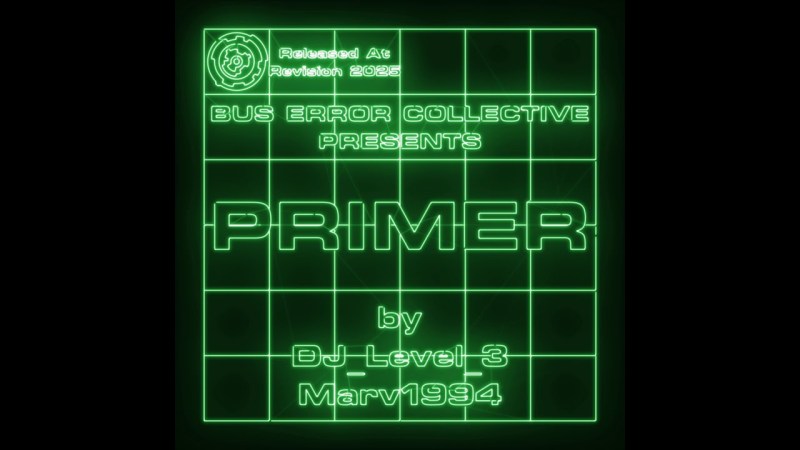
Classic demos from the demoscene are all about showing off one’s technical prowess, with a common side order of a slick banging soundtrack. That’s precisely what [BUS ERROR Collective] members [DJ_Level_3] and [Marv1994] delivered with their prize-winning Primer demo this week.

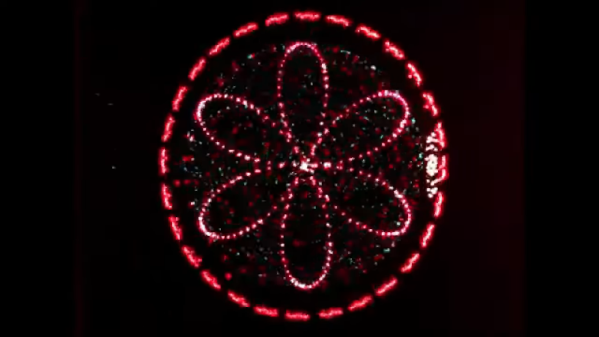
This demo is a grand example of so-called “oscilloscope music”—where two channels of audio are used to control an oscilloscope in X-Y mode. The sounds played determine the graphics on the screen, as we’ve explored previously.

The real magic is when you create very cool sounds that also draw very cool graphics on the oscilloscope. The Primer demo achieves this goal perfectly. Indeed, it’s intended as a “primer” on the very artform itself, starting out with some simple waveforms and quickly spiraling into a graphical wonderland of spinning shapes and morphing patterns, all to a sweet electronic soundtrack. It was created with a range of tools, including Osci-Render and apparently Ableton 11, and the recording performed on a gorgeous BK Precision Model 2120 oscilloscope in a nice shade of green.

If you think this demo is fully sick, you’re not alone. It took out first place in the Wild category at the Revision 2025 demo party, as well as the Crowd Favorite award. High praise indeed.

We love a good bit of demoscene magic around these parts.

Continue reading “Amazing Oscilloscope Demo Scores The Win At Revision 2025”

Retrotechtacular: Computer-Generate Video 1968 Style!

[Classic Microcomputers] read in a book that there was a computer-generated film made in the late 1960s, and he knew he had to watch it. He found it and shared it along with some technical information in the video below.

Modern audiences are unlikely to be wowed by the film — Permutations — that looks like an electronic spirograph. But for 1968, this was about as high tech as you could get. The computer used was an IBM mainframe which would have cost a fortune either to buy or to rent the hours it would take to make this short film. Now, of course, you could easily replicate it on even your oldest PC. In fact, we are surprised we haven’t seen any recreations in the demoscene.

Continue reading “Retrotechtacular: Computer-Generate Video 1968 Style!”

A Demo Party On A Chip

The demoscene has provided our community with its artistic outlet since the first computers which could handle graphics, and has stayed at the forefront of technology all the way. For all that though, there’s a frontier it hasn’t yet entirely conquered, which exists in the realm of silicon. To address this cones the ever awesome Tiny Tapeout, who are bringing their ASIC-for-the-masses scheme to the world of demos with an ASIC demo competition.

With a closing date of 6th of September, all accepted entrants get a free Tiny Tapeout tile for their entry. Entries are limited to two tiles or less. with VGA and audio outputs via a specified PMOD pinout. There are a variety of categories including the expected best sound and best graphics, but among them we’re most interested by the mixed signal one that includes analogue circuitry.

Tiny Tapeout has been a particularly exciting project over the last couple of years, truly breaking new ground for the hardware hacker world. Since they’ve just recently been able to start doing some analog design on the chips, we’re excited to see what people come up with for this competition, and we hope it will provide significant advancement to the art. In the best tradition of the demo scene, they’ve even made an intro for the competition, which you can see below the break.

Want to know what all the fuss is about? Start here!

Continue reading “A Demo Party On A Chip”