Microsoft’s Topological Quantum Computing Claims Once Again In Question

A central problem with the arguably overhyped field of quantum computing remains the difficulty in objectively ascertaining performance and new developments, as much here relies on indirect measurements. Such is especially the case with topological quantum computing, with its use of Majorana fermions. For a few years now Microsoft’s quantum computing department (Azure Quantum) has made claims here of major progress, which have subsequently repeatedly been shot down in peer review. Their most recent attempt at said progress in topological quantum computing now got a blistering response (PDF) by Henry F. Legg in an article in Nature.

We previously reported on Microsoft’s attempts here in early 2025, when they claimed the detection of the crucial Majorana Zero Mode (MZM), before it faced the criticisms of peer review, including by Legg, which included academically vicious language by some researchers, including terms like ‘essentially fraudulent’.

This raises the awkward question of whether Microsoft’s quantum researchers are just too eager to confirm a discovery, or whether a more benign reason exists.

Continue reading “Microsoft’s Topological Quantum Computing Claims Once Again In Question”
Microsoft (Again) Claims Topological Quantum Computing With Majorana Zero Mode Anyons

As the fundamental flaw of today’s quantum computers, improving qubit stability remains the focus of much research in this field. One such stability attempt involves so-called topological quantum computing with the use of anyons, which are two-dimensional quasiparticles. Such an approach has been claimed by Microsoft in a recent paper in Nature. This comes a few years after an earlier claim by Microsoft for much the same feat, which was found to be based on faulty science and hence retracted.

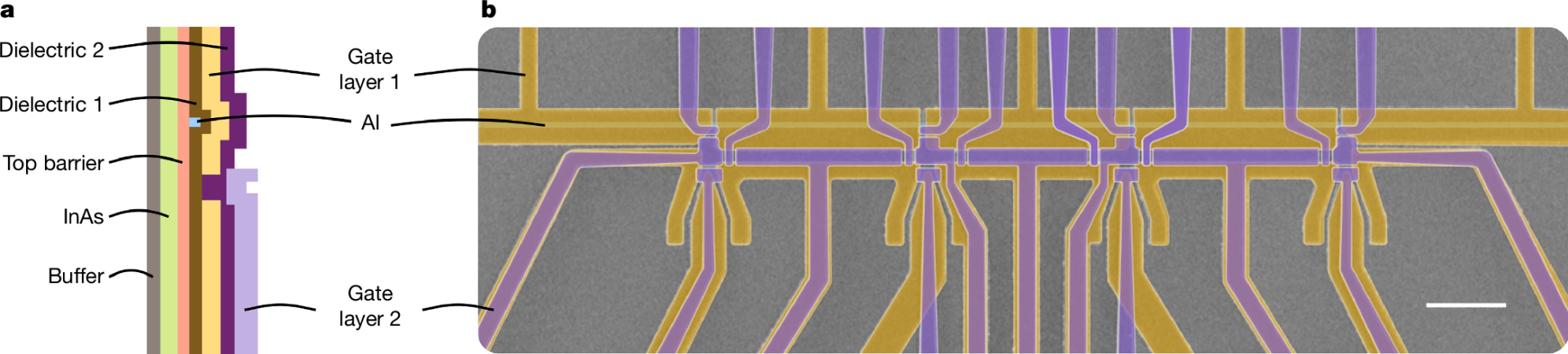
The claimed creation of anyons here involves Majorana fermions, which differ from the much more typical Dirac fermions. These Majorana fermions are bound with other such fermions as a Majorana zero mode (MZM), forming anyons that are intertwined (braided) to form what are in effect logic gates. In the Nature paper the Microsoft researchers demonstrate a superconducting indium-arsenide (InAs) nanowire-based device featuring a read-out circuit  (quantum dot interferometer) with the capacitance of one of the quantum dots said to vary in a way that suggests that the nanowire device-under-test demonstrates the presence of MZMs at either end of the wire.

Microsoft has a dedicated website to their quantum computing efforts, though it remains essential to stress that this is not a confirmation until their research is replicated by independent researchers. If confirmed, MZMs could provide a way to create more reliable quantum computing circuitry that does not have to lean so heavily on error correction to get any usable output. Other, competing efforts here include such things as hybrid mechanical qubits and antimony-based qubits that should be more stable owing to their eight spin configurations.

Quantum computer

Scientific Honesty And Quantum Computing’s Latest Theoretical Hurdle

Quantum computers are really in their infancy. If you created a few logic gates with tubes back in the 1930s, it would be difficult to predict all the ways we would use computers today. However, you could probably guess where at least some of the problems would lie in the future. One of the things we are pretty sure will limit quantum computer development is error correction.

As far as we know, every quantum qubit we’ve come up with so far is very fragile and prone to random errors. That’s why every practical design today incorporates some sort of QEC — quantum error correction. Of course, error correction isn’t news. We use it all the time on unreliable storage media or communication channels and high-reliability memory. The problem is, you can’t directly clone a qubit (a quantum bit), so it is hard to use traditional error correction techniques with qubits.

After all, the whole point to a qubit is we don’t measure it until the end of the computation which, like Schrödinger’s cat, seals its fate. So if you were to “read” a bunch of qubits to form a checksum or a CRC, you’d destroy their quantum nature in the process making your computer not very useful. You can’t even copy a bit to use something like triple redundancy, either. There seems to be no way to practically duplicate a qubit.

Continue reading “Scientific Honesty And Quantum Computing’s Latest Theoretical Hurdle”