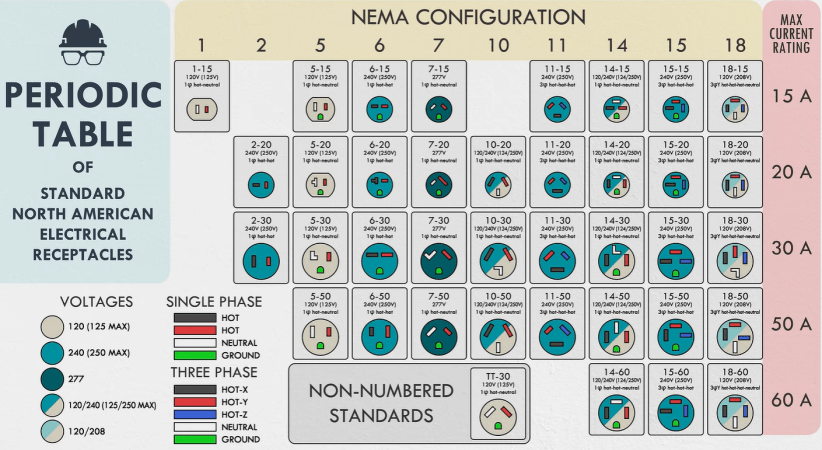
Although things may seem simple on the North American grid as an end-user if you limit yourself to just 120 VAC and NEMA 1-15 and 5-15 connectors, there is a veritable zoo of different voltages and receptacles out there in the NEMA connector catalogue. Recently [Practical Engineering] decided to not only take a look at how many of these defined standards are actually used, but also put them in a nice periodic table style graphic.
Responsible for these standards is the National Electrical Manufacturers Association (NEMA), which as the name says is a collection of manufacturers. Founded in 1926, this US trade association also affects outlet standards in countries like Canada, Mexico, Japan and so on. The caveat here is that compatibility between e.g. a similar looking Japanese 1-15-style plug and a US 1-15 outlet is not guaranteed, even if you ignore voltage and grid frequency differences.
In an ideal world everyone would agree on a set of reasonable connector designs and we could move on, but we live in a world where even today designing your own national connector instead of picking something like the ubiquitous Type F is considered to be reasonable. At least it’s not susceptible to the ‘penny challenge‘ flaw that the NEMA 5-15 connector suffers from, but that’s small comfort.
NEMA connectors are also unique in that they are often polarized, while Type E/F and others rarely are, putting the onus of dealing with AC polarity on the device. This already shows why the NEMA connector diversity exists, as this trade association wanted to have specific connectors for different polarities, different current limits and also the nearly half a dozen of different voltages commonly used throughout the US.
This ‘one connector for a specific combination’ approach means that quite a few of them are not really used in real life, though from a European perspective where you deal with Type C (‘euro plug’) and Type E/F (‘Schuko’) on ~240 VAC and triple-phase 440 VAC connectors if you run a heavy machine shop or want to fast-charge an EV at home, it’s still a bewildering number of active combinations.
Continue reading “Introducing The Periodic Table Of US Electrical Receptacles”