
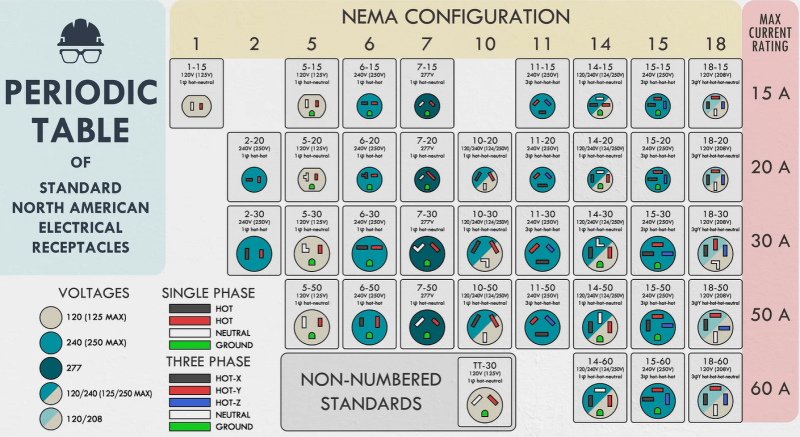
Although things may seem simple on the North American grid as an end-user if you limit yourself to just 120 VAC and NEMA 1-15 and 5-15 connectors, there is a veritable zoo of different voltages and receptacles out there in the NEMA connector catalogue. Recently [Practical Engineering] decided to not only take a look at how many of these defined standards are actually used, but also put them in a nice periodic table style graphic.
Responsible for these standards is the National Electrical Manufacturers Association (NEMA), which as the name says is a collection of manufacturers. Founded in 1926, this US trade association also affects outlet standards in countries like Canada, Mexico, Japan and so on. The caveat here is that compatibility between e.g. a similar looking Japanese 1-15-style plug and a US 1-15 outlet is not guaranteed, even if you ignore voltage and grid frequency differences.
In an ideal world everyone would agree on a set of reasonable connector designs and we could move on, but we live in a world where even today designing your own national connector instead of picking something like the ubiquitous Type F is considered to be reasonable. At least it’s not susceptible to the ‘penny challenge‘ flaw that the NEMA 5-15 connector suffers from, but that’s small comfort.
NEMA connectors are also unique in that they are often polarized, while Type E/F and others rarely are, putting the onus of dealing with AC polarity on the device. This already shows why the NEMA connector diversity exists, as this trade association wanted to have specific connectors for different polarities, different current limits and also the nearly half a dozen of different voltages commonly used throughout the US.
This ‘one connector for a specific combination’ approach means that quite a few of them are not really used in real life, though from a European perspective where you deal with Type C (‘euro plug’) and Type E/F (‘Schuko’) on ~240 VAC and triple-phase 440 VAC connectors if you run a heavy machine shop or want to fast-charge an EV at home, it’s still a bewildering number of active combinations.












You can just search for nema receptacle diagram and find a lot of these. In commercial and industrial situations you come across most all of these depending what your hooking up. A lot of times lab equipment or assembly lines have lots of different variations depending on what the equipment needs. There are also a whole bunch used for temporary cords as well that are different and have different weatherproofing standards. These get used a lot on construction sites for various power needs.
So many good faces… It looks like a school yearbook for robots
And thank you for showing the ground (PE, earth) pin at the bottom, as God intended.
Then your god(s) must hate you.
The original idea, at least for the NEMA 5-15, was that an unintentional conductor from above would fall into contact with the protective earth conductor first, thus providing a path for the hazardous voltage that would be through a current-interrupt device
What does that have to do with the orientation of the outlet? Supposed tilt from a person bending over to plug in? If they want ground to connect first, they should make the ground conductor longer (they do)
I find the most amusing thing about the Japanese implementation (besides the aversion to using earthed outlets, and often having a screw terminal on the outlet where an earth is provided, ‘optional earths’ I call them) is that even though the the socket is designed and polarised as per US convention, I have yet to find a polarised 1-15 plug anywhere in Japan in 13 years.
Regarding the earthing thing, most, if not all, whitegoods are supplied with a non-polarised 1-15 plug, and then there may or may not be a seperate earth flylead supplied. Sometimes it’s atrached to a screw on the back, sometimes it’s left to the user to attach, and sometimes there’s no flylead at all, just a screw marked with an earth icon beside it, and the user is expected to supply their own cable…
The wire is supposed to be screwed into an earth terminal under a flap on the outlet.
Of course, in 99% of installations the earth cable isn’t connected. Why bother finding a screwdriver? The thing works fine when I plug it in anyway, right?…………
As a working EE for a product design consultancy, Japan is the bane of my existence. The voltage is low, the frequency is either 50 or 60 Hz, and the current to a building is a fraction of what it is in the US.
j/k but they are definitely a mains power outlier!
Try the Philippines… Utilities are Delta distribution without neutral or any multi-ground neutral between customers. Every customer has their own “ground pit”. They are 230V 60Hz commonly using North American Square D panels and double pole breakers for every circuit (no L-N, just L-L). They use the NEMA 5-15 as a common outlet (at 230V). Even utility transformers can resemble North American versions with split windings, but the middle neutral point is unused/not grounded. Voltages found at loads are quite variable from 200 to 260V at the extremes.
Yikes! Does this lead to a statistically significant increase in fires or electrocutions? In Arizona a lot of older buildings were wired without an electrical ground conductor and the actual ground is a pretty good insulator most of the time.
I looked it up and apparently that is indeed a bigger problem over there
Forever grinding the wide blade down on “polarized” AC plugs till I die, because of Edison’s screwball socket that should have been surrounded by a ground! Now they’re on everything even totally insulated devices. There is no polarity on AC by definition.
AC polarity is there to ensure that you switch the LIVE on mains going into consumer gear. If you have the wrong polarity, and switch neutral, than the complete mains circuit inside the equipment is still live…posing a hazard for anyone working on gear plugged in, while “thinking” it is switched off.
Apparently when the Schutzkontakt socket was invented no one cared about such frivolities. Works for us.
You people are insane …
Compared to Europe (minus UK) we have 4 plug types. 1 for unshielded low power 230V , shielded 230V (first plug is compatible with this) a 15A Triphasic 400V and a 30A Triphasic 400V plug these are not compatible with each other as plugs .
Yap. We really have it the way it is supposed to be. Also, Alternating Current means NO predefined polarity in outlets. I always believed Hackaday is a site where people writing articles know at least a little about the topic.
It’s beautiful, but as a european I am glad I am never going to have to deal with it.
Hear Hear. In the Netherlands there’s the stupidity (or actually smart) that older, unearthed equipment doesn’t fit in earthed sockets, as traditionally earthed sockets were only placed in rooms that required them (kitchen, bathroom). But a quick hack with a grinder makes an unearthed plug into one that fits into an earthed socket (which are now everywhere).
You are unlikely to deal with all of these, but Europe has similar standards. Where we have all kind of different sockets as well for different power ratings. Some connectors look the same but are different sizes (400V 16A, 32A, etc.) and some have the same pinout, but have a plastic pin in a different location (clocking) preventing some systems to be connected.
This whole thing reminds me of early engineering work for light & vision for TV and events. The people in the field made whatever cables they needed. As when you have a filming set, you can’t wait. At the other side of the company, we destroyed all the dangerous cables. But they always made more. Similarly, you can calibrate a RCD, and in the field they’ll jumper the RCD as it was too sensitive.
As for this video, I’ve watched it and was mostly wondering if the periodic table of sockets is AI slop. Not that it is correct, but it doesn’t exist elsewhere on the web, and most other graphs show more different sockets.
Europe has many sockets, but for any recent (last 30 years) you’ll mostly come across the CEE7/1 (unearthed), 7/3 (earthed) and 7/4(socket) and 5(plug) (French) and Europlug plugs (all more or less compatible), and for industrial and outdoor you’ll come across the CEE/17 sockets, of which there are a multitude but for each situation there is only one or two that apply, except for very specialist applications.
In house yes, very much all my connections are CEE7/x, except Perilex for cooking, and several other variations for specific purposes. I’ve also have specific connectors for outdoor use (332P6), extension cables with the French earth pin instead of the side pin, etc. I would also include several variations of Euro sockets, be it the device side. (These aren’t unique to Europe, though.)
As a North American consumer, you don’t have to ‘deal with’ it either. Basically, 99.9% of what you’re going to deal with are 5-15 plugs, which accommodate polarized and non-polarized appliances with or without a ground pin. Essentially, any appliance you’re going to encounter is going to ‘just work’ with the plugs you have available. I can drive for 30 hours or more in any direction (well, I’ll hit the ocean in about 12 if I go West), and any of my gadgets will work without hassle in any of the plugs that are available.
The only exception (for consumers) is for large appliances that are essentially built-in: ranges, laundry, etc. Stuff that you might have to plug in once a decade, then leave it. Those are going to have the appropriate plug available at the location where the appliance is going to go anyway.
EVs have changed that. Level2 chargers often have 14-50P, and sometimes 6-50P.
I’d categorize those as ‘built in’ appliances as well, in the same vein as ‘you plug it in once a decade’ sort of thing. There’s literally one spot that’s dedicated for the charger. You install it there, plug it in, and leave it basically forever. Heck, I’d expect home charging stations to eventually become hard-wired, once things standardize and stabilize (we’re still very much in a transitional stage, where norms are yet to really be entrenched). Which is a good thing, because those outlets really aren’t INTENDED for frequent insertions. It’s the CCS/NACS/CHAdeMO plug that’s gonna get most of the use.
Evidence of the pariochiality of Europeans that they believe they are immune from evolving standards over time and proliferation of variants. You have your own version of this, but much like Americans you only ever see two or three of them 99% of the time. Most of these are so rare I’ve never seen a single one in the wild.
USB sockets on consumer devices… every 10 years a new “standard”.
I happen to find the CEE standard that’s common in europe, to be a little bit more concise and less random looking (with the prongs shaped and pointed every which way). CEE is kinda bulky though and there is also a large number of oddball configurations that are rarely used. And, seeing that there is industrial three phase power in the US, makes me wonder why all those plugs either have ground or neutral.
Probably good reasons for all of it. Should go watch the video by Practical Engineering :-)
Nice diagram but I would have added a subsection (similar to space between 57-72 and 89-104 on elemental chart) for obsolete outlets. There used to be 2 slots that were in line and 2 sideway T outlets that was common in the 30s as US hadn’t settled on one plug style. Those may still exist in older home that has not had any upgrade.
As a proud Welsh person, are very few things that make me almost irrationally patriotic about Britain or the UK. But the Type G plug & socket design is most definitely one of those things.
Now if you’ll excuse me, I’m going to go dump 3kW of electrical power into some heating coils so I can make a hot-water infusion of dried bush leaves.
Hear hear. When I’ve visited the US I’ve always been amazed how how some plugs just don’t seem to stay in sockets. That’s never been a thing with a Type G.
Having been to the UK frequently of late, I find it ironic that you’ll need ID to buy a butter knife but they’ll sell any miscreant what amounts to a spiked rope dart with every electronics purchase. ;-)
That’s no different from the CEE 7/3 “SCHUKO” continental standard socket in a 16 Amp circuit. 3.5 kW max. The only difference is that since ring mains are not allowed, you don’t need to have a fuse in the plug to protect the wiring.
No, the plug fuse has nothing to with ring mains. The fuse is there to protect the flex, not the installation. The installation wiring is protected by a suitably rated protective device – usually a 32a mcb. The plugs fuse wouldn’t help to protect the ring anyway since there is no limit to the number of outlets permitted on the ring, and just 3 13A resistive appliances would overload it without blowing those fuses. That’s what the MCB is for.
But, I agree that the rest of Europe has as good a system as the UK, by the most important measure – how quickly can you make a nice cup of tea. And at 230v/16A you are actually slightly better than the UK’s nominal 240v/13A outlets.
The USA has to languish in a world of 120v/15A or 20A outlets for most of their appliances. As a result, they grow impatient waiting for their tea, and have to put up with stale filter coffee that’s been sitting on the side all day instead.
My 120V flow-through water heater plugs into a standard 15A socket and makes a cup of fresh coffee (or tea) in 60 seconds. How long does your kettle take? And, honestly, does it really matter?
It did matter to me when I was living over there, yes. It drove me mad how long I had to wait to get a drink – In my head in felt like 10mins to boil enough for 2 cups. if you make 8 cups a day (working from home) thats a long time. Ok, it was probably less, but it FELT really slow, and it’s your perception that counts. It was slow enough that it really annoyed me.
Yes, fair point on the instant hot water option. It takes me 40s to boil 1 mug of water. 60s is likely to feel the same though, assuming that’s really boiling the water. You can’t make a cup of tea with just hot water. And if you’re making several cups, the difference is more noticable, and painful.
In UK the ring mains system, the ring can carry more current than is permitted out of each socket, so each outlet or cable needs its own fuse to protect it. In the continental system it’s common that the main breaker for that circuit is sized by the maximum current allowed out of any socket in the circuit, so they don’t need to have separate fuses.
I do like how proud the UK people are about their kettles. It’s such a very UK thing to fixate on, very cozy.
>Sees mess that is NEMA plugs and sockets
>Laughs in CEE7/7 and IEC 60309
They are all messy! I use IEC 60309 connections all the time and keep a reference printed out for quick reference. The source is a company called StayOnline that sells power cords:
https://www.stayonline.com/product-resources/reference-iec309-international.asp
I’m not sure if they created the chart or if they “borrowed” it, but it is really useful and they have NEMA (including locking) and some proprietary applications (like California Standard) as well.
A HD image of the periodic table would be nice to print out
Tip: A receptacle that is both 120V and 240V…. perfect for a North American kitchen to use a 3kW EU hot water kettle converted to NEMA 6-15 plug. Boils water twice as fast. Older North American kitchens have split duplex plugs wired with 14/3. Easy to convert to this: Leviton 5031-W 15 Amp, 125/250 Volt, Narrow Body Duplex Receptacle, Straight Blade, Commercial Grade, Self Grounding, Dual Voltage (White). This version has a reasonable price. The rectangular Decora version is a stupid price (7X more).
Good point. That would work well for resistive devices like kettles. But you couldn’t guarantee that any EU appliance (which is designed for 50Hz) will work reliably. Devices with 50hz AC motors may not work at all – Our UK ice cream maker certainly failed to start in the USA on a 240v/60hz transformer. But, at least if that happens you can recover from the disappointment by making yourself a quick cuppa.
I have some reservations about using the 2 hot wires in a device designed for 1 hot and ground referenced neutral. But I can’t think of a concrete example where this would be a problem. Probably not really an issue. Maybe.
If its a decently designed device it should not be an issue. Plugs on the continent (EU) are not polarized, so any serious kettle maker has to deal with the live being on either wire.
Fun detail: The French/Belgium receptacle (with the protruding earth prong) has only one possible orientation, and thus supports polarized (live always on the same pin) connections.
Belgium actually requires this, France doesn’t. And to fsck it up further: B has plenty of 130V three phase networks. These have 230V between the phases.
So your socket can have:
– two contacts, both 130V above earth, 230V between them (Y connection, not often used)
– one contact grounded, the other 230V above ground (Delta)
– both contacts 230V above ground, 230V between them (Delta, with the other (third) phase connected to ground)
Good luck with a polarized connector!
What happened to outlets designated with 3,4,8,9,12,13 etc?
You forgot “California Standard” plugs
can you share a higher resolution image of this chart? It’d print it.
it’s not a periodic. it’s a matrix. periodic is when incrementing one variable reveals periodic behavior, whereas this is two independent variables.
and yeah, it’s been done. there’s nothing new here
Thank you. I came to look for this comment.
Better than some “periodic table of X” I’ve seen, but the third dimension is missing.
As someone that lives in Brazil since 7 y/o (even though I’ve been just spending like 3 or 4 months a year here lately) i’m sorry but the “Laughs in Brazilian” card must be throw here.
You people doesn’t have any idea of the mess that is down here, insanity doesn’t even begin to cover.
It’s a pity they leave off all the round variants
Where are the many varieties of twist lock recepticals?
Why don’t any of them look happy?
They’re all either woefully sad or surprised looking.
Sad that despite USA being the first country to discover electricity (Ben Franklin) and the first to make it commonly available (with Edison and Tesla) it still can’t build a single grid like ENTSO-E or ЕЭС.
Surprised because this old, outdated and crummy infrastructure somehow still works.
Just a friendly reminder that the power grids of Spain and Portugal during the 2025 Iberian peninsula event were part of ENTSO-E. Poor design decisions are directly responsible for this failure and not some freak accident or overtly abnormal condition.
Apples and Oranges. Grid interconnects will never prevent local failures.
In that sense, the 2025 Iberian blackout was not much different than the 2003 North East blackout.
The usefullness of grid interconnects is in the increased possibility for power exchange and trade. And it can help a little in compensating a local generation faillure, as you have a larger pool of backup sources.
The real funny part is that the US cannot even create a country-wide grid, compared to the ENTSO-E that includes 35 countries, including ones that have significant conficts between them (i.e: all balkan countries, Turkey/Greece/Cyprus)
The only other developed nations that do not have a national grid I can think of are Japan (using both 50Hz and 60Hz) and Australia (which has 1000km of unhabitated desert between west and east)
oo just saw this, would have been to group the two replies together, sorry.
“The only other developed nations that do not have a national grid I can think of are Japan (using both 50Hz and 60Hz) and Australia (which has 1000km of unhabitated desert between west and east”
Indeed. Australia has it’s Eastern Seaboard Grid for Queensland, New South Wales, Canberra, Victoria, Tasmania, and parts of South Australia with interconnections. Nicely shown here https://www.aemo.com.au/aemo/apps/visualisations/map.html if it’s not geoblocked.
But vast tracts of the country and so many scattered towns are generating their own power.
To look at it a less sad way… Franklin worked out that lightning was electrical in 1752. And as lightning comes in so many forms :
CG, -CG, GC, +GC, CA, IC, CC, ball, bead, ribbon, fork, sheet, crawlers, elves, jets, sprites
it seems quite fitting the USA has embraced that same diversity in it’s sockets.
(Would elso explain them sticking to imperial measurements)
We only have AS/NZS 3112 which is nice and simple.
(William Gilbert did the amber and fur thing, in 1600 England, and gave it the name)
The AS/NZS 3112 is only the10 Amp. we also have a 15, 20, 25 and 32 Amp versions that all can accept smaller rated plugs. Then we have AS/NZS 3123 for Industrial and multiphase that use round pins available in 3 single phase sizes and 11 3 phase sizes up to 200 Amps
This is absurd! How many of the readers here have a clue as to the size of North American electrical service? Having a “single grid” for this space is the total opposite of resilience. Much effort is put into having DC interconnects across the Rockies and with those crazies in Texas. I’m also quite sure Quebec and Canadian hydro want nothing to do with the lower 48. It’s just simplistic to think very large services should be tightly integrated.
I would absolutely love to have a full-resolution copy of this Periodic Table. In the meantime, I was able to improve on the lead image above by doing a screencap of the YouTube video on my laptop. It’s good enough that I can read the finer details in the image like voltages and phase counts.
I thought I’d share this in case it might be useful to others.