Pong On Your Wrist

pong_wristwatch

[John] wanted to take a pong clock and put it in a wristwatch form factor. Take an afternoon and pour over his detailed build logs. This multi-year project is done with meticulous cleanliness that makes us jealous. He’s milled the case and buttons himself, achieving a professional look that equals or surpasses the quality of some commercially available “gaming” watches. The project centers around an OLED display driven by a TI MSP430F2013 processor. Don’t miss the video after the break covering prototyping, PCB work, case milling, and the watch in action. Currently, this is the third generation of development but with a project this exciting, are you ever really finished? Continue reading “Pong On Your Wrist”

Status Icon For Your Office

[flickr video= 3187384682]

[Furan] wanted a way to let people know his status at the office. Maybe he didn’t want to be bothered, or wanted to let them know he was on break. His solution is to set up an OLED display outside his office to display his status.  He’s using a 4d systems OLED display.  He has a windows application that updates the status, with plans of making it synchronize with his  messenger status. Its a fairly cool idea, but just watching the video, we have no idea what some of the icons are supposed to mean. We would possibly choose something a little more obvious and generic, like text stating our status. What would you use?

Nintendo DSi Teardown

dsi_teardown

[bunnie] managed to pick up a Nintendo DSi while in Japan. It seems he had the device running less than an hour before he tore it down for an impromptu hotel photoshoot. There’s nothing too surprising and he mentions that the CPU certainly feels more capable than the previous model, which may explain the shorter battery life. The ARM processor sits under an RF shield directly below the WiFi card. The best photo is the top side of the board with every single debug point labeled in plain English on the silkscreen. We’re sure that’ll help with the development of new homebrew hardware.

[bunnie] has posted some interesting teardowns in the past. Have a look at his Sony XEL-1 teardown to see the inner workings of an OLED TV.

Sony XEL-1 OLED Teardown


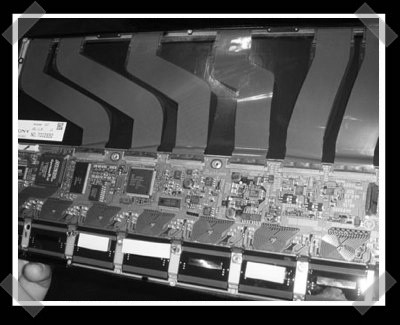
[bunnie] just happened to be at the Embedded Systems Conference in San Jose on exactly the right day to witness the live teardown of a Sony XEL-1 OLED TV. The XEL-1 is Sony’s flagship OLED panel that’s only 3mm thick… and $2500 for just an 11-inch screen. [bunnie] was able to take quite a few shots of the components as they were passed around. He pointed out a few interesting bits about the construction. There seems to be quite a bit of thermal material on the display to prevent “avalanche thermal failures” (which I’m guessing doesn’t look as cool as it sounds). OLED displays are completely transparent and their legendary contrast ratio is just a result of the dark backing material. The mainboard seems to be a bit of overkill for this TV and [bunnie] concludes that it’s just the standard image engine architecture from Sony’s Bravia line put into a smaller package.