Streaming Games Means The Nintendo DSi Will Never Be Obsolete

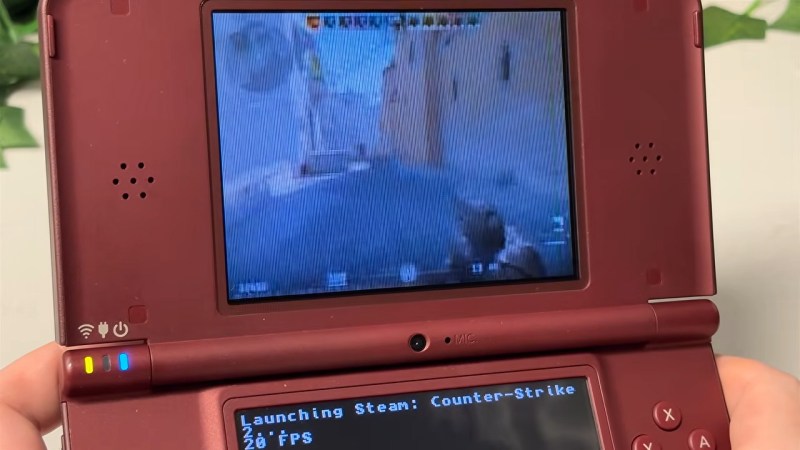
There comes a point where you have to acknowledge that your beloved console is out of date and– barring the odd homebrew title– won’t be playing new games ever again. You’d think that Nintendo’s 2008 DSi handheld would be in this category, but [gavff64] has a workaround. What if the odd homebrew title streamed games over the network?

At its core the RNDS-Stream is just decoding an MJPEG stream from a server on a Linux PC, giving you the content of an X11 or xWayland window with relatively low latency at around 15-20FPS. So while you won’t be entering any e-sports tournaments, you can enjoy more relaxed, casual games like Counterstrike. Well, at least there’s no audio streaming yet, so you won’t have to hear the other team’s trash talk. That ought to make it more relaxed.

Sound may come; the project is very much a work in progress, and also a showcase of RubyNDS, [gavff64]’s Ruby-based homebrew framework for the DSi. Why Ruby? Why the DSi? For no other reason than [gavff64] likes both of those things.You can observe it in action after 4:48 in the video embedded below– just be warned, it’s editing is tuned to a TikTok-using audience and won’t be to everyone’s taste. Don’t let videography get in the way, though, because the hack is the thing and it’s up on GitHub for all and sundry under an MIT license.

The DSi is no stranger to hackers, having gotten its first flash cart the year of its release. In spite of that, we’ve seen surprisingly little homebrew for the dual-screen device, this augmented reality app being an exception.

Continue reading “Streaming Games Means The Nintendo DSi Will Never Be Obsolete” →
Augmented Reality Project Utilizes The Nintendo DSi

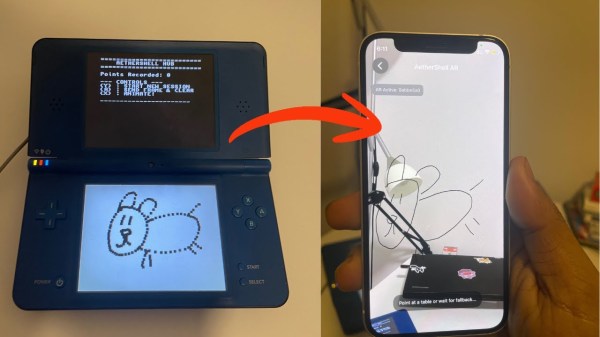
[Bhaskar Das] has been tinkering with one of Nintendo’s more obscure handhelds, the DSi. The old-school console has been given a new job as part of an augmented reality app called AetherShell. 

The concept is straightforward enough. The Nintendo DSi runs a small homebrew app which lets you use the stylus to make simple line drawings on the lower touchscreen. These drawings are then trucked out wirelessly as raw touch data via UDP packets, and fed into a Gemini tool geometric reconstruction script written in Python which transforms them into animation frames. A Gemini tool is used to classify what the drawings are in order for a future sound effects upgrade, too. These are then sent to an iPhone app, which uses ARKit APIs and the phone’s camera to display the animations embedded into the surrounding environment via augmented reality.

One might question the utility of this project, given that the iPhone itself has a touch screen you can draw on, too. It’s a fair question, and one without a real answer, beyond the fact that sometimes it’s really fun to play with an old console and do weird things with it. Plus, there just isn’t enough DSi homebrew out in the world. We love to see more.

Continue reading “Augmented Reality Project Utilizes The Nintendo DSi” →

Breaking Into The Nintendo DSi Through The (Browser) Window

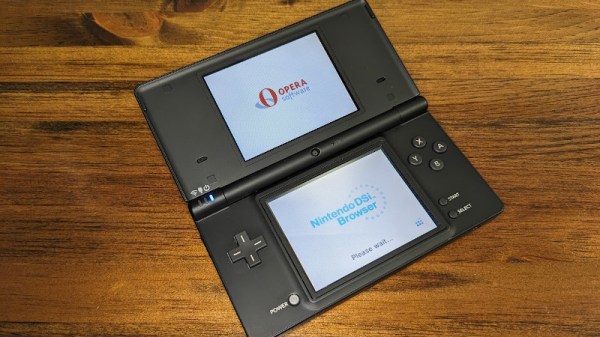
The Nintendo DSi was surpassed by newer and better handhelds many years ago, but that doesn’t stop people like [Nathan Farlow] from attempting to break into the old abandoned house through a rather unexpected place: the (browser) window.

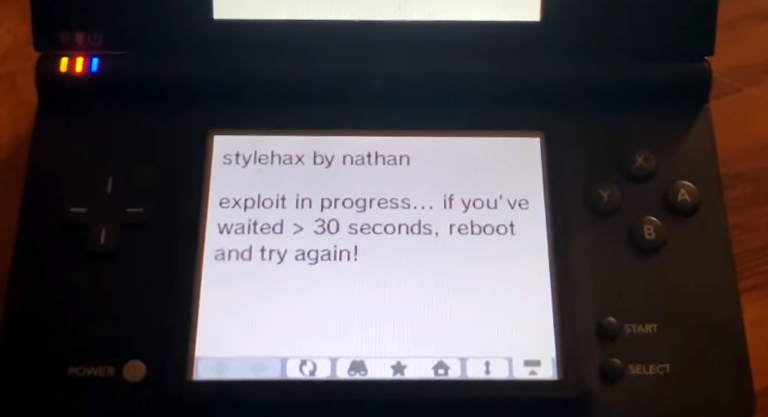
When the Nintendo DSi was released in 2008, one of its notable features was a built-in version of the Opera 9.50 web browser. [Nathan] reasoned an exploit in this browser would be an ideal entry point, as there’s no OS or kernel to get past — once you get execution, you control the system. To put this plan into action, he put together two great ideas. First he used the WebKit layout tests to get the browser into weird edge cases, and then tracked down an Windows build of Opera 9.50 that he could run on his system under WINE. This allowed him to identify the use-after-free bugs that he was looking for.

Now that he had an address to jump to, he just had to get his code into the right spot. For this he employed what’s known as a NOP sled; basically a long list of commands that do nothing, which if jumped into, will slide into his exploit code. In modern browsers a good way to allocate a chunk of memory and fill it would be a Float32Array, but since this is a 2008 browser, a smattering of RGBA canvases will do.

The actual payload is designed to execute a boot.nds file from the SD card, such as a homebrew launcher. If you want to give it a shot on your own DSi, all you need to do is point the system’s browser to stylehax.net.

If you’re looking for a more exotic way to crack into a DSi, perhaps this EM glitching attack might tickle your fancy?

Continue reading “Breaking Into The Nintendo DSi Through The (Browser) Window” →

Nintendo DSi Teardown

dsiteardown

Now that the Nintendo DSi has been officially released in the US, the team at iFixit has worked their magic. That magic being: completely disassembling it. They found the new 840mAh battery to be much smaller than the DS Lite’s 1000mAh. The device features two cameras, but both are a paltry 0.3megapixels. They note that this is the first Nintendo device that they’ve taken apart that didn’t require a tri-wing screwdriver.

Many more DSi compatible flash carts are available now than our initial report in December, so you can pick up a Nintendo DSi for homebrew without worry.

[via iFixit blog]

Nintendo DSi Gets Its First Flash Cart

ak2i_power_on

A month ago, we reported that Nintendo’s new DSi portable didn’t work with any of the current crop of flash cartridges. Things didn’t look good for homebrew. Here we are a month later and looking at the release of the Acekard 2i. It’s the first DSi compatible flash cartridge. The features appear to be identical to previous versions and we expect other manufactures will be updating their product lines in short order. You can find a video of the Acekard 2i after the break.

These carts may exist because of pirates, but we happily use them for homebrew. There are a lot of great programs out there; here’s a list of 24 apps that are dedicated to music creation. You can run Linux on it too. It’s as easy as copying a file to a flash drive. If you have a DS and aren’t using homebrew, you’re wasting it. We’ll be picking up a DSi as soon as they’re in the US (they’re region locked).

Continue reading “Nintendo DSi Gets Its First Flash Cart” →

Nintendo DSi Teardown

dsi_teardown

[bunnie] managed to pick up a Nintendo DSi while in Japan. It seems he had the device running less than an hour before he tore it down for an impromptu hotel photoshoot. There’s nothing too surprising and he mentions that the CPU certainly feels more capable than the previous model, which may explain the shorter battery life. The ARM processor sits under an RF shield directly below the WiFi card. The best photo is the top side of the board with every single debug point labeled in plain English on the silkscreen. We’re sure that’ll help with the development of new homebrew hardware.

[bunnie] has posted some interesting teardowns in the past. Have a look at his Sony XEL-1 teardown to see the inner workings of an OLED TV.

No Nintendo DSi Homebrew

The latest version of the Nintendo DS, the DSi, has officially launched in Japan. It features larger dual touchscreens, dual cameras, and an SD card slot. The members of GBAtemp.net have decided to tackle the most important question: will it run homebrew? Current DS systems just need a purpose built flash cartridge to load homebrew software (usually stored on MicroSD). Forum members have tested at least 10 different flash carts, and none of them worked. While not completely exhaustive it’s proof enough to us that current generation carts will not work. We hope this is something that can patched with a new firmware. Most carts load their firmware off the flash, so upgrades are easy. The blocking of homebrew maybe a side-effect of Nintendo’s announced region-locking on the DSi.

We hope this gets sorted out soon. Maybe we’ll see hackers figure out how to take advantage of the SD slot instead. If you’ve got a Nintendo DS, there’s no excuse not to be playing with homebrew. It’s as easy as copying files to a card. We’ve had success with the DSTT, which you can find on DealExtreme for just $10.

[via Gizmodo]