Cadsoft Eagle Migrating To XML

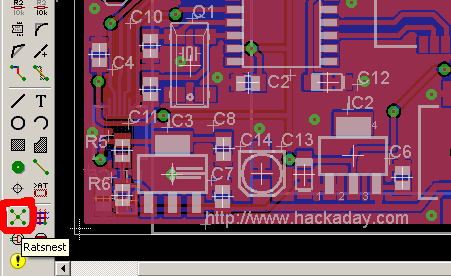
[PT] posted about an exciting development from Cadsoft, the migration to XML based parts, schematics, and board layouts. The adoption of this open standard goes hand-in-hand with the open hardware initiatives people like [PT] have been pushing for.

Cadsoft Eagle is our go-to schematic and PCB software. We even have a tutorial which guides you through preparing your files for PCB manufacture. But the files containing parts libraries, schematics, and board layouts have always been binaries. A transition to XML means a lot of things. They will be easier to edit, and much friendlier for tracking changes using version control systems like SVN, CVS, Mercurial SCM, Git, etc. But immediately on our minds is the accessibility for hacking. Think of how easy XML parsing is in programs like Python. It should be snap to write scripts on a whim that will manipulate the XML files in any way imaginable. This doesn’t discount the value of Eagle, it extends the usability far beyond what any team of engineers at Cadsoft could produce by themselves. And for that, we say Bravo.

Laser Cutter Doubles As A 3D Printer

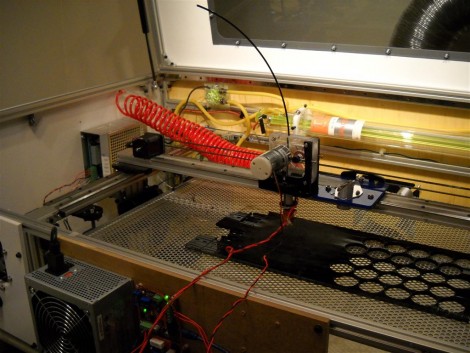
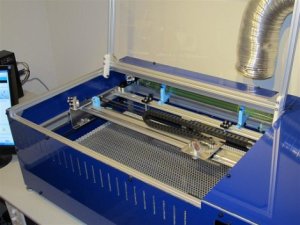
[Bart] figured out how to use his laser cutter as a 3D printer. We’ve checked in on his open source laser cutter in the past and we’re happy to see he’s now done with the build. But rather than stop there he took it a step further. For less than $200 he built an extruder head and added RepRap circuitry. You can see in the image above the laser tube is in the background and the extruder head with a line of black filament is mounted on the gantry. [Bart] has other plans for extensibility as well, including a knife cutter, a pen plotter, and a Dremel mount.

Open Graphing Calculator: Beagleboard + R

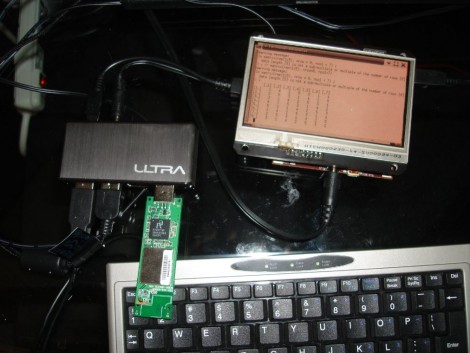
It looks like we missed the boat on this one but just in case you missed it everywhere else on the Internet, last Saturday [Matt Stack] introduced the world to a completely open source calculator. This marries two heartily tested open source projects; the R Project for Statistical Computing and the Beagleboard. The hardware side of things is very similar to that Linux tablet from back in June. It uses a stock Beagleboard with the BeagleTouch module.

Why do we care? First off, don’t forget what’s under the hood. That ARM processor kicks the 6 MHz Z80 processor found in TI’s calculators to the curb. The R language is a boon as well, offering plots of almost limitless quality and allowing extensibility that can’t be equaled with the current non-open offerings. But mostly because it’s a hack. We like seeing software run on hardware it wasn’t intended for.

Open Source STM

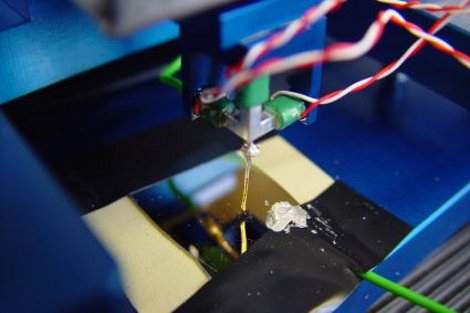
We hope you paid attention in advanced theoretical and quantum physics classes, or making your own Open Source Scanning-Tunneling Microscope might be a bit of a doozy. We’re not even going to try to begin to explain the device (honestly we slept through that course) beyond clarifying it is used for examining the molecular and atomic structure of surfaces; but for those still interested there is a nice breakdown of how Scanning Tunneling Microscopy works.

[Thanks Rich]

Update: Nintendo DS Camera Control

All of the juicy details needed to control a camera from your Nintendo DS are now available at the Open Camera Control project. This is the descendant of [Steve Chapman’s] setup from a few years ago. The system has been polished up and has seen many feature additions. It’s been used in movie production and works with a wide range of cameras.

Start by building your own interface cable using an AVR microcontroller running the Arduino bootloader. Finish up by loading some open source software onto the DS to add a cornucopia of shot options.

[Thanks Pops Macgruder]

Why Aren’t We Building Our Own Printers?

We’ll ask it again, why aren’t we building our own printers? We’re building 3d printers, CNC mills, and hacking the ink cartridges on commercial printers. What does it really take to build say a 300 dpi black and white printer? Something that lets you clean and service the print head rather than throwing it out when the ink reservoir is empty?

Someone has set out to answer these question with the Openprinter project. If this interests you, join up and start the revolution. RepRap had simple beginnings and maybe it’s time to take the army of self-replicating 3D printers and use them to print parts for 2D printers that don’t drive us crazy.

[Photo credit]

[via LostScrews]

Make Magazine – Open Source Hardware 2009

Former HaD’er [Phillip Torrone] has written an extensive collection of Open Source Hardware projects for Make Magazine. This impressive list covers over 125 projects and kits, broken into 19 categories including 3d Printing, Music, Robotics, and Wireless systems. A number of these projects have been either extensively detailed or mentioned on HaD, so there is bound to be something for everyone here.

[Phillip] is not only detailing these projects for people new to the Open Source Hardware movement, but is also calling for new and unheard of projects to be listed in places like this, as well as central locations such as the OSH Wikipedia page. We are sure that a number of HaD readers will be answer this challenge.

Thanks again to [Phillip] for sharing this with us.