Open Sourcing Everything… There’s An App For That

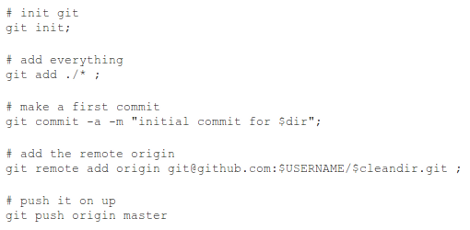
What happens if you’re a prolific developer and decide to release all of the source code from your work? Well, you should get a huge pat on the back from all interested parties. And so we say thank you to [Hunter Davis] for releasing the source code for his 70+ Android apps. But just making the decision isn’t the end of things, you’ve got actually get the code out there. And herein lies the hack. Instead of archiving and posting all of those projects he wrote a script to crawl, init, and push his projects to Github automatically.

This process is made pretty easy because of the Github API. Looks like he used version 2 for his script but you’ll want to check out version 3 if you’re looking to write your own script. His script takes the API key and username as command line arguments, then traverses his local source tree. Along the way it uses some text manipulation to sanitize the directories for use as the name of the repository. Once that’s established it steps into the directory, creates a repository, adds and commits all the files, then pushes them to Github.

Following [Hunter’s] example makes it really easy to share your code. We hope more will follow suit, putting their work out there for others to learn from and build upon.

We’ve seen some hardware hacks from [Hunter] as well. He did a bunch involving the ZipIt, as well as some work with playing games with a Dockstar.

[via Reddit]

Birdwatching Meets A Computer-Controlled Water Cannon, Awesomeness Ensues

squirrel turret

Sure, squirrels may bother the average home owner, but few have attempted as creative a way to control them as this automated water turret. Check out the video after the break to see how this was accomplished, but if you’d rather just see how the squirrels reacted to getting squirted, fast forward to around 16:00. According to [Kurt] he was sure this would be his solution, however, his conclusion was that “squirrels don’t care.”

As for the presentation, it’s more about how to use [OpenCV], or Open Source Computer Vision. It’s quite a powerful piece of software, especially considering that something like this would cost thousands of dollars in a normal market.  An Arduino is used to interface the computer’s outputs to the real world and control a squirt gun. If you’d rather not program something like this yourself, you could always simply use a garden hose as someone suggests just after the video. Continue reading “Birdwatching Meets A Computer-Controlled Water Cannon, Awesomeness Ensues”

Brewtarget: Open Source Homebrewing

[youtube=http://www.youtube.com/watch?feature=player_embedded&v=BEdkZIUkvA4]

Several of us here at Hackaday Brew our own beer. Needless to say, we got a little excited when we saw members of the open source community building a brew tracking system. Brewtarget is an open source tracking system that you could download right now and begin tracking and building your recipes. It looks like there is a fairly active development group working on it and even a feature request form that seems to be filling up. Maybe we overlooked it, but there doesn’t seem to be an existing feature list. We look forward to seeing where this project goes.

Brewtarget implements BeerXML, which means it should also be compatible with Beershmith, a commercial application.

[via adafruit]

Hackaday Links March 8th, 2012

Solder Your Pin headers Straight

straight-header solder

If you’re worried about how to solder your pin headers straight, why not try this simple trick and put them into a breadboard before soldering?

Etiquette for Open Source Projects

soapbox Phillip Torrone

If you use or develop open source projects, it’s worth checking out [Phillip Torrone]’s Unspoken rules of Open Source article. You may not HAVE to do all the things he says, but it’s certainly a good starting point for being ethical with your hacks.

The [GoAmateur] Camera Mount

go-amateur camera mount for bike

If you can’t afford a professional camera mount for your bike, why not make one yourself? As pointed out in the article, normal cameras aren’t really made for this, so do so at your own risk. If this isn’t shoddy enough for you, why not make a mount for your 4 year old dumb-phone (Env2) out of a block of wood?

A 3D Printer BOM

If you’re wondering how much a 3D printer will cost you, or where to source the parts, this Bill of Materials for a Prusa Mendel should help. We would assume this project will be updated as everything is built, so be sure to check back!

MakerBot Assembly Time-Lapse

makerbot time lapse

Along the same lines, if you’re wondering about getting into 3D printing, this time-lapse of the Thing-O-Matic being assembled may give you some insight into what’s involved in getting one functional!

Freedom Toaster Dispenses FOSS… For Free

The Seneca College Linux Club figured out a fantastic way to help promote Linux to a wider audience. They took some surplus hardware and made an Open Source software vending machine. That is and isn’t a play on words. The project itself is an open source project, and the goal is to dispense other open source software in the form of CDs and DVDs.

Their build page shares all of the details. They acquired an older server cabinet which was on the way out from the IT department. It’s more than large enough to fit a person inside, which is overkill but it makes it much less likely that someone will try to walk off with the thing. Inside you’ll find a computer, two monitors (one is a touch screen for consumer use, the other is just an extra hidden inside for maintenance.

You must bring your own blank CD-R or DVD-R (but the burning is free). You can see the DVD shelf at waist-level on the fully painted kiosk above. The only thing we think is missing here is a USB port for brewing up a bootable USB stick.

[Thanks MS3FGX]

Complete Guide To Compiling OpenWRT

Regular reader [MS3FGX] recently wrote a guide to compiling OpenWRT from source. You may be wondering why directions for compiling an open source program warrant this kind of attention. The size and scope of the package make it difficult to traverse the options available to you at each point in the process, but [MS3FGX] adds clarity by discussion as much as possible along the way.

OpenWRT is an open source alternative firmware package that runs on may routers. It started as a way to unlock the potential of the Linksys WRT54G. But the versatility of the user interface, and the accessibility of the Linux kernel made it a must-have for any router. This is part of what has complicated the build process. There are many different architectures supported and you’ve got to configure the package to build for your specific hardware (or risk a bad firmware flash!).

You’ll need some hefty hardware to ease the processing time. The source package is about 300 MB but after compilation the disk usage will reach into the Gigabyte range. [MS3FGX] used a 6-core processor for compilation and it still took over 20 minutes for a bare-bones distribution. No wonder pre-built binaries are the only thing we’ve ever tried. But this is a good way to introduce yourself to the inner workings of the package and might make for a frustrating fun weekend project.

Robot Takes Voice Commands Via Open Source CSR

This is Chippu, a robot that [Achu] has been working on for some time. His most recent addition was to give the robot the ability to respond to voice commands. This is accomplished using a variation of the open source Continuous Speech Recognition package called Julius.

The package depends on two main parts, a set of acoustic models which let it match incoming sounds and a reference library of grammar which is built from those sounds. [Achu] published another post which goes into detail about using Julius on a Linux box. It seems like this is possible with less robust hardware (ie: on an embedded system) if you narrow down the number of acoustic and grammer models that need to be matched.

For now, Chippu is getting commands from a computer that runs the CSR. But this was only used as a proof-of-concept and [Achu] plans to transition the bot over to smaller hardware like the BeagleBoard.

Check out the demonstration of Chippu responding to voice commands in the video after the break.

Continue reading “Robot Takes Voice Commands Via Open Source CSR”