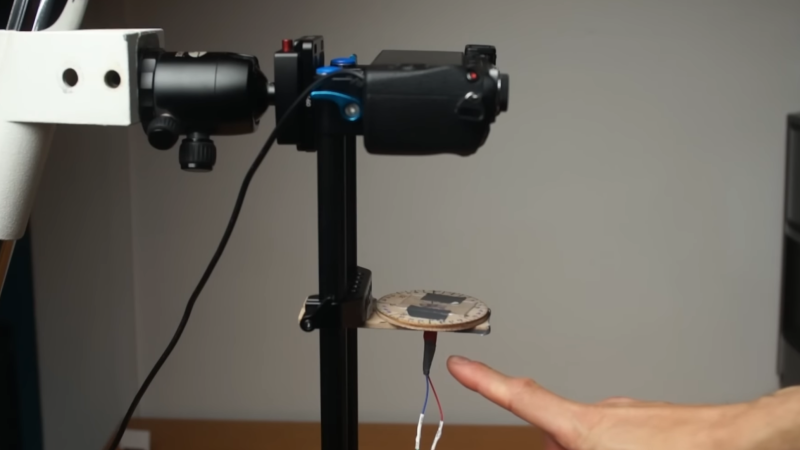
A mirrorless camera is mounted on a stand, facing downwards toward a rotating microscope stage made of wood. A pair of wires come down from the stage, and a man's hand is pointing to the stage.

Building A Microscope Without Lenses

It’s relatively easy to understand how optical microscopes work at low magnifications: one lens magnifies an image, the next magnifies the already-magnified image, and so on until it reaches the eye or sensor. At high magnifications, however, that model starts to fail when the feature size of the specimen nears the optical system’s diffraction limit. In a recent video, [xoreaxeax] built a simple microscope, then designed another microscope to overcome the diffraction limit without lenses or mirrors (the video is in German, but with automatic English subtitles).

The first part of the video goes over how lenses work and how they can be combined to magnify images. The first microscope was made out of camera lenses, and could resolve onion cells. The shorter the focal length of the objective lens, the stronger the magnification is, and a spherical lens gives the shortest focal length. [xoreaxeax] therefore made one by melting a bit of soda-lime glass with a torch. The picture it gave was indistinct, but highly magnified. Continue reading “Building A Microscope Without Lenses”
Ptychography For High Resolution Microscopy

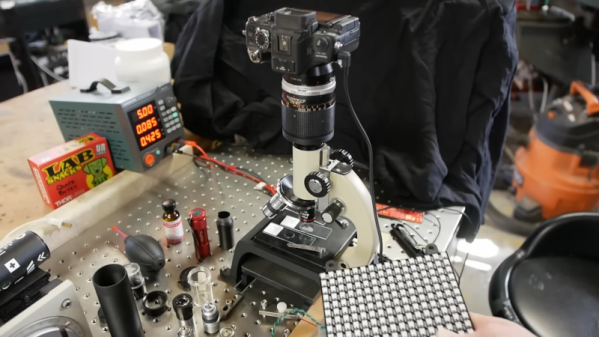
Nowadays, if you have a microscope, you probably have a camera of some sort attached. [Applied Science] shows how you can add an array of tiny LEDs and some compute power to produce high-resolution images — higher than you can get with the microscope on its own. The idea is to illuminate each LED in the array individually and take a picture. Then, an algorithm constructs a higher-resolution image from the collected images. You can see the results and an explanation in the video below.

You’d think you could use this to enhance a cheap microscope, but the truth is you need a high-quality microscope to start with. In addition, color cameras may not be usable, so you may have to find or create a monochrome camera.

Continue reading “Ptychography For High Resolution Microscopy”

Ptychography Shows Atoms At Amazing Resolution

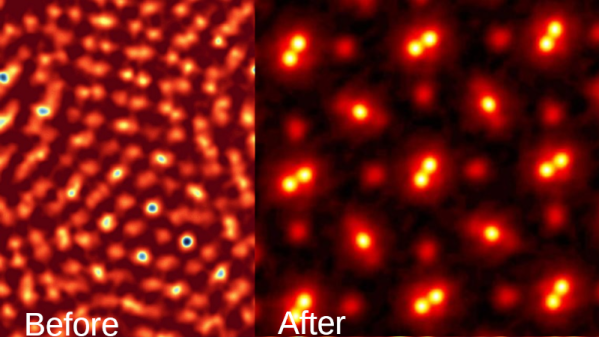
Cornell University enhanced electron microscopy using a technique known as ptychography in 2018. At the time, it allowed an electron microscope to resolve things three times smaller than previously possible. But that wasn’t enough. The team has now doubled that resolution by improving on their previous work.

The team says that the images are so precise that the only blurring is due to the thermal motion of the atoms themselves. This could mean that you won’t see a further improvement in resolution in the future.

Continue reading “Ptychography Shows Atoms At Amazing Resolution”