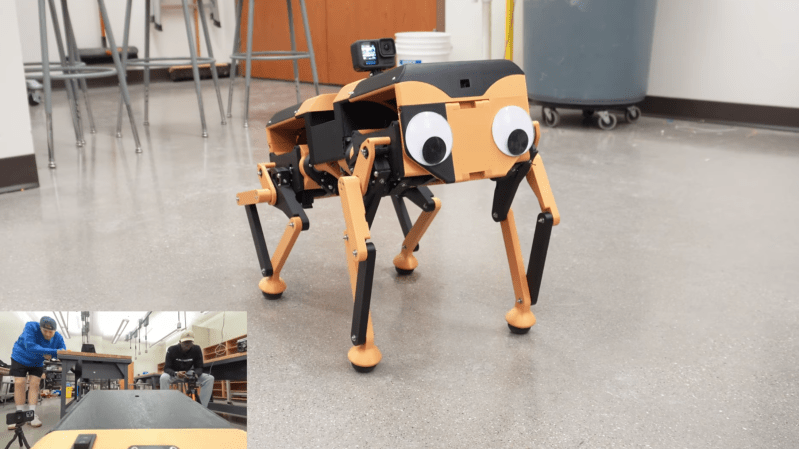
A black and yellow robot dog stands in the middle of the floor, with a GoPro camera mounted on its back. A picture-in-picture view in the bottom left corner shows the view from the camera.

An Improved Robot Dog For Senior Design

[Aaed Musa] has been building robot dogs for a long time now, so it was only natural that he would make one for the senior design project of his mechanical engineering degree. Since this meant working with potential customers, the requirements were somewhat more stringent than for previous dogs, but [Aaed] and his team were able to deliver CARA 2.0, their most agile, versatile robot yet.

Based on conversations with potential customers, [Aaed] and his team aimed for a price around $1,000 USD, a weight under 20 pounds, and a durable design. Like the original CARA, this used capstan drives to actuate the joints, which reduced costs. The drives were printed in resin and powered by brushless drone motors. These motors were designed for speed, not torque, so the team had to rewind them with more wire, an ordeal which paid off by roughly tripling the torque. As far as durability, one joint motor was tested by running it continuously back and forth, and it lasted for over 1,000 hours without obvious damage.

Since the joints don’t contain any absolute encoders, each motor has to home on startup by extending to its limit, as detected by a rise in motor current. As a happy side effect, this creates a lifelike stretching motion on startup. Compared to the earlier iteration, CARA 2.0 takes shorter, quicker steps, and thanks to angled step movements can turn much more quickly. In testing, it originally skewed to the left, which turned out to be due to an asymmetric leg design. Once corrected, CARA 2.0 could walk in straight lines, walk sideways, turn in place, crouch, jump, and keep its balance on an inclined surface. It didn’t quite make the price goal, but $1,450 is still cheap for such a capable robot dog, and it reached every other customer requirement. Most importantly, all the team graduated.

For another take on a capstan-powered robot dog, check out Stanley. We’ve also taken a look at TOPS, one of [Aaed]’s earlier designs.
Continue reading “An Improved Robot Dog For Senior Design”

Building A Little Quadruped Robot

Robots don’t have to be large and imposing to be impressive. As this tiny quadruped from [Dorian Todd] demonstrates, some simple electronics and a few servos can create something altogether charming on their own.

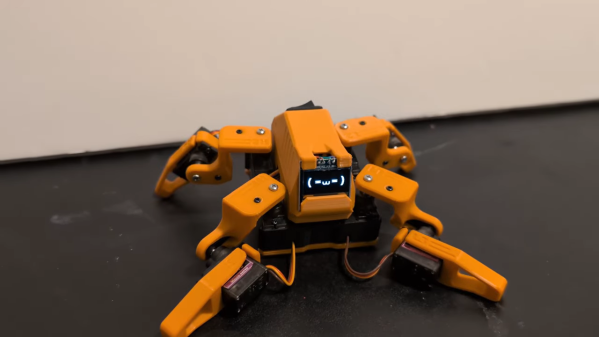
This little fellow is named Sesame. A quadruped robot, it’s built out of 3D-printed components. Each leg features a pair of MG90S hobby servos, one of which rotates the leg around the vertical axis, while the other moves the foot. The ESP32 microcontroller controls all eight servos, enabling remote control of Sesame via its built-in wireless connectivity. Sesame also gets a 128×64 OLED display, which it uses to display a range of emotions.

Mechanically, the Sesame design isn’t particularly sophisticated. Where it shines is that even with such a limited range of motion, between its four legs and its little screen, this robot can display a great deal of emotion. [Dorian] shows this off in the project video, in which Sesame scampers around a desktop with all the joy and verve of a new puppy. It’s also very cheap; [Dorian] estimates you can build your own Sesame for about $60. Files are on GitHub for the curious.

If you prefer your quadrupeds built for performance over charm, you might consider an alternative build. Video after the break.

Continue reading “Building A Little Quadruped Robot”

Robot Gets A Life-Sized Pokemon Costume For Halloween

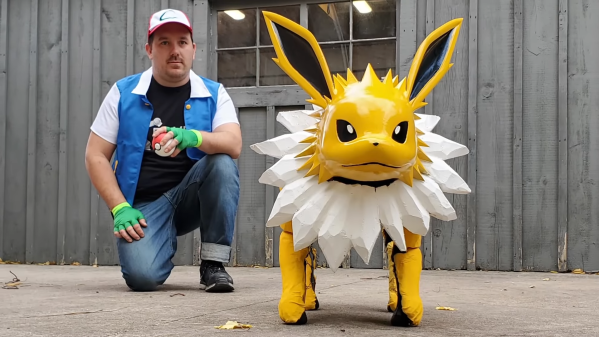
Quadruped robots are everywhere now that companies like Boston Dynamics are shipping smaller models in big numbers. [Dave’s Armoury] had one such robot, and wanted to give it a Pokemon Halloween costume. Thus, the robot dog got a Jolteon costume that truly looks fantastic. (Video, embedded below.)

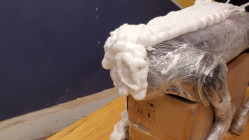
You would think that covering a quadruped robot in foam would ruin it, but somehow it didn’t stop it moving too badly at all.

The robot in question is a Unitree Go1, which [Dave] had on loan from InDro robotics. Thus, the costume couldn’t damage or majorly alter the robot in any way. Jolteon was chosen from the original 150 Pokemon as it had the right proportions to suit the robot, and its electric theme fitted [Dave’s] YouTube channel.

A  3D model of Jolteon was sourced online and modified to create a printable head for the robot application. Two 3D printers and 200 hours of printing time later, and [Dave] had all the parts he needed. Plenty of CA glue was used to join all the parts together with some finishing required to make sure seams and edges didn’t spoil the finish too much. Wood filler and spray paint were used to get the costume looking just like the real Pokemon. Continue reading “Robot Gets A Life-Sized Pokemon Costume For Halloween”