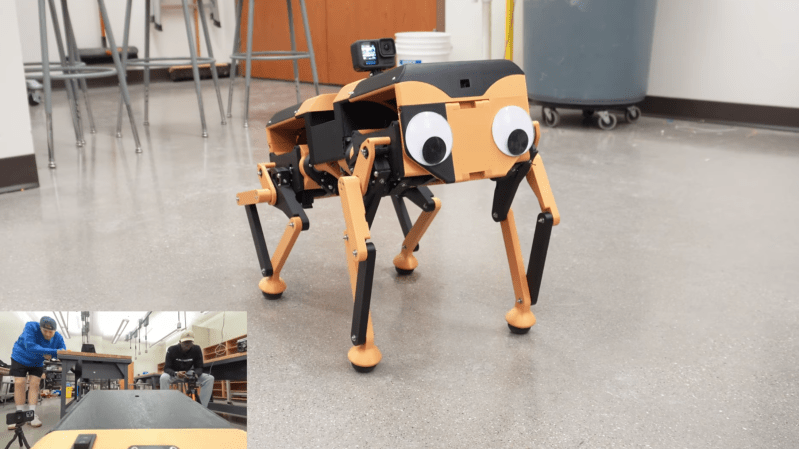
A black and yellow robot dog stands in the middle of the floor, with a GoPro camera mounted on its back. A picture-in-picture view in the bottom left corner shows the view from the camera.

An Improved Robot Dog For Senior Design

[Aaed Musa] has been building robot dogs for a long time now, so it was only natural that he would make one for the senior design project of his mechanical engineering degree. Since this meant working with potential customers, the requirements were somewhat more stringent than for previous dogs, but [Aaed] and his team were able to deliver CARA 2.0, their most agile, versatile robot yet.

Based on conversations with potential customers, [Aaed] and his team aimed for a price around $1,000 USD, a weight under 20 pounds, and a durable design. Like the original CARA, this used capstan drives to actuate the joints, which reduced costs. The drives were printed in resin and powered by brushless drone motors. These motors were designed for speed, not torque, so the team had to rewind them with more wire, an ordeal which paid off by roughly tripling the torque. As far as durability, one joint motor was tested by running it continuously back and forth, and it lasted for over 1,000 hours without obvious damage.

Since the joints don’t contain any absolute encoders, each motor has to home on startup by extending to its limit, as detected by a rise in motor current. As a happy side effect, this creates a lifelike stretching motion on startup. Compared to the earlier iteration, CARA 2.0 takes shorter, quicker steps, and thanks to angled step movements can turn much more quickly. In testing, it originally skewed to the left, which turned out to be due to an asymmetric leg design. Once corrected, CARA 2.0 could walk in straight lines, walk sideways, turn in place, crouch, jump, and keep its balance on an inclined surface. It didn’t quite make the price goal, but $1,450 is still cheap for such a capable robot dog, and it reached every other customer requirement. Most importantly, all the team graduated.

For another take on a capstan-powered robot dog, check out Stanley. We’ve also taken a look at TOPS, one of [Aaed]’s earlier designs.

Continue reading “An Improved Robot Dog For Senior Design”

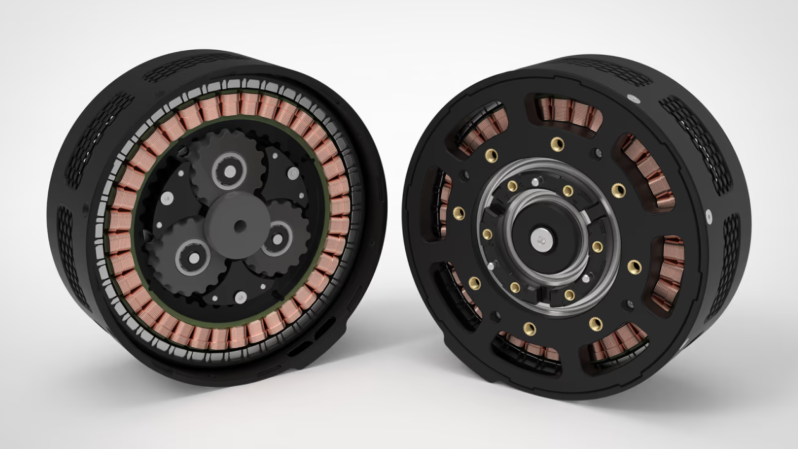
Two views of a motor are shown. On the left, a ring of copper-wire-wound stator arms is visible inside a ring of magnets. Inside this, a planetary gearbox is visible, with three mid-sized gears surrounding a small central gear. On the right, the same motor is shown, but with the internal components mostly covered by a black faceplate with brass inserts.

A Budget Quasi-Direct-Drive Motor Inspired By MIT’s Mini Cheetah

It’s an unfortunate fact that when a scientist at MIT describes an exciting new piece of hardware as “low-cost,” it might not mean the same thing as if a hobbyist had said it. [Caden Kraft] encountered this disparity when he was building a SCARA arm and needed good actuators. An actuator like those on MIT’s Mini Cheetah would have been ideal, but they cost about $300. Instead, [Caden] designed his own actuator, much cheaper but still with excellent performance.

The actuator [Caden] built is a quasi-direct-drive actuator, which combines a brushless DC motor with an integrated gearbox in a small, efficient package. [Caden] wanted all of the custom parts in the motor to be 3D printed, so a backing iron for the permanent magnets was out of the question. Instead, he arranged the magnets to form a Halbach array; according to his simulations, this gave almost identical performance to a motor with a backing iron. As a side benefit, this reduced the inertia of the rotor and let it reverse more easily.

To increase torque, [Caden] used a planetary gearbox with cycloidal gear profiles, which may be the stars of the show here. These reduced backlash, decreased stress concentration on the teeth, and were easier to 3D print. He found a Python program to generate planetary gearbox designs, but ended up creating a fork with the ability to export 3D files. The motor’s stator was commercially-bought and hand-wound, and the finished drive integrates a cheap embedded motor controller. Continue reading “A Budget Quasi-Direct-Drive Motor Inspired By MIT’s Mini Cheetah”

DIY Robotic Actuator Built For Walking Robots

[Aaed Musa] has built a variety of robots over the years, but found off-the-shelf servos to be underwhelming for his work. Thus, he set out to build a better actuator to support his goals of building a high-performance walking bot in future.

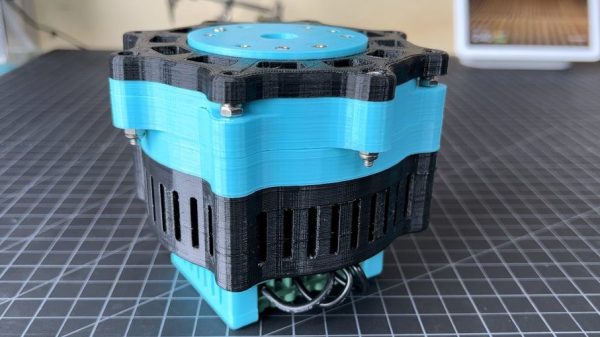
[Aaed] decided to try and build a quasi-direct drive actuator, similar to those used in MIT’s agile mini Cheetah robot. It consists of a powerful brushless DC motor driving a 9:1 planetary gear reduction built with 3D printed parts, which provides high torque output. It’s designed to be run with an ODrive S1 motor controller with encoder feedback for precise control.

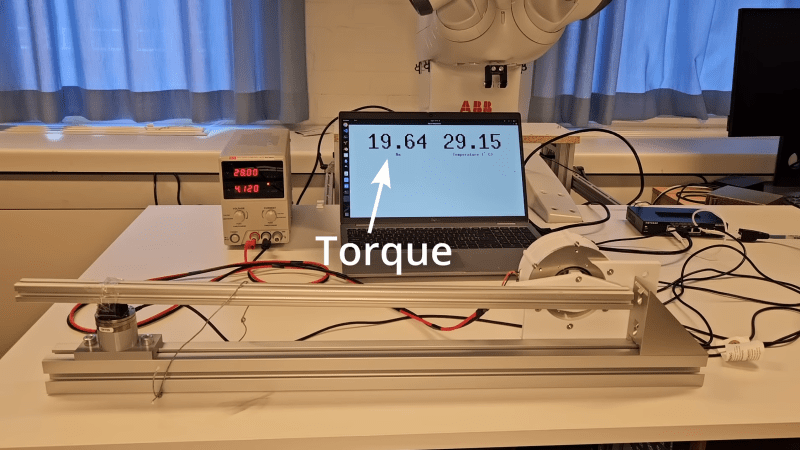
The actuator weighs in at a total of 935 grams. It’s not cheap, with the bill of materials totaling just under $250. For your money, though, you get a responsive robotic actuator with a hefty holding torque of over 16 Nm, which [Aaed] demonstrates by having the actuator shake around some dumbells on a long lever arm.

Walking robots have exploded in popularity ever since Spot hit the scene. We’ve seen everything from complex builds to super-simple single-servo designs.

Continue reading “DIY Robotic Actuator Built For Walking Robots”