Storing Solar Energy As Ice For Air Conditioning

Thermal energy storage is pretty great, as phase-change energy storage is very consistent with its energy output over time, unlike chemical batteries. You also get your pick from a wide range of materials that you can either heat up or cool down to store energy. Here, the selection is mostly dependent on how you wish to use that energy at a later date. [Hyperspace Pirate] is mostly interested in cooling down a house, on account of living in Florida.

As can be seen in the top image, the basic setup is pretty straightforward. PV solar power charges a battery until it’s fully charged. Then an MCU triggers a relay on the AC inverter, which then starts the cooling compressor on the water reservoir. This proceeds to phase change the water from a liquid into ice. The process can later be reversed, which will draw thermal energy out of the surrounding air and thus provide cooling.

Continue reading “Storing Solar Energy As Ice For Air Conditioning”
Hackaday Prize Semifinalist: Portable A/C

Many people with Multiple Sclerosis have sensitivity to heat. When the core body temperature of an MS sufferer rises, symptoms get worse, leading to fatigue, weakness, pain, and numbness. For his entry to the Hackaday Prize, [extremerockets] is finding a solution. He’s developing a wearable, personal cooling device that keeps the wearer at a comfortable temperature.

The device is based on a wearable shirt outfitted with small tubes filled with a cooling gel. This setup is extremely similar to the inner garments worn by astronauts on spacewalks, and is the smallest and most efficient way to keep a person’s core body temperature down.

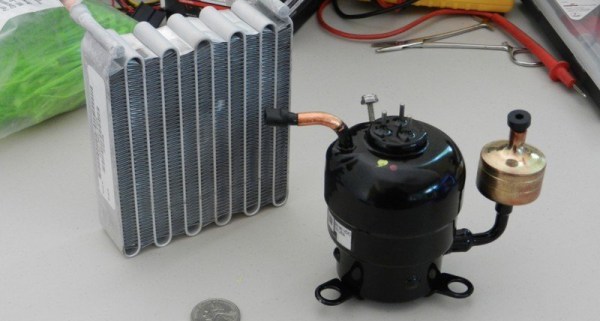
Unlike a lot of projects dealing with heating and cooling, [extremerockets] isn’t working with Peltiers or thermoelectric modules; they’re terribly inefficient and not the right engineering choice for something that’s going to be battery-powered. Instead, [extremerockets] is building a miniature refrigeration unit, complete with a real refrigeration cycle. There are compressors, valves, and heat exchanges in this build, demonstrating that [extremerockets] has at least some idea what he’s doing. It’s a great project, and one we can’t wait to see a working prototype of.

The 2015 Hackaday Prize is sponsored by: