
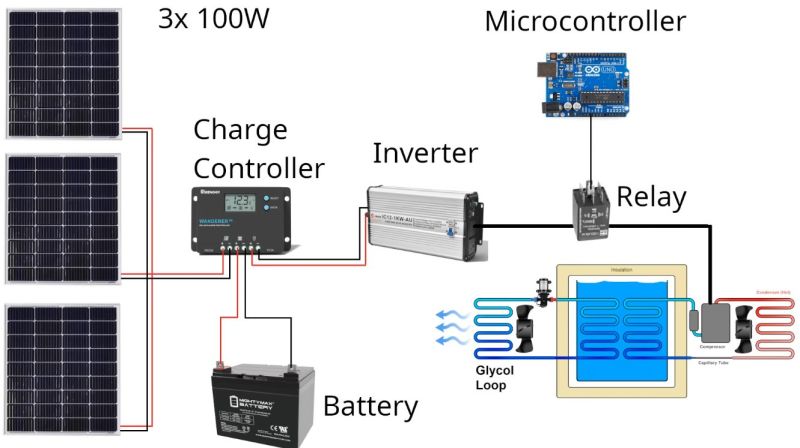
Thermal energy storage is pretty great, as phase-change energy storage is very consistent with its energy output over time, unlike chemical batteries. You also get your pick from a wide range of materials that you can either heat up or cool down to store energy. Here, the selection is mostly dependent on how you wish to use that energy at a later date. [Hyperspace Pirate] is mostly interested in cooling down a house, on account of living in Florida.
As can be seen in the top image, the basic setup is pretty straightforward. PV solar power charges a battery until it’s fully charged. Then an MCU triggers a relay on the AC inverter, which then starts the cooling compressor on the water reservoir. This proceeds to phase change the water from a liquid into ice. The process can later be reversed, which will draw thermal energy out of the surrounding air and thus provide cooling.
Although water is not the most interesting substance to pick for the
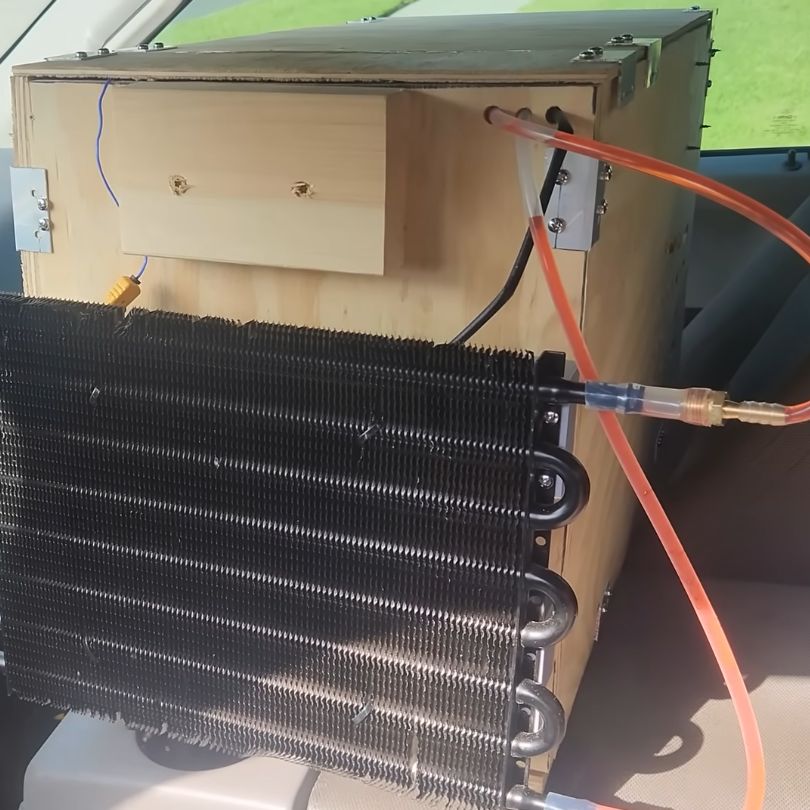
thermal energy storage, it can provide 1 kWh of cooling power in 10.8 kg, or 92.8 kWh in a mere m3. This makes it much more compact as well as cheaper than chemical storage using batteries.
After charging the main compressor loop with R600 (N-butane), the system is trialed with a small PV solar array that manages to freeze the entire bucket of water. Courtesy of insulation, it’s kept that way for a few days, giving plenty of time for the separate glycol-filled loop to dump thermal energy into it and push cold air into the surrounding environment. This prototype managed to cool down [Hyperspace Pirate]’s car in just two hours, which is good enough for a proof-of-concept.












It’s a whacky but good idea. I’m both disturbed for intangible reasons and think it’s a huge success. Kind of like it had alien inspiration or something. It’s like the hightech found in an apocalypse solution to a fred Flintstone device. I love it.
So glycol chillers are a common thing. Usually they are used to get really cold temperatures. Like well below 0c. Why not make ice? I’d love to see the energy spend across the entire cycle. Which probably means I need to watch the video.
The reason this isn’t done more often is that the guy in the video vastly over-estimates the cost of doing it with batteries. If you use batteries you have an off-the-shelf, low maintenance solution (heat pumps leak gas over time, and are mechanical devices), which can also be used to power other things. They are also more practical, by being less sensitive to ambient temperature, and taking up less space.
It’s a nice hack, but tends to work better with hot water for heating as that can be stored easily in a tank. Ice expands and can’t be pumped around, so is more effort to work with.
How much energy is spent to cool the stuff? Is the juice worth the squeeze? Now you have to spend more energy to keep the stuff cool until it’s time to “harvest” the “energy”. A battery just sits there without pampering. “Pushing cold air”? I’m getting a whiff of Rube Goldberg here as if he mated with Joseph Newman and produced a… Monorail!
The advantage of ice over a battery is that water is very cheap, and the bigger you make the ice cube the slower it melts.
Again, the advantage of batteries over ice is not having to pump energy in to keep the bloody thing charged.
“But it’s winter! The ice won’t melt!” So no energy for you because you need that ice melting on that wall to get energy out. Everyone wants what they want and I want numbers which are conspicuous by their absence here. I’m not a full curmudgeon and would happily sign up for a Free Lunch program. Only one problem with that.
their in florida, winter isnt an issue. They run AC year round in Florida. If it were an issue they would heat the water instead of freeze it during winter.
theyre oops
” ‘Straw doesn’t just magically appear without someone inputting energy’
You’re just rambling nonsense now.”
So you’re saying that straw does magically appear, m’kay? Again Joseph Newman comes to mind.
What are you even talking about?
Technically, they’re pumping energy out.
That’s just a matter of sufficient insulation. People managed to keep ice under straw in the 19th century and keep it for an entire year. Here we’re talking about keeping the ice over a day or two.
But here’s the kicker: if you keep the block of ice inside the house, guess what it does even if it melts? It cools down the house, like it’s supposed to.
All you want to do is to moderate how fast the ice melts, so you can keep the temperature steady. The point of the whole thing is just to add thermal mass, so you can run the AC pump on solar power as much as possible when the sun is up.
If ice melts, that’s pumping or sucking energy in. I fear that you’re conflating “keeping ice around” and “using ice to do work”. Can’t have both. If it does work it goes bye-bye. Straw doesn’t just magically appear without someone inputting energy. Have I wandered into a meeting ofthe Free Lunch Society?
“Here we’re talking about keeping the ice over a day or two.” Take it up with the imaginary ice-cube building.
Yes you can. It’s just a thermal mass. Some ice melts, then more gets made next time the sun is up. It doesn’t even matter if it’s ice or just cold water in the box, it all works equally well because it is just for thermal mass to even out the cooling over a few days.
You’re just rambling nonsense now.
“Technically, they’re pumping energy out.” True, but someone had to pump more energy in, otherwise it’s Nobel Prize time.
Imagine all the corpses and bones from pre-air-conditioning Florida that have to be tread under or walked through. Goodness, all those poor Indians, Spaniards and Englishmen. Yet still a real estate boom in the 1920s, go figure. How ever did the Hottentots manage?
I think you’ll find that it happens quite voluntarily by itself when you have a block of ice in a container inside a house that is generally at or above normal room temperature.
All you’re doing is moderating how fast the ice melts, so it doesn’t cool the house down too much.
I guess this will be very useful in Africa, where the ice will melt easily.
I like the idea, but why wait to charge the battery first before starting the cooling process, you gain more energy while the sun is still shining and you use the excess to charge the battery, just use a solar hybrid inverter or put an MPPT solar charger in between the panels and rest of the setup. The charged batteries can later be used to run a fan that will blow over the ice and perform the cooling function. In Africa, you’d be happier if the ice doesn’t melt quickly, even with lagging and the rest to retain it for long.
Good idea 👍
Just surround the tank of water/ice with a very thick layer of Urethane (Polyurethane) Insulation (0.022 and 0.028 W/m.K thermal conductivity) or even with Silica Aerogel Insulation (less than 0.015 W/m . K thermal conductivity) if you have more money than sense. Urethane (used in fridges and freezers) is dirt cheap and simply doubling the thickness, to provide the same insulation as Aerogel, is an optimal solution unless physical space is an issue.
if you have more DOLLARS than sense.
Ftfy
You do realise battery have self discharge too no?
And it is hardly pampering to put a blanket on your box of ice – when the temperature differential is only a few degrees you really don’t need to do much to keep the energy exchange rate really low.
And if the goal is cooling turning your initial energy source into cold directly and storing that is likely way better than doing multiple energy conversions to use large battery bank – even with high efficiency at every stage its likely a lot of extra steps, and even when you avoid that pitfall you still need lots of really expensive battery to have enough stored energy – this sort of concept needs a bucket of water and can scale up/down in energy storage capacity really cheaply – simply use a bigger bucket, you won’t even need new coils unless you want to increase the energy exchange rate.
As someone who lives in florida and works in commercial/industrial hvac I’ll weigh in. The advantage of doing this is lower energy costs. The idea is to make the ice or chilled water during off peak hours, typically night time, then use the stored cooling during peak hours, typically day time.
This is known as an Ice Bear… A common form of shifting power from high-cost daytime to low-cost nighttime for cooling a space.
e.g.) https://www.iceenergy.com/how-it-works/
What to do with excess solar energy at an off-grid cabin is constantly on my mind, since once the battery is filled, you have energy that you either use or lose. i’ve taken to using it to run space heaters (and a mini split) in the basement (in the Adirondacks, heat is always welcome in a basement, even in the summer, and storing it in the thermal mass of an insulated basement means you might make it through the winter without it ever freezing down there). I also heat water only after the battery is full. But it would also be fun, to, say, generate hydrogen from electrolysis and somehow compress and store it in an off-site cannister made of some material resistant to hydrogen embrittlement.
Again, you’re talking about injecting energy. “To compress hydrogen for a single tank, the energy required typically ranges between 2.05 kWh and 3.2 kWh per kilogram of hydrogen”. That’s gotta be a nutcracker, throwing a spanner into the works, whatever.
1 kg of hydrogen contains 33.33 kWh of usable energy so 2.05 kWh and 3.2 kWh lost to compression may be justified depending on use case. A far greater concern is the inefficiency of electrolysis. If youve already thrown away 40% of your power whats another 10-15% to storage matter.
losing 40% of energy i would otherwise lose 100% of isn’t a dealbreaker, other than all the trouble of building out an electrolysis system and finding a suitable tank. but if there was a way to lose less than 40% of it, that would be better. maybe micro-pumped-storage.
“losing 40% of energy”
Its already 46-49% loss when you combine electrolysis and compression losses. Then you have to convert it back to electricity. Fuel cells only produce ~16-20kwh per kg of hydrogen, so youre losing another 40-50%. leaving you with a net energy return of only 20.4-27% of your originally captured energy.
So “if there was a way to lose less than 73-80% of it, that would be better. ”
That would be BATTERIES. Lithium 5–15% of energy during the full charge-discharge cycle. Lead acid 15% to 30%. NiFe 20–35%.
It doesn’t come down to efficiency but cost.
How many cents per kWh and how does it compare with hauling the same amount of fuel up to the cabin?
And, since we’re talking about excess solar power, it’s gonna be energy that is available in excess for a good part of the year and then gets consumed on the other part.
That’s energy you need to store over months, and for batteries that’s gonna turn out very expensive and very inefficient, because of the embedded energy cost and the cost of batteries in general. They’re not going to make ends meet if you’re essentially charging them once in a summer and trying to keep that energy up till winter.
A fuel like hydrogen would be suitable. All you have to figure out is how to make enough, and how to keep enough – which for hydrogen is the biggest problem because it has such a poor energy density.
“A fuel like hydrogen would be suitable. All you have to figure out…” I prefer real world fuels like gasoline, kerosene, and wood. Unless you’re gonna be burning hydrogen, it’s not a fuel. It is however an ingredient in the battery that everyone calls “fuel cell”.
It’s a fuel because it burns with oxygen to produce an oxide (like any other fuel). The “engine” to burn it is a detail, a thermal engine has a poor efficiency compared to a fuel cell. If it was possible to burn gasoline with a fuel cell directly with 40% efficiency, it would be used already everywhere.
A battery does not consume fuel. A fuel cell consumes hydrogen. You seem rather confused as to what constitutes a fuel and what a battery is.
And @sweethack “Solid Oxide Fuel Cells (SOFCs) are most capable of using gasoline directly due to their high operating temperatures, though this technology is currently considered impractical for cars due to size, high operating temperatures, and carbon buildup issues.”
Improvements in efficiency and manufacturing scaling of SOFCs will likely see them become more capable and practical in years to come. Though truthfully, we are more likely to see them and other types of fuel cell using Cellulosic ethanol, a second-generation biofuel produced from non-food plant biomass, such as agricultural residues (corn stover), wood waste, and municipal solid waste.
If I can add one clarification that everyone typically ignores: Fuel cells are batteries. They don’t make anything.
Batteries store energy and release it.
fuel cells are NOT batteries. Fuel cells are generators. Fuel cells have no energy within them. They store no energy They generate energy from fuel.
Fuel is a battery. Fuel stores energy and releases it.
What I hear you saying is you’re not at ease with the concept of potential and e.g. “kinetic energy”. Fuel cells are batteries. Electricity in, electricity out, with chemistry stuff in between, just like a carbon zinc battery, which contrary to the labeling is rechargeable.
Im perfectly fine with the concepts of potential and kinetic energy. You seem uncomfortable with the concept of batteries. A battery is a device that stores chemical energy and converts it into electrical energy.
A fuel cell does not store chemical energy.
A fuel cell is not electricity in electricity out.
Its fuel in electricity out. 95% of hydrogen produced in the US is created through Steam Methane Reformation. SMR accounts for 74% of global hydrogen production.
Roughly 15% of the gas input into the system is burned to create the heat that produces the hydrogen from the other 85%. Minimal electricity is involved in traditional SMR (gray hydrogen). Blue hydrogen production, SMR with Carbon capture, does require 0.4 to 1.0 kWh of electricity per kg of hydrogen.
I’d suggest you would be better off liquefying or simply compressing regular air – both are relatively simple to create and store, long lasting, not chemically explosive so a simple pressure relief valve should keep the whole system safe. And of course its rather controllable in output rate when you do want to let that air out past your turbine for electric or just used directly in air tools etc.
Efficiency and energy density may not be as impressive as many other options but it is pretty easy to scale you storage by just adding another tank, the system can be sized to consume whatever ballpark of energy oversupply you have (though liquefying you’d really want to leave it running, so it might well be a drain on your battery overnight for peak efficiency of the system as a whole – so it is more complex and costly).
If my memory is correct, many many years ago Honeywell had a very large building on a northern US campus and they vented the building in the winter and sprayed water into the building and made a very large ice cube – which they used for cooling in the summer. Pardon the pun – but I always thought it was a cool idea – – never saw any engineering data for it – but there is a lot of energy in the phase change
I’ve been interested in doing this by burying a tank in my yard for overflow heat/cold out of a HVAC/water heater loop I’m planning
Has anyone ever tried powering an absorption refrigerator directly from a solar thermal collector, using a heat pipe? No controller, no battery, no electrical cables. As long as the sun is shining, we store cold…
https://ia803205.us.archive.org/5/items/Secret_Magazine_Files/Home%20Power%20Magazine%20-%20Issue%20053%20Extract%20-%20How%20To%20Build%20A%20Solar%20Icemaker.pdf
Home Power Magazine has you covered!
Many times. Systems using this scheme have been used for Ice production in africa since the early 1970s,
Ice is a poor conductor of heat so hard to get at all the stored cool very fast. It also lowers the efficiency of your refrigeration to have to go that colder than you need to. If you have the space, it is easier/more efficient to store all that negative heat as a larger body of cold water that a small body of ice.
You also don’t have the issue of expansion trying to break everything 😁
Ice is a detail here. The latent energy is what is important (phase change from solid to liquid captures much more energy than simply using cold water). So the fact the the ice is a poor conductor is a very good thing here, since the energy you’re interested in is on the surface of the ice, not inside the cube.
There are plenty of heat transfer fluids that operate at very low temperatures, far below the freezing point of water if you find the properties of simple ice undesirable. Our lab uses one that has a Minimum use temperature of -100°C/-148°F and has a Maximum use temperature of 65ºC / 150°F
The commercial users of ice cold reserves have devised surface treatments so the ice will self detach from the cooling surface and float away.
There are some commercial products that do the same for heat, Sunamp is one example. It uses a phase change material you can ‘charge up’ with heat when it’s cheap and there are water pipes running through it to retrieve that heat as hot water later. The only downsides are some reliability issues and you can’t control the temperature of the water coming out so it needs a thermostatic mixer.
I’m not at the point of having spare solar power but when I own a house I intend to build a massively oversized ground mount array to enable stuff like this.
This is extremely common in many campus type buildings. There will be a large centrifugal chiller used to make ice at night and then cool the buildings during the day. The campus at Wheaton, Illinois U.S.A. College of Dupage makes an approximately olympic sized pool of ice under the main parking lot during the summer nights and cools the buildings during the day. I believe it is a 5 building complex. I applied for a stationary engineers position there when working on my HVACR degree and saw all the associated equipment. One giveaway of an ice storage system is a large cooling tower.
This (making ice at night) makes sense. A lot more sense than spending your PV power during the day to make ice, anyway.
Chillers are more efficient at night, and electricity is much cheaper.
“Chillers are more efficient at night”
Challenge.
Challenge? What?
Every heat pump system I can think of does a better job at dumping heat into a space with a higher capacity to accept it –>> cooler air has a greater capacity than warmer air –>> night is almost always cooler than day, and even at the same ambient temperature there could be radiant heat from daylight directly or indirectly warming the box that’s trying to dump warm out of itself.
Might be cooler just after dawn vs just after sunset.
Night to cooler correlation is not perfect.
Carnot rules. But Carnot was an optimist. It’s actually much worse than Carnot in real systems.
Increase your ambient temperature 30 F and your efficiency drops more-or-less in half, with the details dependent on actual temperatures and load and system design.
It’s easy to see why: When the temperature differential increases, so does the refrigerant pressure differential, and so goes the load on the compressor and the power it requires.
The sense is that any solar setup that produces a significant amount of energy tends to over-produce during the middle of the day.
This excess production is normally sold for net metering, but with more people installing solar there’s fewer people to use it, and that creates the “duck curve” problem. The utilities are getting power they don’t want or need, and they’re forced to give people free electricity in exchange regardless, so they make up the difference by increasing power prices for the rest.
This issue would be solved if everyone could use their own solar power and not push it onto the grid to be everyone else’s problem. Making a bunch of ice is one way to do it.
Electricity is likely not a lot cheaper at night in that situation – as more solar gets on grid the oversupply is going to become more and more commonly huge driving the prices down around noon even when you are buying the electric from the grid. And if you have solar you will never get paid as much to export to the grid as you’ll end up saving using more of your generation locally unless you can offset that export time to the evening/mornings when the solar isn’t generating as much but everyone wants to boil the kettle and cook dinner…
This only makes sense if electricity is cheaper at night than during day, or if you have limited power availible and must spread the load.
If the day temperature outside is +40°C and you have to cool air to +20°C the efficiency would be exactly the same as cooling water to 0°C at night when the temperature outside is +20°
100% loss or do something with the energy.
Lots of comments about batteries. This is a pretty healthy expense.
Hydrogen is nice, water is cheap and abundant. Burning hydrogen is very easy to accomplish (fuel cell is expensive)
Pump storage great
The article/video of thermal mass is great. Hyperspace pirate has condensed o2 from air with some of his cooling projects. I’m sure a heat pump could run in both directions for the colder climate.
Great use for the excess energy. Lots of debate over efficiency but reminder that the extra energy is lost of not put to use, any use is a good use. Simplest version for heat is a resistance heater in a bucket of sand.
Reminder that cooling or heating is the desired effect and how the energy is expected to be used. It not necessary a storage medium to be converted back to electricity or something else.
As more solar comes online this could be good for the areas that often run the A/C into the night.
If enough people run it during the day when solar is plentiful, then this colls at night instead of the A/C
In temperate regions, you will want this as well as solar concentrators for warm water.
Speaking of hot water, might the Mpemba effect cool things faster?
https://en.wikipedia.org/wiki/Mpemba_effect.
Reject heat through those fancy panels sky mirrors whose heat escapes to space:
https://www.sciencealert.com/scientists-have-developed-a-solar-panel-that-can-also-beam-heat-into-the-cold-void-of-space
If you are going to add solar concentrators then you might as well use an adsorption refrigeration cycle using ammonia-water or zeolite-water pairs to create ice when you need cooling, and use the working fluid directly or from storage during periods when heat is required. Theres really no need for electricity to be involved once youre using concentrators and thermal transfer fluids.
Each 20 m² parabolic trough collector (PTC) paired with an adsorption icemaker can produce approximately 50 kg of ice per day.
Solar troughs have been deployed in africa for the production of ice for distribution in lieu of refrigeration since the early 1970s
.
If I were to approach this dual purpose system I would lean away from ice production, instead opting for a system that used a thermal transfer fluid that could operate both at the high and low temperature range. That way you would either store the heated fluid directly from the concentrator in your thermal tanks, or run a fraction of the systems fluid capacity in loop through the concentrator to drive the refrigeration cycle, chilling the remainder of the fluid. This would allow you to use a single pair of storage vessels (one for hot/cold storage and one for warm return storage) and a single set of lines, radiator, and fans to distribute the heat/cold into the home.
Depending on total solar insolation you would need 9 to 20 square meters of parabolic trough per ton of AC needed, or 5 to 15 square meters per 10,000 Btus of heat needed.
A geothermal loop system would probably be a better choice for most people. It certainly has a much effective footprint.
Last sentence should read “It certainly has a much smaller effective footprint”
5 to 15 square meters of parabolic trough solar collector will produce 10,000 BTUs in about 15 minutes. Are you sure you’re using the correct units?
Not sure what planet you live on
10000 btu/15min = 40000BTU/h=11,723W
Given that on a clear day, the sun provides roughly 1000w/square meter, your 5 square meter parabolic trough would have to operate at 234% efficiency to capture 10000 BTU in 15 minutes.
Your 15 square meter trough could petentially pull it off as that would only require an efficiency of 78%. though most real world systems only operate at 60-75%.
But I digress,
The point at hand is that you are nitpicking my choice of units without attempting to comprehend them. Home furnaces are typically sold by BTU. 30000-50000BTU/1000sqft (~93 sq meters) is what a home typically requires. Furnaces installed are usually 3-4X this to allow for intermittent, rather than continuous, use.
So the ACTUAL requirements per 1000 sqft is actually 720000-120000 BTU/day. Which is what a solar trough collector would need to store during its solar insolation period.
I chose to state the trough size in comparable terms to the furnace it would replace, avoiding discussion of BTU/hXperiod of operation vs period of collection To simplify matters and avoid it sounding like the system was dramatically oversized to those familiar with traditional furnace sizing,
Im sorry if my attempt to simplify discussion left you confused.
In any case the fact remains that you would need 15-100 square meters of parabolic trough per 1000sqft (92 m2) of home.
Working through the tortured unit conversions I understand now you meant 10,000 BTU per hour.
Furnaces in the US are rated in BTU per hour, not BTU.
https://shorturl.at/u6flI
https://www.lowes.com/search?searchTerm=furnace
https://hvacdirect.com/furnaces.html
They may be rated in BTU per hour but they are advertised simply as BTU. So address your pedantry with the industry and its distribution network.
PS tortured? Are you really that pained by simple maths? Your education system has failed you if you cannot deal with simple conversions.
Rated in BTU/h sure.
But they are advertised and labeled by the simple BTU alone.
https://hvacdirect.com/furnaces.html
https://shorturl.at/u6flI
https://www.lowes.com/search?searchTerm=furnace
So take your issue up with the Industry and its distributors.
Nerd Fight!
ACs are rated in Tons BTW.
That’s tons of ice per time period.
Not sure what time period (days?) or temperature of ice.
The most plausible explanation for the effect is that hot water in the freezer will stratify more strongly than cold water, and with water being the densest at +4 C it creates a mixing effect as the temperature keeps dropping, which prevents supercooling from happening. Experimenters have shown that stirring the cold water will make it freeze just as quickly, otherwise it might reach -6 to -18 C before it actually turns to ice. That’s because the crystallization requires a seed, and with clean still water in a smooth clean glass it simply can’t get started.
If all the effect does is prevent supercooling, adding a peck of dirt in the bucket will do the same trick and that means starting with hotter water will simply take you longer to cool it down to freezing.
I could buy a 174x72x204 lifepo battery that is about 1kwh. That is 2L so about 500kwh per m^3. A bir of overhead for wiring and it is still 3x more energy dense than 98 kwh per m^3.
Alright well how much does that cost and how much lithium exists on Earth if you want to scale that up
True, but it’ll cost you $120–$280 per kWh in battery modules and other stuff, or $12k at minimum for the 98 kWh – unless you buy old batteries or some sketchy stuff.
A 1000 liter IBC tank would be like $100-300 and the water to fill it would be what, a dollar or two?
This is one of those ideas that at first sounds stupid:
“Wow, you’ve invented the battery with extra steps. How efficient are those steps? Why not just store power in a battery?”
But then you think a bit further, and it’s actually interesting:
“Okay maybe the charger (heat pump) might be less efficient than a phone charger, but how arbitrarily large is the capacity? Could you use this and a very high-efficiency industrial-scale heat pump to store energy in an underground cistern or even lake? Could it be grid-level? How many cycles can you get out of it? How fast does the energy bleed out in different situations?”
Why would you want airconditioning at night, after the sun goes down?
This kills efficiency. Just run the compressor to cool the room directly, it is much more efficient than first freezing water.
Needing active cooling in order to sleep is a way of life when living in the heatbelt. 90F + 100% humidity after dark makes it hard to get by without some form of AC.
“Why would you want airconditioning at night”
Oh! I can answer this one!
Because the weather is still hot at night.
Hope this helped.
Temperatures in cities like Las Vegas and Phoenix often stay in the 80s and 90s through the night.
My attic condo in New Orleans has about 2 months of the year that the air conditioner doesnt run 24/7 struggling to keep the temperature between 75 and 80 degrees. There are plenty of places where running air conditioning at night is a necessity.
This person lives in florida, which is as hot or hotter than New Orleans. Storing the power in batteries and running an AC would be more efficient but require a greater financial investment than the system they have put together. This is HAD and this is a hack. They are often less efficient than ideal.
Electricity is often cheaper at night than during the day. It also requires less electricity to run a chiller and lower the temperature of water when the ambient temperature is lower, you know, like at night when the fusion god sleeps.
Additionally Water has a significantly higher thermal cooling capacity than air, often cited as being approximately 3,000 to 3,500 times more effective at transporting heat by volume. Water can be cooled more, with less power, and hold its temperature longer than air. They dont install these systems for shitsngiggles. They install them because they are highly effective and significantly more efficient than just running ac.
Because the house warms up during the day and it’s actually the hottest in the evening. It only begins to cool down when the sun goes down and may take all night till morning to get down to reasonable temperature.
If you wanted to cool it directly off of solar power, you’d have to run the AC at full power in the middle of the day and make the house too cold. The PV panels start to reduce power well before the sun goes down, so you have to blast it while the power is available and then coast up to a comfortable temperature towards the evening.
Or, you could trap the energy in ice and use it more gradually throughout the day.
It’s wrong but by not much. The difference between the day and the night is day and night. During the day, by definition, the sun is shining and you have to remove the heat your house is generating when converting the pesky sun rays to thermal energy. By night, the opposite is happening, your house is the pesky IR emitter and it’s releasing energy by itself. So you can’t just account for the delta T, but also by the delta P (that is, the power you need to counter to actually get work done). During day, you need to remove 1.2kW / sq meter, by night it’s -0.1kW /sq meter). This is clearly not negligible.
” Ice expands and can’t be pumped around, so is more effort to work with.”
So use an ultra low temperature heat transfer fluid instead. Problems solved.
Discharge rate of a battery is 1 to 3% … Per month.
Using batteries enables you to power more than just the airco, power you fridge, lights, induction hobs, dishwasher, dryer, charge your electric car
Moreover during sunny days power your aico directly from the panels, the sunnier the day the more energy the panels generate AND the more you need the airco
Ice is a good thermal conductor among non-metals. It’s ten times more thermally conductive than most plastics, twice as conductive as ordinary concrete, and about the same as solid stone.
Ice is even three times more thermally conductive than liquid water, but of course doesn’t convect as well.
Your air conditioner has a heat pump anyways. The question is whether you buffer the energy at the input or the output of said heat pump.
The problem with batteries is that the cost scales up linearly with system size, whereas a tank of water gets cheaper per unit energy when you scale up. If you want to store 100 kWh you pay tens of thousands of dollars for the batteries.
The question is how much energy you actually need to store. AC uses a lot of energy and you want a couple days of buffer to account for solar availability, so tens of kWh is not out of the question.
He touches on salt hydrate based phase change, and I think that’s potentially more worthwhile. The ice is convenient and all with his supplies, but if you reduce the temperature delta some, you don’t need as high of a ratio of pressures across the compressor, so you can get more efficiency and cooling power. Or, if you prefer, your carnot limit is higher for that lower temperature delta, and so’s the efficiency of your imperfect process. I am playing with ideas still, but wrapping insulation around a couple IBC totes full of cheap road salt water and setting up some heat exchange is a possible way to either a) moderate your indoor temperature using a large “virtual” thermal mass or b) provide a large “virtual” thermal mass with which your air conditioning may interact, improving the COP but requiring you to then dissipate that heat at night once it cools off outside. It’s by no means ideal, there’s plenty of issues, but it might just be cheap and low tech enough to be useful.
There are multiple things that need to be juggled, because every energy conversion step has its cost, and every energy storage (or negative energy storage) medium has its cost.
A few things have to be known in order to optimize the solution:
1) How much heat has to be sunk overnight by your cold storage system?
2) How much energy does it take to refrigerate the cold media during the day, in order to have that much heat sinking available at night?
3) How much electrical power (in addition to that needed for refrigerating the cold media) is needed during the day?
4) How much other electrical energy is required to get through the night?
First, the total daily solar energy input must meet or exceed the total electrical plus refrigeration demand, and this has to work for various ambient temperatures. Those days that need the most chilling also have the most solar energy input, but you have to do the math for multiple parts of the year, based on history.
Second, there is no way of recovering all of the solar energy input, if you design a system so that it can handle the worst days. This determines how many Watts of PV panels (or whatever) you need, and you just have to get over the notion that you’re “wasting” energy if you can’t store all of it. No reasonable amount of cold media storage is going to get you through the whole summer, and electrical storage is way more expensive per Joule than either chilled water or ice.
So the strategy for storage is, size your chilled mass to handle keeping your building cool overnight, preferably without using any refrigeration system overnight. That is, nothing but regulation of the airflow through a heat exchanger to handle cooling. Otherwise you’re going to need more batteries to handle the refrigeration compressors overnight. And keep in mind that air circulation has to be included in the “non-refrigeration” part of the electrical demand.
There are cheats available, the main one being, using a heat pump with a buried heat sink field to improve the efficiency of the chiller and reduce the solar input required to suck all of the energy you need to out of the cold media. That’s the main thing, because the temperature difference between the media and its heat sink is the biggest factor in how much power the heat pump demands. And then there are the obvious things, like shading the south side of the building, and allowing unoccupied spaces to be warmer than occupied ones. But storing electricity to run chillers is not a great idea.