
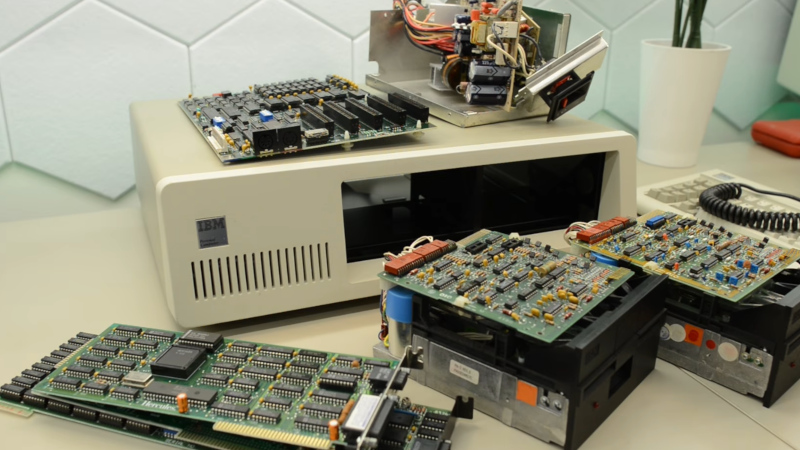
Now that early PCs have moved firmly from the realm of e-waste into being collector’s items, it’s worth putting in some effort to restore them if you find one. [Epictronics] has an early IBM 5150, the ancestor of all today’s PCs, and is bringing it back to life. Along the way, he’s building a replica AdLib sound card, making a useful discovery about how to make new parts look authentic.
The video below the break is a gentle journey through an early PC teardown, followed by the construction of the replica sound card. Here’s the interesting nugget of information: these new cards are careful recreations of the originals, but they just don’t look right. It seems modern soldermask is too shiny, and as luck would have it, there’s another option that is much more period-authentic. We hadn’t noticed matte green was available, but it certainly captures the look of those days much better.
As you might expect, such an old machine has a range of dead capacitors and a few chips. There’s a lucky escape with a Varta battery on an expansion card, having very little leakage, and part of one of the floppy drives needs some surgery. It’s gentle hacking that’s engaging to watch, and of course, at the end, we’re rewarded with the thing booting properly.
You might think reproducing a sound card is unusual, but we’ve seen it a number of times.












The EFT spoofer Windows 10 build I use has a feature to spoof my motherboard serial number.
This brings back memories! I bought an old 5150 from the university surplus sale in the early 90’s. The full-height 10M hard drive wouldn’t work unless it was installed upside down. I used it to run the Bad Sector BBS on Searchlight BBS software.
Loved watching this video. Brought back a lot of memories of working on my own computers in “the early days”. :-)
This brings back memories! In the early 90’s I bought a 5150 at the university surplus sale. The 10M hard drive had to be installed upside-down to make it work. I used it to run the Bad Sector BBS, lol.
An absolute miracle for cleaning corrosion from boards is, Oxalic acid. As found in cleaners like Barkeeper’s Friend. Wet the board, dip a wet brush into the powder, then scrub it in. Let it stand for as long as you like and it won’t remove anything but stuff that’s already compromised. Will not affect un-corroded solder or copper. Rinses off easily, even from underneath BGA chips. Leaves the metal parts clean enough to accept new solder as-is.
Thank You!!! Lately I’ve been justifying my interest/obsession with old hardware (particularly handhelds and “pocket computers”) by noting “this doesn’t track me”. It won’t do all the things my smartphone can do, and maybe not as well, but there isn’t an intense effort to find where I go and advertise to me when I do it. Other people may not ‘get’ the aesthetics or the tactile experience, or even the repairability, but everyone understand the need for privacy nowadays
But what kind of corrosion? I think oxalic acid is good to remove rust, but i’m unsure it is good for corrosion caused by leaking components.
I’ve read that since electrolytic capacitors are acidic, you need to neutralize leaks with a basic solution. At the opposite, batteries are leaking alkaline chemicals, so you can use acidic solution, like white vinegar, to neutralize these leaks.
However, i wonder if there’s a good method to help desoldering corroded components. Like in this video, i’ve noticed that corroded solder doesn’t takes heat very well and doesn’t melt well with new solder. And removing components is then very difficult. Does anybody has some good advices?
Flux
Yes, a cleaner with oxalic acid. I’m not just doing Internet Speculation here, offering up suggestions based on some Wiki article I just read 5 minutes ago, it works.You could always just try it instead of defaulting to Internet Contrarian mode – who knows, you may discover a better product or method than what I’ve found, and then share that, so that everybody keeps learning new things instead of a never-ending cycle of pissing matches.
You can solder or re-solder or de-solder after the oxalic acid just like if you were working with new parts. It eats away corrosion and any bits of the solder that’s gone crumbly, while not affecting any of the solder that isn’t already crumbly.
I’m sure there are some types/concentrations of oxalic acid that would eat right through a PCB and everything on it but the one I have experience with, whatever the ratio is in Barkeeper’s Friend, is very mild. While still absolutely destroying all the nasties. Hence, ‘miracle’.
According to its safety data sheet, Barkeeper’s Friend contains 7.5 to 9.5% of oxalic acid, and mostly feldspar (abrasive) and linear sodium dodecyl benzene sulfonate (detergent). Will try next time… Thanks.
Very clear diagnostic work, expertly explained, will now check out your other videos.
Nice to see a vintage IBM up and running !!
This also made me think that I need to dive into my large plastic bins and see what old cards I never threw away that someone else might treasure today. :-)