
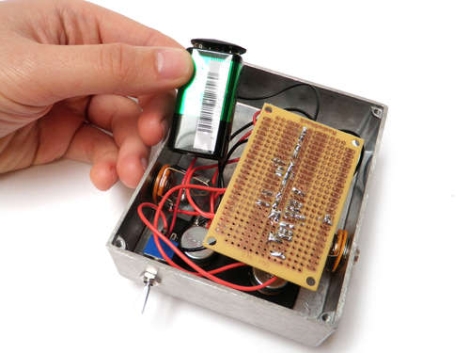
DIY Guitar Fuzz Pedal

diy_fuzz_pedal

Instructables user and Community Manager [Randy Sarafan] recently put together a tutorial on how to build an ages-old musical standard, the “Fuzz Pedal”. He says that the secret to rocking out is fuzz, so if you can handle both a soldering iron and a guitar, this project is for you.

When you take a close look, the pedal’s components are actually quite simple. The distortion is created by a pair of transistors, which in his case are vanilla NPNs from RadioShack. We have covered other distortion pedal builds before, and they have used germanium transistors to obtain a ‘creamier’ sound – you should be able to swap these cheap ones for uprated models with little trouble.

The handful of components were soldered neatly to a piece of perf board, and placed into a sturdy metal case that looks like it can withstand even the harshest abuse. He’s got schematics and a BOM in his writeup, so all that’s keeping you from a rocking weekend is a little bit of time and a soldering iron – what are you waiting for?

Stick around to see a quick video of [Randy’s] fuzz pedal being built.
Continue reading “DIY Guitar Fuzz Pedal”

Intermediate Concepts: Building Discrete Transistor Gates

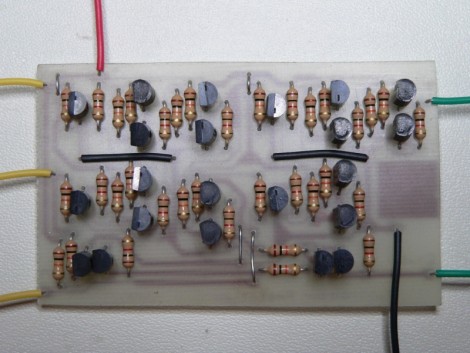
[Simon Inns] has put together a lesson in digital logic which shows you how to build your own gates using transistors. The image above is a full-adder that he fabricated, then combined with other full adders to create a 4-bit computer.

Don’t know what a full adder is? That’s exactly what his article is for, and will teach you about binary math and how it is calculated with hardware. There’s probably at least a week’s worth of studying in that one page which has been further distilled into the five-minute video after the break. Although building this hardware yourself is a wonderful way to learn, there’s a lot of room for error. You might consider building these circuits in a simulator program like Atanua, where you can work with logic gate symbols, using virtual buttons and LEDs as the outputs. Once you know what you’re doing with the simulator you’ll have much more confidence to start a physical build like the one [Simon] concocted.

Finding this project a little too advanced? Check out our Beginner Concepts articles to help get you up to speed.

Continue reading “Intermediate Concepts: Building Discrete Transistor Gates”









