Camera flash marquee: Real of Fake?

posted Jul 27th 2011 11:01am by
filed under: digital cameras hacks


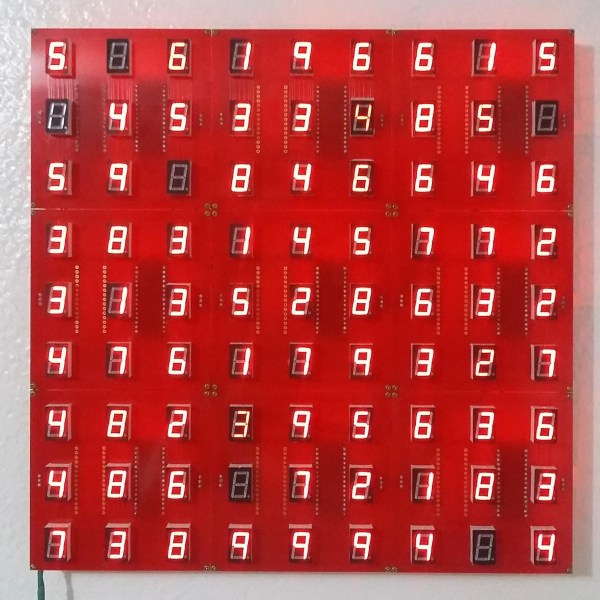
It’s time for everyone’s favorite comment thread game: Real or Fake? This week’s edition comes in from a tip that [Fabian] sent us about the music video Bright Siren by the band Androp. The video starts by showing bundles of cables being sorted and connected to breadboards. We get a brief shot of a large LED matrix (presumably being used for testing purposes) then footage of a lot of DSLR cameras with external flashes. These are mounted on racks to produce the marquee seen in the image above. The band performs in front of it for the rest of the video.

We’ve embedded the original video, as well as a ‘making of’ video after the break. There’s also a website you can checkout that lets you write your own message on the marquee. That bit could be easily done in flash so there’s no que, you’ll notice there’s no live feed. While we think the theory is real, we’re a bit skeptical about whether this performance is real or video editing magic. In the behind the scenes clip you can see breadboards attached to each camera flash with rubber bands so we’d guess that at least some of the hardware was setup. But we’re wondering if the animated effects were done in editing like that tea light animation. Let us know what you think by leaving a comment.

Music Video:

Making of:


104 Responses to Camera flash marquee: Real of Fake?

  • cde says:

    I’m not sure any flash can recharge and discharge at that rate (nearly 30fps). And that would be hell on batteries too.

  • Olivier says:

    Why ? Is it to show off they have a lot of money and they don’t know what to do with it (cameras aren’t needed, just the flash) ? Or is it to show they are bored ?
    Probably both.

  • bWare says:

    If this wasn’t a Canon advert why did they need the cameras?

  • Jfiliaul says:

    Deffinately real! NO QUESTION!

  • sm10sm20 says:

    I believe it to be both real and completely ridiculous.

  • HAD says:

    Calling fake on this one although with a fairly convincing setup. It just doesn’t feel quite right and it seems like they went out of their way to show that it was real but didn’t go out of their way to prove it – which means they were trying to lead you to believe that it was real when in fact it was not.

  • Paul says:

    parts are fake and parts are real.

    the fake ones are eaisly recognizable due to the terrible quality photograin that is repetitive looking (like a texture). This appears for most of the text.

    The real looking parts are stop motion captures of the flash I’d say.

  • sblowes says:

    Seems to be like that many flashes would be A LOT brighter, and would wash out the video camera filming the music video. Even one camera flash from the side usually completely washes out a single frame of video.

  • HAD says:

    The making of video seems to provide more evidence but 250 60D cameras at what, $3000 each would be $750k. They obviously appear to have quite a few people working on this project as well as a fairly large space….. I would put this down as plausible but we don’t know if those cameras are real and functional and we don’t know if the flashes aren’t just LEDs instead of real flashes.

  • WhiteCrane says:

    the interweb says
    “Their team was inspired by the track’s title and the lyric “not to make it a memory” and used the flashes of 250 Canon cameras to create light animation that appears throughout the film, intermittently illuminating the band’s performance on the stage. Like this recent clip for Bell, technology–Flash, openFrameworks and Arduino–helped to achieve dazzling effects without any postproduction. The video is also featured on a dedicated site, where viewers can pause the clip to see photos taken from the cameras during the shoot and can also create their own version of the clip with a special message.”

    So maybe real.

  • justDIY says:

    duration and repeat rate of those flashes seems suspect, my money is on fake, possibly a viral video advert for Canon?

  • PoisonWaffle says:

    My first thought was “Hell no, this isn’t real. This has gotta be another tea light animation…”

    After looking more closely, though, I’m impressed. Each flash lights up what is directly around and in front of it, and you can see the reflections from that on the camera/flash body in each ‘pixel’ of the wall of cameras. After doing a quick frame-by-frame examination, it looks like it’s at least somewhat legit.

    Any decent camera flash can strobe like that, very easily, at 50fps+ without a problem as long as it has power. Seeing that they’ve got everything hardwired in (note the huge power strips in the making of video), I’m pretty sure they’ve got plenty of available current to recharge the caps in those flashes.

    Also, they appear to be DIYer’s/hackers at heart, anyway. They’re geeky enough to specifically note that they’re using Arduinos and OpenFrameworks, so why couldn’t they figure the rest out, too? They’ve got the LED matrix built, and after that it’s as simple as wiring a relay for each pixel to a flash and setting it up.

    Canon may or may not have sponsored the video. TimeSliceFilms.com may have also supplied the cameras and shot the ‘bullet time’ scenes. Either way, it’s a pretty badass video, and I see no reason that it would have to be faked. It’d obviously be an expensive and somewhat complicated undertaking, but definitely possible.

  • Nathan says:

    there should be an epilepsy warning for this vid…

  • PoisonWaffle says:

    A Canon 60D with stock lens is ~$900USD. They’ve got huge boxes of them and most likely got a volume discount if they outright bought them. It’s also likely that they rented a large number of them (which is common practice for smaller-scale studios).

    I’d estimate that this video could be made for under $250k, and probably under $100k if most of the equipment could be rented instead of purchased.

  • hpux735 says:

    It’s an extremely convincing fake, if it is one. If it isn’t, they have more money than brains. Though @bWare is probably on to something. The “matrix” effect is super fake, though, because the virtual motion is on an arc and the cameras are on a plane.

    All that aside, the effect is amazing. I love the tiled video that makes a larger screen. Cool idea.

  • hboy007 says:

    the cameras look real to me – so what’s the point in faking the flashes? Reflections on the floor and on the lenses / bodies look ok, too. Besides, it is by far easier to fire the trigger than to replace the whole setup with cheaper flash units or do a photorealistic animation. The only thing that might be necessary is messing with the frame rate or pre-trigger flash sequence.

  • notmyfault2000 says:

    If they merely rented the cameras (and didn’t physically modify them) then that would drastically reduce the cost of this setup. The only thing I really have any question about is how quickly the camera can prep the flash to fire again. The rate at which they animated the thing seems doable. IDK where CDE got the 30FPS framerate, it seemed more like 10 or less with a short period of off time when they had an individual camera ‘on’ for 2 consecutive frames, giving the flash a chance to recharge.

  • PoisonWaffle says:

    After another quick look through it, I’m seeing even more evidence that says it’s real. Pause it on a frame where there’s a high rate of motion in the same direction. You can see the the dark spots where the flashes were illuminated in the previous frame. This is artifacting from the CCD in the camera that’s filming it.

    Also, hpux735, they’d have cameras mounted on tripods or on a multi-camera jig so they could all be fine-tuned to focus on the same central point for the ‘bullet time’ shots. That most likely was shot after the initial video and was edited in.

  • jeremiah says:

    It’s certainly possible with some modern professional flashes. They’re going about 7-9 fps or so, which is definitely doable. Short bulb-life, though, I think.

    My bet is on LEDs, fashioned inside flash housings. the wiring is to allow them to be controlled via a single computer.

    Music video budgets would certainly allow all the real gear to be purchased, then modified, but using actual flashes would be troublesome due to flash bulb failure. LEDs are far more reliable, and can be made to look just as bright.

    It’s likely that it’s very real, but done with LEDs. the slo-mo shots, in particular, make me believe that they’re using LEDs.

  • Luke says:

    Looks real to me, and yes, high quality flashes can recharge and discharge that quickly. Especially if they are set to lower power (like 1/128th). Though not sure why they have lenses and cameras to go with it? My guess is some of the cameras and lenses are either lower quality or just dummies.

  • macona says:

    I cant tell for sure, but it looks like they are using the Canon 580EXII flash which has a recycle time as low as .1 second.

    Set the flash to low power, fully manual and it should be possible. Also low power settings have a longer flash period than high power settings.

  • pascal says:

    Maybe they are being sponsored by Canon… the video does go out of its way to show that it’s the 60D, Canon flashes and the kit lens. Although it has been out quite a while…

    Can’t the flashes be tuned down anyways? You don’t need that much light from each individual flash, and even in 1080p the picture is a bit blurry, maybe it was filmed with high ISO…

    It would be much more complicated to film the stopmotion individually and then have the band perform alone while recreating the lighting…

  • Chris says:

    While the marquee could be real, those camera flashes are not. They probably swapped the flash bulbs with traditional bulbs and are driving them via the cables. The cameras were probably gutted so that the wires connect directly to the hot-shoe.

  • Shadyman says:

    I’m with PoisonWaffle in saying “real”… Flashes can have insane recharge rates at low power.

    Maybe the cameras/flashes are rentals? I wonder how much that’d run for a day of renting.

  • Lee says:

    If you visit the website you can see the time-coded photos the cameras “actually” took. Seeing as it’d be a pain in the ass to try to make this look “real” I think it’s real. The LED breadboard was probably a small scale sample to see what the animation would look like, and then later they wired the cameras to be triggered based on the LED’s. If a flash can recover that fast and they did the legwork with the breadboard, I’m not sure why they’d go through all the rest of the trouble to make it look real if it’s fake.

  • Ryan says:

    This is plausible from a technology standpoint. The cannon speedlites in this video have a recycle time of 0.1s at lowest power.

    Nothing in the video exceeds that capability and low power would explain the exposure not getting completely fucked.

  • ferdie says:

    its real i think
    or is a viral or reclame for cannon
    but why bye 250 camera,s when you only need a flash
    a stroboscoop is cheaper to use i think

  • LOL says:

    Are this faulty 60D ? or something :D ?

  • LOL says:

    And there is a lot of analog cameras !

  • wildzbill says:

    Probably real.
    Who says they bought or rented the cameras? They knew someone that is a distributor, sales are slow, cameras are sitting in a warehouse. They use them, repackage, and sell them later at full price.
    Electronics on breadboards? Too expensive, unless you ‘borrow’ everything for the weekend and put it back when you are done.
    Total cost? Maybe a party for everyone involved.

  • NastyNinjaBear says:

    Seems to me to be real. All they would have to do is contact a Canon rep and I bet anything acquiring that many cameras was EASY considering they clearly show the Canon logo in the video. Product placement is money.

    Anyway, the cameras should have the capability…The hardware should be pretty straightforward using the remote control buttons for pictures. External flash can easily handle that speed of strobe.

    The only two suspect parts are when it goes from 1 marque to like 12 in a huge display…im positive that was just edited…. also…I notice there arent any hard shadows on the ground in front of the band members…
    I dont know much about light dynamics and shadowing so they could just be overpowered by all the angles or something but still, id expect to see some shadows.

    In any case, totally plauseable and I think its 95% real.

  • Scott says:

    Not sure if those flashes can work at such a rate, as stated above, this would be super expensive unless they have some kind of Canon sponsorship in which case it is just an advert. I have to call fake on this one.

  • macona says:

    No, distributors wont have cameras in 5 packs and then they cant sell them as new.

    Canon does give quantity discounts. We have 50 5DMarkIIs at work.

  • David says:

    I agree it is probably a gutted flash, perhaps camera. Not all cameras are 60D’s, and not all flashes are the same, many not even the EX series (maybe not even canon). Given the difference in power from the various flashes as well as different recycle profiles and reflector specifications, to try to match the output of everything by means of control would be daunting at best.

    Beyond recycle times, the burn time of each is silly long in some cases, even if you try to argue matching to the frame rate, not possible. As well, on low power, the flash durations of speedlites is shorter than the scan time of teh video camera. So even if you could match 30, 40 60 fps, that does not mean the ENTIRE frame of each would subject to captruing the flash.

    My call is fake, in so much as it is not as it seems.

  • bigbob says:

    Interesting concept. The song kinda sucks though, and an arduino, really? Can’t people try just a little bit and learn to use microcontrollers like adults instead of children or “artists” that can’t possibly grasp programming an avr in C supposedly…

  • Joegeek says:

    Fake or not it’s a cool effect for a video shoot. Food for thought. Please keep in mind if anyone wants to implement an effect into a live concert it can be problematic to the audience. In my case, I experienced it first hand. It was dark and the lighting was great up to the point where the audience was being flashed. Our pupils were in a relaxed large state. Then we started getting flashed by the lights from on top center stage. We we getting blinded and it distracted us from enjoying the band because we had to block the flood lights with our hands. I am very surprised they didn’t notice the first 12 rows were all looking away from the spotlights. As for using this in a Video shoot – It’s an awesome effect that projects an original look. A great way to breakout their video from the rest. Really impressive to me is how many cameras were collected to make the video. I can see some poor soul standing in line at Walmart returns with two shopping carts of cameras :-P hehehe jk

    TY for sharing

  • woutervddn says:

    Please tell they are giving away those cameras as we speak? :p a simple flash would have saved them a lot of money,..

    Although I want to know the “Why?” about this..

  • Anonymous says:

    Partly fake.
    @1:24
    A flash can’t reload that quit (instant)

  • Nikos says:

    If you take a look on their website they provide lot of pics from the shootings. i dont say that is definitively real but I think its real.

  • Baghdad_boy says:

    I would say FAKE. In the first video at 1:25 the flash on most cameras stay on for like 4 or 5 seconds. Camera flashs can’t stay on for that long as far as I know. It’s a quick burst and that’s it.

    My 2 cents

  • BadHaddy says:

    I’m going for real. The flashes are eTTL compatible, and they are probably just kicking off the lower power AF-Assist rather than a full flash.

  • me. says:

    I’m with all those that say that it is partially fake. Did anyone else check out the website? (http://www.androp.jp/brightsiren/)
    If you go there, you can get your own message displayed during the video. Of course, you get only the “flashes” without any band members. But it looks a lot like the stuff that’s going on in the background of the video.
    Given that they implemented that just for fun on their website, I believe, that they are also able to do something like that in AfterEffects/Vegas/Premiere in a convincing way.
    So not completely fake. But fake.

  • Kyle says:

    I think it’s fake. Some of those flashes stay on way too long to convince me it’s real. The flashes also seem to have a gradual brightening that looks more like an LED, which can be seen in the slow-motion scenes.
    The effort gone into the synchronizing seems to be real, but I’d bet the flash bulbs were replaced with LEDs.

  • mad_max says:

    I’m less intrigued by the cameras than I am that this song starts of in 9/4 time.

  • Kyle says:

    @BadHaddy: “they are probably just kicking off the lower power AF-Assist rather than a full flash”

    Good observation. I agree, this could be the case that would make this all real.

  • Drackar says:

    I’d say it’s possible.
    The strobes are not putting out much light. On full power, that many strobes would over-power the cameras they are using to film…that entire stage would be washed out for the flash. Instead there are these thin bands of light…reasonable, for the lowest power setting.
    I have a $50ish YN-460. Lowest power setting, I can fire 19 low power flashes in a row, as quick as I can hit the button. The longest repeat of strobe fires I counted was somewhere in the 20 fire range…a better strobe could pull that off, easily.

    For most of the video, there are a minimum of three-five camera with intervals between the scrolling wall…three-five fires, three-five intervals to recharge the capacitors, which, for a low power burst, doesn’t take long…less than a second or two.

    Possible. The hardest part would be wiring it all up to something to control it…the strobes themselves are no problem.

  • Piotrek says:

    It is fake. There are white LEDs attached in front of every flash. Thats why light has round shape (flash shape is more or less rectangle, not circle).
    Look at the 2:53 on video – it,s clear to see :)

  • bbepeefencer says:

    They are doing it the hard way but it looks real to me. I used to work for a lighting company Highend systems and they make a strobe system called dataflash http://www.highend.com/products/effects/dataflashaf1000.asp It does the same thing but using DMX512 digitally addressable and dimable.

  • Dgent says:

    100K + for a music video is a lot these days. I can say for sure that this was a canon sponsored video and the total budget was prolly only like 20-30k. With the cameras provided of course…. You don’t go out of your way to show product shots like that just for kicks…

    As for if it was the real flashes??? idk looks like they mighta slowed up the shutter speed on some of the shots so that the individual flashes would bleed over frames a bit more to make it feel more like a consistant light. It was for sure not digitally added light, Just look at the drum set to see thats legit.

  • Chris McDonald says:

    Most of the shots are real.

    I’m wondering if they synced to the camera’s shutter, some shots it looks like its in sync other shots it appears to be drifting out of sync.

    As for it being too bright, or not looking bright enough, that all comes down to the camera’s aperture, shutter speed, film ISO or gain and what filters are used. I would have shot it alittle brighter looking to milk that camera flash look. It looks more like LED’s in this video than camera flashes.

  • spiderwebby says:

    I’d say it’s real. Or at least it’s possible.
    one of the photography students at school had a flash unit like those in the video, which could fire at at least 30Hz for about 5 seconds and be bright enough to annoy everybody in the room.

    surely someone just needs to dig out the spec’s on cannon flash units…

  • WestfW says:

    I’m with the “LEDs replacing the actual flashes” (at best) camp. Flash duration is too long for an actual strobe (and getting video synced of a strobe tube is hard.)
    > high quality flashes can recharge and discharge that quickly.
    Perhaps. But can they be triggered at that rate through the camera? (Of course, they could just be using the cameras as particularly expensive flash mounts. +1 to the comments about the camera+flash setup being extremely wasteful.)
    I don’t know about low power being dim enough to create the video as seen. At 4:00 we see a band member with an actual camera behaving and looking more like I’d expect from an actual flash.

  • Zombiefredrik says:

    Regarding price of cameras it says “camera support: Canon Marketing Japan Inc” in the youtube info along with more information … I say real.

  • StrangeRover says:

    When I saw the photo at top, I thought, “That’s got to be the flashiest invitation to a bris I’ve ever seen.” Mazel Tov!

  • DivePeak says:

    The flashes have a strobe mode, allowing for the “way too long for a flash” parts. As mentioned by many others, at low power these units can recycle very quickly.

    Why use the cameras instead of just flash? Because it’s probably cheaper and easier to hack a remote trigger cable than to hack a hotshoe (and still have working/undamaged equipment to return to the place where you hired them from).

  • DivePeak says:

    Leave the lens cap on, and send the camera a “focus” signal. You’ll get high speed, low power strobe for up to a second.

  • M4CGYV3R says:

    100% real. They even showed how they control it. I know for a fact that there are flashes that can stay on indefinitely, in a very rapid strobe, with essentially zero recharge time. They can also be dimmed considerably, and there are control/trigger signals that the flash and camera can receive.

    Personally, I believe they just set the cameras to take pictures when triggered remotely, and that every flash you see has an accompanying picture. Otherwise, I feel like it wouldn’t have been worth the cost to buy that many cameras, even as decoration.

    There are some parts that are obviously edited together, such as the four-story dancing guitarist animation, but the electronics are completely valid and there would be no reason to fake anything.

  • Graham says:

    It makes sense that people here are thinking more like engineers and not like artists: it’s music (art) and video (art). Having all those cameras is artistic and a great hack.

    Sure they could have done it with a mish-mash of different camera’s but why wouldn’t someone pitch the idea to a camera company to sponsor it.

  • Dean W says:

    I’d love to see the result of chucking all them images into autostitch to make a HOOOOGE panorama

    10 tall by 25 high 60D’s would make a lovely
    34,560 x 129,600 Pixel image of the band from behind!

    anyone know any hardware capable of playing 4.5 Terapixel HD video? :-P

  • Az says:

    Quite well done, I’m going to say that it looks legitimately enough put together.
    To the folk saying that the shots from the camera seem off, consider the field of view of each individual camera will change considerably across the range of that wall/shelf. Like an exaggerated effect of how your eyes see two separate points, enabling you to see “3d”.
    On that note, how many “D” can this be considered to shoot in?

  • kak says:

    let all not forget how fast a strobe light can flash. Based on any mods that could be done to trade brightness for speed, I say that a strobe marquee is entirely plausible. Is this one REAL? we will find out.

  • roy says:

    and i think flashes should have looked square because the opening for the bulb was square and yet they are perfectly circular and the light from so many flash bulbs would definitely destroy a cameras light balancing or contrast or blind it completely

  • Bill Bohan says:

    I’m almost sure this is real. Unless they’re fake, those cameras are worth a lot of money; fans would probably be willing to pay double MSRP to get one. I saw enough hardware shown to accomplish what it purports to be. They had the equipment, it looks like they did it.

  • WestfW says:

    The 580EXII manual does say it has “stobe capability” at up to 100+ fps.

  • Valen says:

    I’m calling fake,
    using LED’s not cameras with just enough cameras for the “setup” to seem real, also doing a few runs, some with a few real cameras taking shots to provide the “bullet time” shots and such which look way more exposed than the regular video. And others with the LED’s going to provide the videos

  • Paul says:

    if you watch just the animation you start to get a hint at what is really going on. Do the flashes make the graphics…oh yes, are they stock flashes, possible, but not necessary. If they are stock flashes then, the boards on the back of each flash make sense. They are NOT flashing in real time and each frame is based on the real time refresh of the flash. However if they gutted the flashes you no longer have a flash but a strobe which can refresh fast but would need external timers and addressing to do the marque.

  • Az says:

    Dean: Entertaining though that idea is, I shudder to imagine trying to correct the perspective shift over such a large area for a subject that’s so close. I do plenty of panorama work myself as a hobby, and most of that time is spent fixing perspective shift for my camera on a tripod over the course of three or four frames, nevermind how many this is.
    Anything above fifty or so images in a panorama and you’re looking at at least a couple hours of realigning, unless you’ve gone to lengths to find your no-parallax-point for your lens.

  • Thiago Naves says:

    I think the cameras are real, but its not the flashes we see. First, I think it would be much brighter, also I don’t know if a flash can fire that fast. The batteries would be a problem, but they show a bunch of AC plugs with means they are probably not using batteries. I don’t think they bought the cameras, they are either rent or models. Also, if you look at the flashes at 2:51 ~ 2:53 you can see 2 black lines comming from the sides, wich suggests they put white LEDs in front of the flashes, and those are the lights we see. This explains both the brigthness and the fire rate.

  • WestfW says:

    So does anyone have a canon camera and flash they can experiment with to see what sort of effects you can get via the remote control inputs? Real data trumps speculation! (and this would be the sort of thing an Arduino excels at; a quick proof of concept/test for something that you don’t really want to spend time building much custom HW for.)

  • nitemarez says:

    maybe fake simply because:

    - at 00:12 we can see that the flashes were rectangular, so when in action, they’d give a wide oval flash
    - at 3:55, we see that the flashes in action and all were a pretty perfect round white glow.

    Most probably they’re some kind of bright LED based lights or something..

  • Rob says:

    If this is real, whatever flash they are using that has that amazing of a refresh time, I want! Mine is horrible in comparison.

    I’m gonna say fake. As I know with my flash, sometimes it refreshes fast, but there are several times where I have to wait before the next one is ready.

  • OA says:

    If you pause the first video at 0:14 you’ll notice those flashes are all different.
    Another problem; if the cameras are shooting every time the flashes go off they’d have to be shooting at a much higher fps than low end Canons are capable of. If they aren’t synced and only the flashes are firing then how did they do the bullet time video?

  • RemBrand says:

    Technically doable. As said, when hard-wired proper flashes should be capable of strobing like this. Financially I would have gone for just a flash without the canon bodies but ok. I you have enough cash to and want to show it off, it could be real.

  • me says:

    i’m thinking they’re using a LED in front of the flash. look at the making of video at around :25 and you can see a wire going to the front of the flash.

  • Max says:

    I think it is real, but the flashs are LED ones (like in mobile phones) and not those with a xenon tube in it (pause the vid & look, they’re a circle and not a line…

  • Garbz says:

    @rob Are you sure?

    I would be able to quite comfortably set mine to strobe at min power and then set it off at what looks like well below 20 fps.

    The most common application for flash requires the illumination of a subject. Conversely lighting up a bulb just enough to see it come out in a video requires next to no power. Remember flash power is measured in hundreds of WattSeconds. How many watts are required to light up a filament enough so a video camera can see it?

    The video obviously has computer editing, but I call the concept of the flash strobing marquee real.

  • cutandpaste says:

    Response:

    1. OMG! Too fast!

    Strobes can recycle very fast, indeed. It’s just a matter of charging, duration, and intensity. (RC time constant, Mr. Kelvin, Mr. Ohm, Mr. Watt, et al.)

    (Whether these particular strobes can do this, I don’t know. Let us debate that instead.)

    2. OMG! Too dim!

    Modern camera strobes can be turned down in intensity. Filters can be added to video cameras. Exposures can be adjusted. The overall “look” of the video has nothing to do with whatever it is that is making the video happen, and everything to do with creative intent. Video cameras can take pictures of the friggin’ SUN — a wall of camera strobes is meh in comparison.

    3. OMG! Too expensive! Must be fake!

    Have you priced a music video lately? How about a set full of “ordinary” lighting and rigging? A few hundred SLRs with flashes sounds like a fairly cheap 2-day rental, to me — especially without needing to do any other set-work.

    But whatever the case, money is a management problem — not a technical one — and it’s already spent.

    4. OMG! It must be LEDs, because there were LEDs in the first few seconds!

    Of course there were. Would you finance a project like this if you -couldn’t- visually predict what patterns the geeks had in mind? LEDs are an easy way to see things.

    5. OMG! Why use camera bodies? Why not just use strobes? OMG, so complex my brain hurts from the inefficiency!

    Because it looks cool. Maybe not to you, and maybe not to me. But to someone. If they just wanted to use strobes without the visual effect of having cameras, there’s a myriad of professional strobes which can produce anything from brief intense flashes to constant blinding white light (given human persistence of vision), which are very rentable in quantity for stagecraft.

    The whole point of a visual exercise such as a music video is to produce the desired look. (Why is this a foreign concept?)

    6. It’s fake because there’s a flash animation on their website that lets you “display” whatever words in that you want to using their “strobes”! OMG! Anyone can make this!

    Yeah, there is a widget on their website. It shows one letter at a time. How many letters are there, exactly? How long do you think it took to photograph each of them and convert it into a customizable flash animation? I had cooler tricks than that on my CGA-equipped XT in 1987.

    (Is this comment too negative for the new HaD? We’ll see!)

  • David says:

    Lets assume for a second the 580EXII could do this (even though it can not). Not all of the flashes are 580EXII’s. Some are very old flashes from the 70′s or 80′s. Quite possibly (probably) without any TTL communication, no focus assist, no “model light” function, no HSS, etc. One pop at a power setting you choose, then up to 10-15 sec to recycle, on batteries or AC. Lower power will decrease recycle time, but will also yield faster flash duration which is harder/impossible to catch on an entire frame of video.

    I can see this being plausible in a still frame. I can see plausibility of it being possible to the human eye (if all flashes were the same and newer). But video cameras do not see the same as the human eye.

    The video is cool, I even like the song. but it is not straight camera flash.

  • Andrew says:

    I’m going with real-ish.

    I think the strobing animation really was done on the camera flashes. (Which is wicked awesome) based on this other video they have linked off the end of the making of: http://www.youtube.com/watch?v=9ycl8DJZUOw

    But, again, based on that other video, I don’t think the band performed in front of it. Thinking it was quite possibly recorded at a different frame rate (addressing earlier noted concerns about recharge rate) and then composited with the band performing.

    As for the concerns about “why have all the cameras if you just need the flash?” my guess: product placement. It’s been showing up more and more in music videos over the last 5 years and I wouldn’t be surprised at all if Canon payed a placement fee and supplied the equipment. Especially with that camera vanity shot right near the beginning.

  • Adam says:

    That looks extremely fake to me, I noticed that there was no glare from the camera flashes, they didn’t momentarily blind the filming camera, which seems strange to me.

  • Arjan says:

    I doubt this is all done real-time, with the stock equipment the are showing to be using. I find the flash duration suspect, the flash-on time seems to be too long on some moments. I’m not a Canon user, but I have a Nikon SB-800 speedlight which is I guess is at least somewhat comparable with the EX580. At full power the flash lasts only 1/1000th of a second with this unit. At 1/128th power, the flash duration is reduced to a mere 1/40,000th! It also supports a sort of fast burst mode for 2-3 seconds in which is looks almost like a flash light. However, the intensity during that burst fluctuates quite a bit. I have honestly no idea how this would register on a video camera but around 3:55 in the clip when they show the slow-motion close-ups of the bandmembers, the ‘flashes’ seem te be ‘on’ for quite a while. For instance the moment when the singer closes his mouth again. No way that those flashes on the background lasts only 1/1000th of a second or produce such solid light when ‘bursting’.

  • Alan Parekh says:

    Looks real to me. Nothing is over the top for a production piece except possibly the cost of all the cameras and flashes. However how much of their value is gone from a few days of shooting? I wonder if Canon sponsored the shoot? We might see a huge supply of refurbished Canon gear on the market soon!

  • Cold_Turkey says:

    I vote fake. The animations are definitely real but as a few have mentioned the flash would be far too bright for the camera to see anything and the animations run too smoothly as the ‘flashes’ seem to be on longer than not. I think every lamp has been replaced with an LED. Looks good though!

  • Mark says:

    Totally real. Look at the floor reflections.
    No problem with low power flash or recovery time – all that is needed for the camera to see them.

    clearly completely real.. wonderful job – hats off to them. Great idea – well executed. 10 points for Gryffindor

  • I assumed they were using flashes with modeling lights (lower-intensity continuous lights you can use to predict where your shadows will be). I think using the actual flash bits would be pretty close to impossible in the video.

  • basroil says:

    As a photographer with access to those types of flashes, I can assure you it’s perfectly possible with two methods.

    First method:
    Single “shot” at high frequency. At lowest power (all you need, these things are bright), you should be able to get off maybe 15 frames before recharge and overheat issues happen (more with the newest generation). Perfect for video if you sync it to a 180 degree shutter. Actually very easy to charliplex to a large number of strobes, since all you need to do is pull down the voltage.

    Second method:
    Use the above with high speed sync, but with a 1/4s shutter speed on camera (actually have camera take a photo). Lowers resolution, but removes the 180 degree shutter requirement. Will only work for maybe 5 times before you need more time to cool the flash.

    Now, it’s likely done either with an actual strobe system, or cgi, but it’s entirely possible to do a hardware version, especially with method 1. It’ll be expensive though, rental of that many flashes alone will be $2000 or so, more like $3000 with the custom boards for multiplexing. Then again, that’s absolutely nothing compared to the cost of cgi for a music video, so sure, it’s probably real.

  • Steve says:

    Real. (or at least for most of the video)

    It appears they just made the flashes trigger on their lowest setting (prob 1/64). This would keep the flash from washing out the video and allow the flash unit to recharge in a very short period.

    I wouldn’t be surprised if Duracell tried to use that as a battery commercial. :)

  • PoisonWaffle says:

    DivePeak, great experiment! The only thing I could think to add to it would be the possibility of AC adapters making things even simpler.

    Agreed, totally plausible. Actually, not only plausible, but probable.

  • Mike says:

    It’s a combo of real pulses and “fake” pulses from some kind of supplementary lamp in a similar position or possibly in the same housing, but the rig and setup could easily be real.
    - Camera body: totally unneeded for this (I call viral ad like many others)
    - The “fake bit” there are a number of sustained flashes that are too long and clear to be multiple strobe pulses appearing to be one long flash.
    - The most damning bit is the time between flashes. After a long string of pulses the capacitors will take much longer to cycle. Even the best “pro” grade strobe would not be able to keep up with this pace.

    In any case, rather cool looking.

  • Willegeek says:

    Those are for sure 10w LEDs @ 2:53 every flash except the one in the center camera has a 10w LED in it (look on ebay for 10w leds to see the ones I’m talking about) So while they may not have used original hardware it is still impressive and I really like the concept.

  • Greeeg says:

    Looking at the site, if you watch the video they show you the photos that were taken during every flash.
    There is of course a bit of editing that has gone into that music video however I do believe that the camera wall was real.

  • henry says:

    i vote fake, probably used 10 cameras and did the rest.

    Either way its an incredibly stupid waste of money. Alot of flashes have an override button, which you can easily rewire without the camera and have the same effect.

  • andar_b says:

    THEY WANTED THE CAMERAS FOR THEIR OWN SAKE PEOPLE! lol I don’t understand the lyrics, but even if they used some other sort of strobe, they’d have to fake the cameras anyway. The pictures floating around near the end show that much.

    For some reason, it reminds me of “Who Needs Pictures”

    I loved the multiple screen effect near the end, where they made a matrix of several streams of video to make the flash matrix look even bigger. That was the coolest part of the video.

  • Anartech Systems says:

    Is it not possible the flash tubes were replaced with high intensity LEDs and parabolas before the shoot? While I only skimmed the comments so far and someone else may have said it, surely this is the only way you’d get those refresh rates? And those lights don’t seem to have the conventional rectangular pattern you see with a tube flash.

  • bob says:

    As mentioned early in the thread, parts are real, parts are fake.

    It looks like they only have about a dozen of the cameras actually functioning to make the stop motion photography and give the impression of real cameras via the obvious reflection from the ground.

    The rest of the cameras could be there, but are not being used in the video, just props. Anyways, why would they use hundreds of real DSLR’s if they are going to shoot the freaking video in the dark?

    I don’t know how this is even a real topic of debate. Kudos to anyone who would invest in, or borrow, that many DSLR’s and then use a CGI rocker guy to close out the video.

  • Philip Albertsson says:

    Those bigger photo flashes CAN recharge that fast. They do not reach the maximum output, but they can be triggered very fast if you set the brightness (or whatever it’s called, can’t remember) to minimum. By doing that they also pull much less current from the batteries. So i have to call this real. I can’t see what should be fake…

  • Vignesh says:

    Okay, Good!…but why the Camera ? they wanted flash to sync with the LED matrix, so best would be to use just the flash unit.
    ..and about flash recharge rate ? that can be fixed, with High current battery source, but ..why the Canon SLR Camera ?? stupid! and waste of money, instead they could have placed the camera around the band and top also and combined/stich the image to create a cool effect.

  • Leave a Reply

    XHTML: You can use these tags: <a href="" title="" rel=""> <abbr title=""> <acronym title=""> <b> <blockquote cite=""> <cite> <code> <pre> <del datetime=""> <em> <i> <q cite=""> <strike> <strong>

    Hack a Day serves up fresh hacks each day, every day from around the web as well as hacking related news.

    Send us your hacks


    Hacks

    Resources