
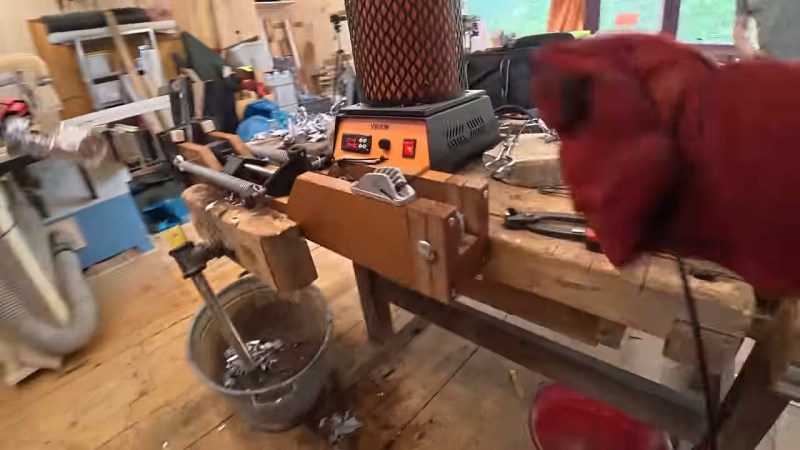
You don’t normally think of die casting as something to do at home. Pressurized fluids demand respect at all times, which is perhaps in part why we see most projects skipping hydraulics for linear actuators. When the pressurized fluid is molten metal? Well, we’d say don’t try this at home, except that’s exactly what this video by [Know Art] is making us want to do. He’s doing die-cast aluminum, and it looks way easier than we thought it would.
If you’re wondering why anyone would attempt such a thing, it’s for the same reason die-casting has been an industrial powerhouse for the last couple hundred years — you can crank out a lot of parts, very quickly, with excellent detail and dimensional stability. You just need a mold, which in this process is called a die, and a way to squeeze metal into it with some force.
In this case the die was carved on a desktop CNC machine. Depending on how long you want your die to last, you’ll need something hard and heat resistant, like the graphite used in this video. Graphite is also used in constructing the piston for the injector, which is made from a modified hydraulic cylinder and a couple of old trampoline springs.
He first tests the setup with molten wax before moving onto aluminum, as the process is the same regardless: pour the hot liquid in, release the springs to provide the pressure that forces it into the die, and a part is made. It looks easy, if a bit frantic, as you have to work fast before the metal cools in the cylinder.
After CNC milling, EDM machining and all the fun things we’ve learned how to do with lasers and 3D printers, and now this we’ve got to wonder– is there any industrial process you can’t hack onto your desktop? We’ve even seen the chemists get in on the game.
Thanks to [Keith Olson] for the tip!












I once saw an aluminum die casting system that used a heated block of inconel 625 with a hole bored in it to melt and inject aluminum into molds. They would load a slug of aluminum into the cylinder, apply vacuum, heat to melt, then inject their mold a couple of dozen times before reloading.
After seeing molten aluminium in a shed, I wonder how long until shed goes on fire.
My uncle did professional casting in a shed outside of his for over 50 years, literally until the day he died, without ever starting a fire. The only problem he ever had was when some idiot launched fireworks that landed on the roof of said shed, but we managed to put that out by throwing a cooler full of melted ice from the 3rd floor of the main house.
By that sort of argument you could wonder how long till the shed catches fire because its a petrol lawnmower or the school burns down for doing the odd chemistry demonstration etc. There are risks to everything, but as long as you know what they are and act sensibly…
In this case its a rather small scale of operation, and the risks to the building beyond any normal electrical fault fire only happen while you are actively there. The scale means that even in worst case there won’t be enough molten Aluminium to do much – char the floor, maybe a small fire than can be relatively easily contained – after all you are actively there and its only a few hundred grams of molten metal that will cool rather rapidly! It can mess you up really easily, but only if you were stupid enough to do this process with a floor covered in sawdust and oily rags that only need a little push to burn vigorously (or even explode) is the building at much risk.
Its probably safer (for the building) than a FDM 3d printer you leave running unattended for days, as if one of those goes a bit wrong its reasonable to have a continuous source of high heat still actively pumping in more and more energy till the fire is really started enough to destroy your wiring and cut it off…
Well, you could put it out a few billion years until the shed (and the whole earth) is consumed by the fires of the sun.
My worries come from seeing molten aluminium being thrown away in all directions from the mold when injection was done. I have no idea what combustibles are in the shed, but if one spread of molten aluminium starts several fires in several locations, the place could be (partialy) destroyed.
The aluminium dropplets might be small enough to lose enough heat to the surrounding air during flight to become to cool to start a fire, but is not safe for my p.o.v..
Now, for me, it would be safer if the aluminium is pushed down and the mould is kept in a barrel half filled with sand (so all extra aluminium lands in the sand after hitting the thick barrel walls).
Seems to me the only real occasion of throwing stuff around was the test with wax, little bit around the fill funnel before figuring a better method out but not very much or much energy throwing it around in that case.
I do agree you could do a little more (and I certainly would, at least for the first tests as I always tend to paranoid assuming absolute worst case till the process is rather proven. Also really really not interested in creating more work for myself fixing the damage). But you really don’t need to worry that much with the tiny spatter bits – keep a clean not highly combustible shop and they will not have the energy, quite possibly not even enough to char the surface of dry solid wood.
We’ve all seen worse in the home casting youtube community.
Worst I’ve seen was:
(Redneck/southern gentleman) pouring a casting under the eves of his house (where the ant nest was).
In sneakers and overalls.
Interrupted by his toddler coming into frame for a second.
Him chasing her off while yelling at his wife.
Dropping and forgetting the crucible.
Seems the safer alternative is 3D printing metal powders.
Except that die casting is very geometry limited, and more suited to printing a large number of identical parts. Where 3d printing metal powders allows more complicated geometry while being more suited to printing unique iterations of parts.
Not sure you can really call super fine metal powders safer than casting molten metal – the risks are different but you really need to treat both with the right level of respect as there are plenty of dangers to both. Though given the dangers of 3d printing in metal powders are much less clearly visible and obviously an immediate danger I’d suggest in practice it might actually be the more dangerous of the two.
And as WHA? says they really are better for different tasks – the only reasons to 3d print something beyond that tiny prototype run over die casting would be the geometry can’t easily be cast or the material properties required mandate a metal that doesn’t cast well but can be printed.