
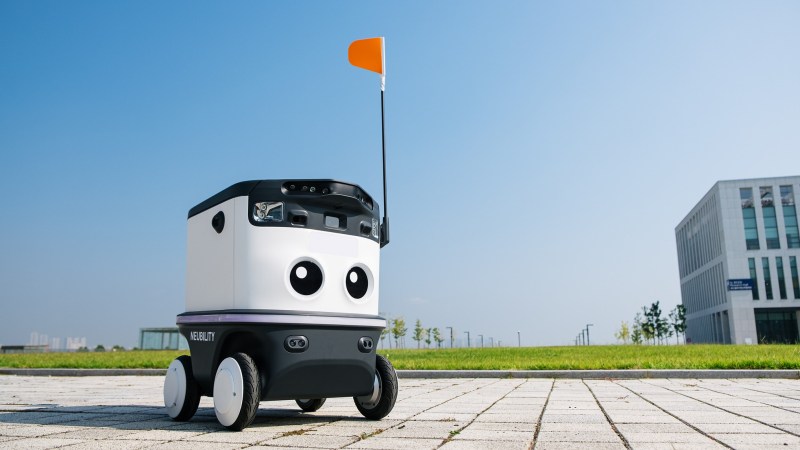
While online shopping was already very popular in South Korea, it has become even more so as people stay home more during the pandemic. Several robotic delivery services have launched around the city, such as 7-Eleven using the Neubie robot by Neubility, the GS25 convenience store using LG’s CLOi ServeBot, and the Baemin food delivery service using the Delidrive robot.
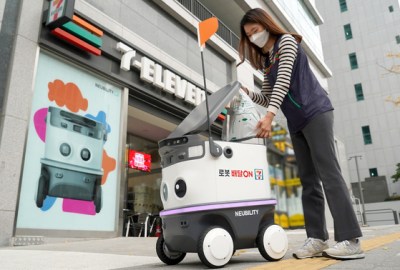
Love it or hate it, in the dense population of big cities like Seoul the vast majority of people live in apartment complexes. This lends itself well to these robot delivery projects. In fact, many of these pilot projects are only available in one apartment complex, which can consist of ten to twenty 15+ story buildings. Training your robot to navigate the sidewalks, operating the doors, calling the elevators, and buzzing the customer’s home intercom is an easier task when dealing with only one campus.
Some projects are more ambitious, like another Neubility system operating on the Yonsei University Songdo City campus. You can order fried chicken and have it delivered by a Neubie robot, which comes to your address along the sidewalk at a brisk 5 to 6 km/h. There are some issues, however. First of all, government regulations haven’t quite kept up with the technology. These services are basically operating case-by-case, temporary waiver basis. They are not allowed to operate on the streets, and when driving on the sidewalks they have to avoid bumping into people.
We wrote about a prototype RC truck delivery system last year, and covered Amazon drones and Automating Freight Delivery as well. These all show promise, but are not mainstream yet. The vast majority of your orders are still delivered by a person. Will these automated delivery services eventually replace humans? Let us know your thoughts in the comments below.












https://www.youtube.com/watch?v=pi4jZKqZ8v8 We’ve been doing this (and sending videos and schematics to HaD!) since 2010, by the way. Remember us? https://www.robots-everywhere.com/re_wiki/pub/web/Main.HomePage.html
https://www.robots-everywhere.com/re_wiki/pub/web/Main.HomePage.html We’ve been doing this (and sharing schematics/firmware, and sending video to HaD) since 2010. Can we get mentioned in the article, please?
Just a heads up, all the images in your cookbook section are dead. Hopefully you have all those schematics backed up.
Heh that’s what I get for not hosting on my own box….
I want food delivered by pneumatic tube right to my table! Imagine a network of a series of tubes. Make it so!
I want it delivered straight to my throat.
Not pneumatic but it does use a series of tubes:
https://www.youtube.com/watch?v=BD1HusIXOPc
Tubes, or (rhymes with tubes)?
B^)
Not yet ready for winter: https://v.ylilauta.org/f3/7c/f37ca83750a42c18.mp4
Problems like that is why these fool things will never work in all cities. Around here snow is a reality 4-5 months out of the year.
There is also the potential issue of tweakers stealing the things to pay for their next high.
Looks cool on paper but in reality it wouldn’t last long. People would kick them or even break them for scrap metal or copper wires to sell and buy food.
They will buy drugs and alcohol.
Either way, it would be making the economy run.
But technology niceness aside, it would be better to employ cheap students to do that work.
The problem is for some reason South Korean youths refuse to mate, opting instead to spend their time playing computer games and watching cartoons. With every year the situation is becoming more dire because there are no hands to do work and support social insurance system for growing elderly population.
It could easily be solved by unifying with more industrious Northern part of the country but United Nations is not agreeing and would start another war to prevent such scenario.
Average fertility rate in S. Korea is 1.12, while around 2.1 is needed to maintain existing population. Given those trends, unless something is done first, by 2050s Seoul will be turning into Asian equivalent of Pripyat ghost town.
So this robot can gain access to the building find the elevator to the correct floor and then find the apartment by reading the room numbers ?
So this robot can gain access to the building find the elevators and select the correct floor then find the apt by reading the room numbers ?
There were some spectacular fails unfortunately – like when snow caused major robo congestion in Estonia – https://gadgets.ndtv.com/internet/news/robot-courier-trucks-snowfall-estonia-video-2636862.
Over in Milton Keynes (England) we’ve had robot delivery service for a few years now. starship.xyz
Reminds me of RALF from Flight of the Navigator https://disney.fandom.com/wiki/R.A.L.F.
They have these at Purdue University too
Cute.