
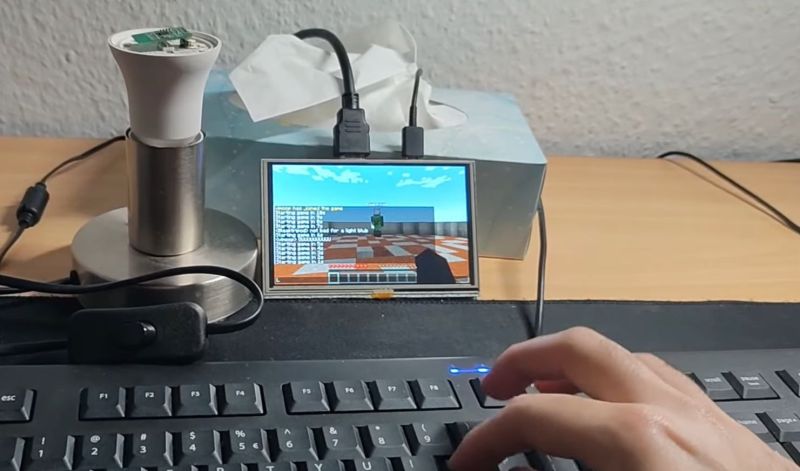
WiFi-enabled ‘smart’ light bulbs are everywhere these days, and each one of them has a microcontroller inside that’s capable enough to run all sorts of interesting software. For example, [vimpo] decided to get one running a minimal Minecraft server.
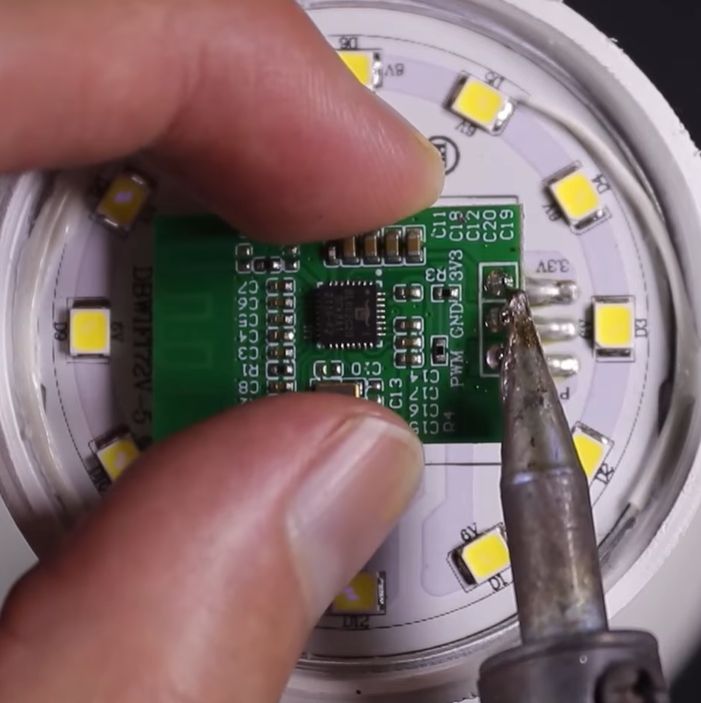
Inside the target bulb is a BL602 MCU by Bouffalo Lab, that features not only a radio supporting 2.4 GHz WiFi and BLE 5, but also a single-core RISC-V CPU that runs at 192 MHz and is equipped with 276 kB of RAM and 128 kB flash.
This was plenty of space for the minimalist Minecraft server [vimpo] wrote several years ago. The project says it was designed for “machines with limited resources”, but you’ve still got to wonder if they ever thought it would end up running on a literal lightbulb at some point.
It should be noted, of course, that this is not the full Minecraft server, and it should only be used for smaller games like the demonstrated TNT run mini game.
Perhaps the next challenge will be to combine a large set of these light bulbs into a distributed computing cluster and run a full-fat Minecraft server? It seems like a waste to leave the BL602s and Espressif MCUs that are in these IoT devices condemned to a life of merely turning the lights on or off when we could have them do so much more.











Looks like a more advanced version of the Doom test…
Nope, not at all. At least AFAIK.
Because none of these are actually “Minecraft”. More like “µcraft” or something.
Most if not all Doom ports actually run full doom.
Running some minuscule amount of a stripped bare MC server(!) is just – “what?”
Quote:
How much does the light bulb cost?
9 out of 10 times when they brake the lihtbulb is fine, just the powersupply is burnt. you can still hook up 5/3.3v to the board and it might work just fine … i’d call that “free”
When they brake – how fast were they going ?
The speed of light?
it should last for years but it depends un usage and external factors; heat kills the electronics.
i had 4or5 smart lights burn out after maybe a year of use. on the other hand, ive had the exact same bulbs work for years in other fixtures.
i guess its a como of QC and heat dissipation.
one thing is certain, it was the little tansformer every time.
” It seems like a waste to leave the BL602s and Espressif MCUs that are in these IoT devices condemned to a life of merely turning the lights on or off when we could have them do so much more.”
Sound to like you are supposed to buy the bulb to save the MCU from a boring life instead of just buying the MCU?
Maybe that’s why some people run botnets on them? :)
How many engineers does it take to change it ?
Finnaly the software ones can change the lightbulb themselfs. If they can find the bulb class properties.
With that much communications and compute horsepower this sounds like an ideal setup for a distributed LiFi-like broadcast setup.
Also a great plot element for an infiltration story.
That’s an interesting idea. Do the phosphors in white LEDs react fast enough to make that invisible?
On a related note I recently visited a restaurant that was mainly illuminated by strings of half wave rectified LEDs, made me feel nauseous before the food ever came.
I measured “normal” white (i.e. red+yellow) phosphors to have time constants in the 1-2 microsecond range, so they could support baud rates of 100 kHz. Actual bit rates might be 2-5x that, depending on coding complexity.
But the underlying blue LED can be modulated much faster, and even with relatively mundane drivers could support 10 Mbps outbound bandwidth, and the narrowband blue light would afford better SNR through filtering out other ambient light.
The return channel, if needed, could be a plain old near-infrared receiver. Bit rates vary with range, SNR, etc., but existing COTS solutions support everything from 4 Mbps to 9600 bps, or even longer range/poor SNR but slower solutions with IR remote-control signalling protocols.
Feels alott like bareiron for the esp32 https://hackaday.com/2025/09/13/esp32-hosts-functional-minecraft-server/ HaD earlier made a post about. maybe we can see a subcatagory for any platform we run minecraft servers on. First we had Pong, Doom, Crysis and now Minecraft but for really small systems. cool.
I like this benchmark. Doom is for single player, Minecraft is for networked devices
*a lot
Great story. Terrible video, unfortunately.
People of the past had such great imagination and plans for what would happen when electronics got so cheap and small that we could have the computing power of a whole desktop computer, by 1980’s standards, in a light bulb.
What we actually do with it is just turning the lights on and off.
Imagine that and extrapolate 50 years into the future, when we will be using the equivalent of a 64 GB Ryzen 9 setup running at 5,4 GHz to ring the doorbell.
And the funny part will be that it makes sense to do so.
Because manufacturing a simpler microchip to make the “ding dong” sound at the press of a button would cost more and have a longer lead time, and besides there’s nobody left who can design such archaic stuff anyhow. If it doesn’t run a live LLM interpreter then nobody knows how to program it.
How you operate it: you tell the LLM what you want the device to do through a speech recognition program and the LLM takes the description of the task and turns it into lower level instructions like Python on the fly, which then gets interpreted into machine instructions and executed. The reason why you need such a powerful CPU to run it is because the program flow is handled at the highest level by the LLM which monitors the user inputs and keeps re-generating the commands over and over.
After all, the user might decide that the doorbell should make a “bong bong” sound instead, so they need to be able to talk to the doorbell and tell it to do that instead.
Vomit in my mouth at the inevitable truth of what you’ve just commented.
I forgot to add: while the system runs locally on the light bulb, it will still be a subscription service because of all the security patches and bug fixes that need to come in, so burglars can’t smooth-talk your doorbell into opening the door for them.
Right. That’s exactly the way of “rational” thinking I despise.
It’s the equivalent of “Perlen vor die Säue”.
https://crossidiomas.com/perlen-vor-die-saue-werfen/
OK, I read that. Is something lost in translation? That looks like a load of AI blather.
I don’t know. But as a German, I think that the description is alright.
“Perlen vor die Säue (werfen)” translates to “pearls in front of the pigs (throwing).
It means that you give something prescious to someone who doesn’t appreciate it.
The pearl symbolizes something of value, something pure, while the pig is a symbol for something dirty (undeserved, btw).
The pig has no use for the precious pearl, doesn’t see it valuable.
But “worth” is not about monetary worth only, but about value in a larger sense.
There’s another saying that goes like this “he knows the price of everything, but not its worth.” Not sure if it’s German specific, though.
See, the microchip isn’t just a collection of plastic, metal and silicon.
It’s also the legacy of the human mind. What we accomplished, who we are.
By valuing this 5 cents chip, we do pay honour to great minds such as Marconi, Maxwell, Konrad Zuse and many others.
And by “valuing” I mean treating it with respect, treating it with care. Because it’s just more than just 5 cents of something.
I know, that sounds crazy. How can I explain?
Ok. Let’s the books or comics.
Old, worn issues of mass produced books or comics might be worthless from an economic point of view, but they have immaterial value.
An old copy of, say, the Bible still deserves some respect, too.
It shouldn’t be used to fix a wobbly table by putting it under one leg.
And I’m saying this as someone who doesn’t reallly like that book.
Or let’s take food. When I was little, we were raised to not waste food.
Because food was precious.
And that was long after war, when no shortage existed.
It had nothing to do with money, either. It was a priciple.
Same ways, it makes sense that some people save these old light bulbs to remove the PCB with the microcontroller.
Because that chip is the embodiement of human creation.
It’s a miracle of our imagination, a structure so fine and fascinating like an icy snow flake.
And the act of trying to save it alone makes us human, too.
An A.I. wouldn’t bother. It wouldn’t see the immaterial side, just the resources.
It’s not crazy, it’s just unwarranted sentimentality.
Like the pigs with the pearls, our problem is that we see value in the pearls because of their scarcity and difficulty to obtain, which leads to status symbolism, which leads to the perception of value and desirability. We see throwing pearls at pigs as a waste, because we could use them or the value they represent otherwise. At least, in theory.
But, the pearls carry no value and have little practical use – it’s just proteins and minerals in the shape of a ball. If you had a barrel of the finest pearls, what would you actually do with them? What if you had a million barrels? They would be of no value, because their value is imaginary and contingent on pearls being scarce and difficult to obtain. You could just as well throw them in the pig sty.
Likewise, the sentimentality about the 5 cent microcontroller is misplaced. It’s like looking at sandpaper and suddenly realizing that it’s made out of diamonds. Diamonds! Imagine! How can we possibly use such a precious material to waste in simply turning stone or wood into dust. People have fought wars over diamonds.
Yet the people who toiled in 18th century mines digging up the crown jewels of England had nothing to do with the case, nor do they know of or care. They’re just industrial diamonds, pieces of crystalline carbon, just like the 5 cent microcontroller is an industrial commodity – just silicon and phosphorous, and a bits of other mundane materials manufactured in the millions. It’s sandpaper. Why wouldn’t we just put it in a light bulb?
You see the point: values are dependent on the conditions that created them. The fact that you were taught not to waste food comes from food being scarce and expensive, and while we might still take the same value because of other reasons, food is no longer scarce. The fundamental point has changed. Holding on to the value without regards to its reasons is intellectual rigidity, dogmatism.
Putting your used sandpaper on a plinth for a display of human ingenuity would be misplaced reverence. If we’re compelled to find uses for discarded sandpaper because it contains diamonds which we supposedly value so much for sentimental reasons, we’re compelled to do absurd things and waste time and resources in doing so. We become as if religiously attached to the sandpaper and forget the point of what it’s for.
In truth, the fact that old sandpaper is discarded and new sheets are made continuously is the prayer wheel of celebration for the fact that this is possible at all. The good that it does to us is what is worth celebrating, not the fact that there’s diamonds on the paper.
Ah, okay. Thanks for your understanding. ^^
I suppose that underlying mindset is not that uncommon were I live, though.
It used to be the land of poets and thinkers, after all. Of dreams and fairytales, of romanticism.
Before WW2, industrialization, punctuation and efficieny had been associated with it.
It’s a bit of an contradiction, maybe. Like the other side of a coin.
Chances are also good that I’m just a weird exception, of course. ^^;
Hi, yes. It’s also about admiring a certain purity or elegance, I think.
A bit like how the Japanese do admire their cherry blossoms.
Worthless in terms of usability or money, but still of high value to them.
I see that as a sort of circular argument as well. It’s about self-definition: we are elegant people, we value beautiful things like cherry blossoms, therefore cherry blossoms are valuable and the fact that we revere them makes us elegant people. It lifts the cherry blossoms or other stereotypical things up as idols of the definition.
At some point such things become a self-justifying cultural institution, almost as a bit of jingoism. I mean, they’re nice, but so are other things and you don’t necessarily need to value cherry blossoms in particular to value elegance and purity.
In fact, Buddhism says that suffering comes from ignorance of the true nature of things, which makes us judge things as better or worse, prettier or uglier, desirable and undesirable. With such definitions and projections of value, as we seek the desirable we are unable to avoid the undesirable, because they are created by the same action.
In other words, to find value of elegance in a tiny microcontroller is at the same time suffering it being wasted as a light switch. It’s a self-inflicted problem.
It also reminds me of the observation that the finest most expensive tool in your toolbox never gets used, while the worst tool does all the work.
So what was the point of the fine tool?
Hi, that’s an interesting take. But again it’s centered about the own well being, about profits.
That’s not my way of thinking, at least. I don’t think highly of myself.
I for simply value things that I admire, without thinking about myself.
Same ways, it makes me happy to see others being happy – even if I have a bad day.
Can’t speak for others, of course. Though I really think here might be difference of culture on a deeper level.
To me, it’s about the fact that food was being made through the sacrifice of life.
Plants and animals have been sacrificed so we have food.
When we eat, we treat the food with a minimum of respect, at least.
We remember where the food came from and try to be grateful.
This was no doctrine to me. My parents just told me once and I instantly understood the deeper meaning.
But again, might be a cultural difference. In other parts of the world, money means everything.
So what was the point of the fine tool?
I’m afraid I do lack the extent of competence required to explain this.
Please let’s just remember that philosophy used to be the mother of all science.
And what is sacrifice? Life and death are the same. To differentiate between the two and say that we’ve lost something because something died, and gained something when it lives, is as someone put it “trying to arrange the furniture in your room so that everything is up and nothing is down”. Can’t be done. The chair is up, but the legs are pointing down.
To appreciate life as it is, is at the same time appreciating death. The fact that something dies so I can eat is wonderful! To pick one over the other and call it sacrifice requires other motivations, subtle as they might be, that usually go back to the way we feel about things. Like empathy: we feel we ought not to hurt others, because if that is the case of me then that is probably the case of someone like me – you. I don’t hurt you, so you don’t hurt me. So, the fact that something has to die for me to eat is not wonderful, it’s a sacrifice. See how it goes?
That’s not a rational selfish motivation that we arrive at by thinking, but by our nature, yet it is still arises out of a selfish motivation. That we carry this motivation then makes us perform rituals or invent rules, or ways to get around our feelings and justify acting against our nature, even in times or cases where it makes no difference.
For instance:
Like a hunter that says a prayer to the soul of the animal they’ve killed. That’s a ritual meant to appease our own minds – we invent the soul of the animal so we can then say sorry to it, so we wouldn’t feel too bad about killing it.