
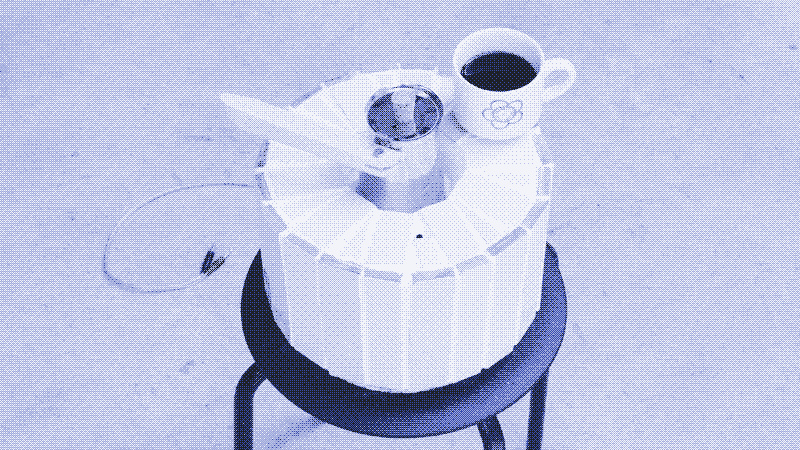
The folks at Low Tech Magazine are here again, this time with a solar powered coffee maker. Lest you think of a large parabolic mirror with a pot at its focus, in this case the device is much more friendly. It’s a table-top appliance that relies upon a 100 W, 12 V panel for its operation.
They make the point that an electric coffee pot requires at least 300 W to work, so what’s the secret? In this case, insulation, as a standard moka pot is placed within a nichrome heating element set in mortar and surrounded by cork. On the outside are tiles, though they appear largely ornamental and the write-up suggests you could experiment with other materials to serve as an enclosure.
It appears to be an effective coffee maker, with the significant caveat that it’s hardly fast. In full sunlight the first pot takes over an hour to brew, with subsequent ones once it’s up to temperature being somewhat faster. But you can’t argue with the idea of free power, even if your favourite caffeinated beverage may now take a while to appear.
We like this idea, despite its slow brewing. We’ve featured Low Tech Magazine before, not least in their solar powered oven.












I came across this website a few years ago and immediately fell in love with the idea of a solar powered web server. Sadly I forgot the name of the website and didn’t really attempt to search it.
Thanks for reminding me [Jenny], I now have a nice addition to my reading list
In a perfect world with a solar panel that doesn’t have loss and a perfect insulation, it would take 8 minutes and 22 seconds, based on a 3 cup (150ml) mokka pot and the 100W panel.
With a warm mortar slab, which is mentioned, it takes 20 minutes. It’s only the first one that takes over an hour. Now, 20 minutes vs 8 minutes, with a solar panel that won’t be 100% effective, that’s actually pretty reasonable.
The two biggest improvements I can find are, covering the top and a much better insulation. Quality ceramic fiber blankets for example, with an outer coating for the fibers. Make a cover on it to cover the top and that solar panel might be able to produce coffee much faster. It’s also generally advised to start out brewing with hot water, reducing the time even more.
Very interesting article.
A more efficient method of heating would be to put the heating element around a copper tube and then drip water through it, through the coffee and straight into a thermos flask.
In the past I’ve made tea using tea lights with this method, and it’s surprisingly effective although each candle is only worth about 40 Watts and about half of that blows past the heating coil. That was my experiment into “how to make do when the power goes and you haven’t prepared”. I made a tinfoil oven to cook an egg, a single cookie, brewed some tea…
Still doesn’t make the thing cheap though. The cost of power from a 100 Watt solar panel that’s not generating useful power most of the time is going to be enormous compared to grid power, because you pay the investment but you’re not making use of the energy it’s providing.
Just put the pot out at night before bed and hopefully by the time you’re awake the dawn sunlight has brewed it for you!
I’m a little bothered by the presence of the solar panel, which is far from low-tech when you consider the machinery needed to produce it. It would be cool to see a version with a Stirling engine powering a heat pump to transport heat and raise the temperature.
That’s a common theme with the helpful gadget nerds though. If there’s no real practical use of it or it performs poorly, it’ll be “sold” as something for emergency use, or for the unprivileged, or as an aid for disabled people… just something that sounds plausible to justify spending so much time and money tinkering with it.
The typical version is, “This gadget will help people in developing countries. It uses parts only available from highly developed countries.” See the OLPC laptop, or solar street lights in rural India (most got stoned to bits by kids, or stolen for the solar panels).
I do some volunteer work in developing nations and you are spot on.
There is a whole room full of modern equipment that was donated with the best intentions but broke and became a boat anchor. The stuff still in use is from like the 60’s (guessing) that is bullet proof, easily repairable with regular tools, and seems to work just fine without touchscreens and, for some stuff, is pneumatic powered and doesn’t even need electricity.
I was in talks with some people doing basic education in villages, and they wanted something to demonstrate electricity. Okay, simple enough: wire, resistors, magnets, battery – makes a galvanometer that can show the passage of current.
Batteries and magnets were available from scrap, could make do without the magnets in a pinch, but the resistor proved a problem. They wanted controllable values, not just random scrap. No biggie: take an tin foil gum wrapper, pencil lead, paper, smudge some graphite on the paper and sandwich between foil wrappers. Add layers, 50-5000 Ohm resistor doable with a bit of arts and crafts. Problem: no gum wrappers. Not even aluminum cooking foil. No multimeter to check value.
They were literally expecting to teach electronics by banging sticks and stones together.
Also, as I recall, the ultimate aim was to teach how to use and construct LED lights using the resistor and batteries, which begs the question where’s the LEDs gonna come from?
Dead TVs have loads of working white LEDs.
Typically attached to strips of carpet tape, which can be easily pulled off.
Only works with African labor rates.
Dead TVs aren’t just found lying around in the savanna.
But car batteries are, apparently.
Also, a similarly sized panel but made with reflectors and copper tube painted black would generate 3-5 times as much heat and be less sensitive to solar angle, so it would work earlier in the morning and later in the evening. When it gets running, the water will boil inside and pump itself around.
If you use that all through the day to collect hot water in an insulated tank, by next morning you’ll have gallons of very hot water. You can’t use that water directly as it would be contaminated with stuff, but you can use it to heat up a smaller quantity of water through a loop in the tank and use a bit of flame or a smaller solar panel to bring that up to a boil.
You probably could use it directly, to be honest. If the copper gives the water a bad taste you could just tin-plate it on the inside, same as you would for copper pots and pans.
Solar thermal is highly underrated, IMO. Under the right conditions it can be competitive with silicon, despite being much lower on the tech-tree.
It’s not the copper tube, but the fact that the same water keeps circulating in a closed loop. The gravity pressure from the tank feeds the water into the solar collector, and the heating lifts it back into the tank. You never empty the tank, you just use it for heat storage.
They sell these multi-source water boilers btw. You can hook up a solar collector, solar PV, an oil/gas/wood burner, and top it off from the grid if needed.
But do you have to consider the machinery to make it? As by that argument your Stirling engine is also a high complexity item dependent on a chain of goods. Sure it is slightly easier to recycle some metal scraps into a pretty decent stirling engine (assuming you have a decent enough lathe and probably foundry/forge for the scale of stirling engine you are making) then it is to create a pretty decent solar panel from scraps. However with how well solar panels made in the last 3 decades+ last, and how many have been replaced because that 10 year old panel wasn’t as energy dense as a new one salvaging a perfectly good panel really isn’t difficult or that different from salvaging metal to recycle. If anything the solar panel is far easier. And unlike a stirling engine that will have some wear components, and need maintenance a solar panel is really fit and forget for quite likely longer than you’ll live at least for primitive use like this – its the battery, inverter, active MPPT type stuff that will likely fail over a relatively short time. You can get a little bit more performance cleaning the panels, but its not really really required – so optional maintenance.
Pushing ‘Low tech’ to the extreme you’d have to be doing something like using an animal stomach and some fire heated rocks to make your hot water, and that fire had better have been started by rubbing two sticks together! Then to make coffee you’d better have made a decent tight weave cloth from your available fibres to act as the filter, and going to need to build something pizza oven like to roast the beans in the first place etc etc. Oh and without the high tech cargo delivery infrastructure you’d better be growing/havesting your own coffee…
Solar powered coffee roaster.
Nice, today morning I thought about solar panel powered coffee machine, but with battery instead mortar.
Trying to sell us an under-powered, mildly insulated electric kettle as solar ?
That´s borderline abusive.
The most idiotic thing about this, when not making coffee, the solar panel isn’t used.
Perhaps not the most idiotic, that’s the whole Fn idea.
Honorable mention, need to wait till noon to make coffee.
It’s just ‘solar panels on cars’ in miniature and without a battery to not effectively charge.
Some people need the definition of ‘fungible’ pounded into their heads.
Precisely, i would just hook it up to one of those big power banks and then you can just use a regular coffee maker with it. Charges in half an hour, but still makes coffee in regular time. You can also use the extra energy for other things.
I am not sure where the line is drawn for low tech stuff. For sure low tech can also mean easily available, as opposed to custom made.
You can argue that the panel is in use – assuming you leave it connected its keeping the coffee pot and its surrounding thermal mass at a ready to use temperature all day. Which gives you a similar effect to having that big battery bank and control electronics to store the power for delivery to the device on demand, but much much simpler as a system. Sounds like its still a fair bit slower to brew than dumping a few hundred watts of heat in, but not crazily bad once its at temperature – “subsequent brews take only 20-25 minutes” isn’t all that bad.
I suspect the right move for this sort of concept is one unified thermal mass slab for all types of cooking possible at these temperatures, embed a well fitting metal tube/cone to the slab for each appliance (doesn’t have to be that well fitting as you can fill the gap between cooking pot and socket with a little water or other thermal interface material). Or you could if the cooking pots have draft angle simply coat them in a mould release and pull them out of the slab when its hardened, but that would likely be less durable. Either way you can remove and clean the pans when you need to easily, and cook more flexibly with a big one for a slow cooker, smaller one for this sort of coffee pot, and whatever else you can think of and the ability to pull the stew for tomorrow off the heat to use its spot to say raise your bread. Going to take longer to heat up being so large, and if you don’t have enough energy put into it for the demands you are making the temperature would drop, but having so much more thermal mass and some decent insulation it should stay relatively heat saturated through the day in use, and still be warm by morning – so your first cuppa in the morning might still take a while after the sun rises, but its not as bad as the real cold start.
There is no free power. You paid for the solar panel. That’s what, $150 or thereabouts?
The energy to boil a cup (150 ml) of coffee in a kettle is about 15 Watt-hours. The faster you do it, the more efficient it will be. With a US-average electricity price at 12 c/kWh that’s roughly 0.2 cents a cup. To cover the $150 for the panel, you’d have to brew 75,000 cups of coffee.
Six cups a day, you’ll be at it for 34 years.
Yeah, taking energy from the panel only for brief moments of time, makes it not worthy, especially if you over inflate the price of the panel and pick a very cheap electricity rate.
But put a bigger panel and power a lot more things and things look different. Here in Europe balcony plug in solar is starting to become a thing, with 800W kits reaching even below 500 euro. Depending on the situation, it can pay for itself in 3-5 years.
It’s easy enough to run the numbers if you want to compare different cases.
Their device is actually very inefficient, because it needlessly heats up a bunch of thermal mass around the pot. It’s got a resistive heater that is not matched to the panel with any sort of regulator or power tracker, and their only point is to make an RV style coffee maker work with about 1/3rd of the normal power by putting a load of insulation around it, because it would otherwise never reach boiling.
If you have an 800 Watt panel, you don’t need this.
Thing is, the price of solar panels doesn’t scale down linearly. The price per watt goes up the less you buy, both in the number of units and the unit size (power).
Luxor SOLO LINE M36/100W – €109.00 ($125 USD)
Renogy monocrystalline 100 W – €116,99 ($134 USD)
Add shipping and you’re pretty much at $150 USD or more.
Where I’m at, electricity costs about 11 euro-cents a kWh all told, so it’s comparable to the US average. It’s a different case with Germany which puts all sorts of extra taxes and surcharges on top, making it three times as expensive, so saying “here in Europe” doesn’t say very much.
It kind of does scale down – you can find odd small quantities of salvage panels at really good rates, sometimes even free, you just have to collect/ship them. At least around here it isn’t hard to pick up the small numbers wanted for a balcony (etc) much cheaper than buying similar new.
If you need a real array and are buying new the scaling factor will end up being the fitting/shipping costs – which usually work out to being as many panels as you can fit on the back of the lorry is a reasonable ballpark for a days labour in many cases, so you’ll pay much the same in those costs up to that scale of install, then eat another full hit if you break into the next lorry. (Obviously style of fitting and how accessible the wiring it ties into is matters – for example in our case here “needing” to put up a scaffold for access to one part of the roof added some labour costs)
Come to Australia and you’ll get that payoff in only 20,000 cups :)
For that first cup in the morning you could just burn the box the solar panel came in and boil the water over a fire.
Good article, lots of great content on this site.
I wake up at 4am and have my first cup of coffee before sunrise. I guess I’d need a Lunar panel. (And then I’d only get coffee, maybe, one week a month.)