
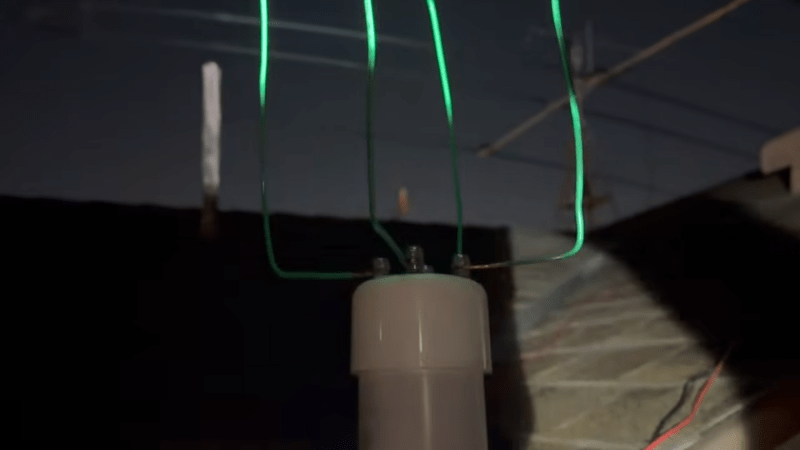
Looking up at the sky just after sunset or just before sunrise will reveal a fairly staggering amount of satellites orbiting overhead, from tiny cubesats to the International Space Station. Of course these satellites are always around, and even though you’ll need specific conditions to view them with the naked eye, with the right radio antenna and only a few dollars in electronics you can see exactly which ones are flying by at any time.
[Josh] aka [Ham Radio Crash Course] is demonstrating this build on his channel and showing every step needed to get something like this working. The first part is finding the correct LoRa module, which will be the bulk of the cost of this project. Unlike those used for most Meshtastic nodes, this one needs to be built for the 433 MHz band. The software running on this module is from TinyGS, which we have featured here before, and which allows a quick and easy setup to listen in to these types of satellites. This build goes much further into detail on building the antenna, though, and also covers some other ancillary tasks like mounting it somewhere outdoors.
With all of that out of the way, though, the setup is able to track hundreds of satellites on very little hardware, as well as display information about each of them. We’d always favor a build that lets us gather data like this directly over using something like a satellite tracking app, although those do have their place. And of course, with slightly more compute and a more directed antenna there is all kinds of other data beaming down that we can listen in on as well, although that’s not always the intent.












Once a week or so it’s fun to sit outside with binoculars and do some satellite spotting.
Back in the early 00’s We used to go out at sunset and watch for “Iridium Flares”.
Before that all through the 90s, Dad and I would lay in the yard on moonless nights in the winter and he’d tell me the classic stories about the constellations. Occasionally breaking the rhythm of a story to point out a com-sat or something else man made.
Don’t know where he got it but he had a printout on tracktor fed paper with time tables and dates for some of them.
Used to do that too and IIS etc.
Website for table and charts for your location can be made for free from here https://www.heavens-above.com/
On endless paper, maybe? If so, it might have been running on an IBM PC with a vintage printer.
Because there were a couple of MS-DOS programs for orbit prediction.
STS Plus, for example – it flew on MIR space station.
https://celestrak.org/software/dransom/stsplus.html
They often were in the ham radio or astro category of shareware CD-ROMs, mailboxes or internet servers.
Some more:
https://www.qsl.net/kd2bd/predict.html
https://home.hiwaay.net/~wintrak/products.htm
https://www.infania.net/misc/simtelnet/msdos/satelite.html
The new train spotting…
The unfortunate thing about this project is you HAVE to have a telegram account to even connect to the API. I really dont want to sign up for a service for one thing. And they want my phone number. I really dont want to do that for a satelite tracking project. I would rather go with Satnogs.
Hope they can get aroudn that restriction!
Apparently it’s now also possible to register without telegram:
https://mastodon.social/@tinygs/114710821254592848
I didn’t know that there were any low cost satellites. I thought they were all really expensive. How does the tracker know that a satellite overhead is low cost anyway?