
The “Long Dark” is upon us, at least for those who live north of the equator, and while it’s all pre-holiday bustle, pretty lights, and the magical first snow of the season now, soon the harsh reality of slushy feet, filthy cars, and not seeing the sun for weeks on end will set in. And when it does, it pays to have something to occupy idle mind and hands alike, a project that’s complicated enough to make completing even part of it feel like an accomplishment.
But this time of year, when daylight lasts barely as long as a good night’s sleep, you’ve got to pick your projects carefully, lest your winter project remain incomplete when the weather finally warms and thoughts turn to other matters. For me, at least, that means being realistic about inevitabilities such as competition from the day job, family stuff, and the dreaded “scope creep.”
It’s that last one that I’m particularly concerned with this year, because it has the greatest potential to delay this project into spring or even — forbid it! — summer. And that means I need to be on the ball about what the project actually is, and to avoid the temptation to fall into any rabbit holes that, while potentially interesting and perhaps even profitable, will only make it harder to get things done.
Pushing My Buttons
For my winter project this year, I chose something I’ve been itching to try for a while: an auto-starter for my generator. Currently, my solar PV system automatically charges its battery bank when the state of charge (SOC) drops below 50%, which it does with alarming frequency during these short, dark days. But rather than relying on shore power, I want my generator to kick on to top off the batteries, then turn itself off when the charge is complete.
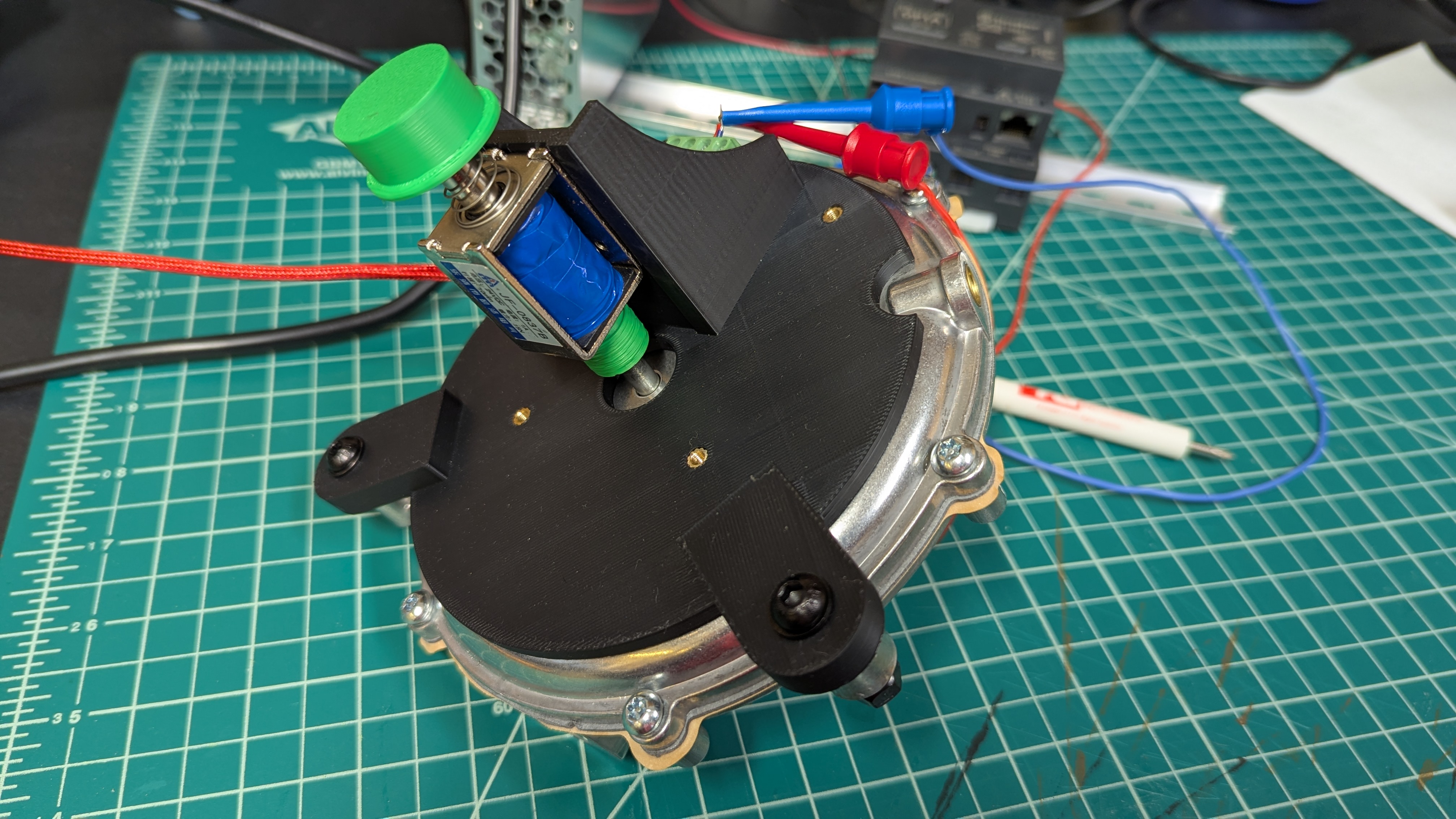
In concept, it’s a simple project, since the inverter panel I chose has dry contacts that can trigger based on SOC. It seems like a pretty easy job, just a microcontroller to sense when the inverter is calling for a charge and some relays to kick the generator on. It’s a little — OK, a lot — more complicated than that when you think about it, since you have to make sure the generator actually cranks over, you’ve got to include fail-safes so the generator doesn’t just keep cranking endlessly if it doesn’t catch, and you have to make everything work robustly in an electrically and mechanically noisy environment.
However, in my case, the most challenging aspect is dealing with the mechatronics of the project. My generator is fueled by propane, which means there’s a low-pressure regulator that needs to be primed before cranking the starter. When cranking the generator manually, you just push the primer button a few times to get enough propane into the fuel intake and turn the key. Automating this process, though, is another matter, one that will surely require custom parts, and the easiest path to that would be 3D printing.
But, up until a couple of weeks ago, I didn’t own a 3D printer. I know, it’s hard to believe someone who writes for Hackaday for a living wouldn’t own one of the essential bits of hacker kit, but there it is. To be fair to myself, I did dip my toe into additive manufacturing about six or seven years ago, but that printer was pretty awful and never really turned out great prints. It seemed like this project, with its potential need for many custom parts, was the perfect excuse to finally get a “big boy” printer.
Pick Your Project
And that’s where I came upon the first potential rabbit hole: should I buy an out-of-the-box solution, or should I take on a side-quest project? I was sorely tempted to take the latter course by getting one of those used Enders returned to Amazon, having heard that they’re about half the price of new and often need very little work to get them going. But then again, sometimes these printers have gone through a lot in the short time they were in a customer’s hands, to the point where they need quite a bit of work to get them back in good order.
While I like the idea of a cheap printer, and I wouldn’t mind tinkering with one to get it going again, I decided against the return route. I really didn’t like my odds, given that our Editor in Chief, Elliot Williams, says that of the two returned printers he’s purchased, one worked basically out of the box, while the other needed more work to get in shape. I wanted to unbox the printer and start making parts right away, to get this project going. So, I took the plunge and bought a Bambu P1S on a pre-Black Friday sale that was much less than list price, but much more than what I would have paid for a returned Ender.
 Now, I’m not going to turn this into a printer review — that’s not really the point of this article. What I want to get across is that I decided to buy a solution rather than take on a new hobby. I got the Bambu up and running in about an hour and was cranking out prototype parts for my project later that afternoon. Yes, I might have had the same experience with a returned printer at about half the price of the Bambu, but I felt like the perceived value of a new printer was worth the premium price, at least in this case.
I think this is a pretty common choice that hackers face up and down the equipment spectrum. Take machine tools, for instance. Those of us who dream of one day owning a shop full of metalworking tools often trawl through Facebook Marketplace in search of a nice old South Bend lathe or a beautiful Bridgeport milling machine, available for a song compared to what such a machine would cost new. But with the difficulty and expense of getting it home and the potential for serious mechanical problems like worn ways or broken gears that need to be sorted before putting the machine to use, the value proposition could start to shift back toward buying a brand new machine. Expensive, yes, but at least you stand a chance of making parts sooner.
Your Turn
Don’t get me wrong; I’d love to find a nice old lathe to lovingly restore, and I just may do that someday. It’s like buying a rusty old classic car; you’re not doing it to end up with a daily driver, but rather for the joy of restoring a fine piece of engineering to its former glory. In projects like that, the journey is the point, not the destination. But if I need to make parts right away, a new lathe — or mill, or CNC router, or 3D printer — seems like the smarter choice.
I’ll turn things over to you at this point. Have you come up against this kind of decision before? If so, which path did you choose? Has anyone had a satisfying out-of-the-box experience with returned printers? Was I unnecessarily pessimistic about my chances in that market? What about your experience with large machine tools, like lathes and mills? Is it possible to buy used and not have the machine itself become the project? Sound off in the comments below.












My first 3D printer was a Tevo Tarantula – kit bought from the hackerspace I was a member of, with a weekend assembly class. This was in the late teens, and the 3DP landscape was much different than today.
I never got that thing dialed in. I spent so much time and money on it, and eventually it just sat in the corner of the basement scorning me.
This spring I bought a cheap, reliable, no-name printer from the Make: Magazine online store, and I’ve been printing downloads and OpenScad designs ever since.
I never really wanted a 3D printer as a hobby, I wanted to print 3D objects for hobby and household use. That old Tarantula put me off the whole thing for years.
I think you made the right choice this time, Dan.
P.S. – None of the local hackerspaces wanted the Tarantula, either. Apparently they had something of a reputation. Now I have a plastic bin of parts to build some future project.
Addressing the (north) winter photovoltaics poor performance, mostly in off-grid systems, solution can be in adding panels. But then you need a clever hack either with some gadget or included in inverter to ensure that in more sunlight the system will not burn itself. Any hints?
Inverter or charger, according to system setup, of course.
Back in the day… hahahah. In the early days of hobby 3d printing when Makerbot was a thing I bought a used Thing-O-Matic for $600 (after building a small CNC and then hotglue 3d printer). I was sure that 3d printing was the way. I spent the next 6 months tinkering and learning (not much printing). It literally took that long to get it printing something somewhat useable. My next printer was a used Flashforge Replicator clone. That was less of an issue. By then slicers had improved enough that things almost worked without months of tinkering. The printer still was a basket case and things like burnt teflon tubes and warped build plates etc. were eventually found and sorted out. From that printer I earned enough money 3d printer to buy a Prusa MK2s (~$900). That was the best decision ever. It printed right out of the box and the prints were really nice. So a few years of tinkering to get to the conclusion of buy the best thing you can afford so you can do the thing you originally wanted to do instead of going off on side quests. Side quests are interesting and you learn stuff however most of us just want tools that work. I am glad you decided to get a nice printer to start with. I think you will be much happier digging in to the actual project.
Forgot to mention slicers… Simplify 3D was a game changer. Up to that point it was much more difficult to get good consistent prints. After that Prusa’s slicers have been print and play.
My winter project is the half-finished projects from yester-year. I know that I’m stuck inside so I’m “spring cleaning” both the house and my project piles.
Well that has turned into my winter project – was meant to be done promptly after picking up the machine in spring, but life got in the way and nothing much at all happened on the restoration part till about a month ago…
And this restoration has largely been buying a solution rather than doing it myself (though actually very little to do it turns out). Which is fortunate as without my other tools useable, which a lathe so large for the space dismantled filling all the work surfaces out there prevents (also not sure any of the parts I’ve needed would be in the scope of my much smaller machines anyway)…
It is that challenge to actually be able to make a part to recondition an old iron tool that is the big challenge if you don’t already have a decent enough machine though. Once I get this lathe and all the tooling it came with reconditioned anything it or my other tools need should be very much something I can do myself – no foundry (yet anyway) so might have to substitute cast iron for a machined bronze/steel/way filling epoxy etc as suited to the task or spend rather longer making lots and lots of chips, but having hit that minimum viable toolset to do all the tasks or relatively sanely make all the jigs that might be required…
My winter project is working on the Einstein CNC project, I’ve put on hackaday.io.
And off course modifying the PuzzleBox32 CNC Controller with more features
Link? I looked under “Henrik” and “Einstein CNC” and couldn’t find it.
There you go. Nothing much to see – playing with OpenCV on a it and haven’t posted a lot recently: https://hackaday.io/project/203018-einstein-cnc
I wouldn’t buy a used car without testing it out first, and I feel the same way with lathes and mills, so at least I can have a reasonable guess at how much work it’s going to need. And at least for all of my first tools: first lathe, first mill, first 3d printer, first lasercutter, I didn’t even know what I wanted. I thought I did. But after using it for a year I was like oh THESE are actually the things that are valuable to me, and then I went and got ones that did THOSE things, and I’m glad I got cheap worn out stuff first, to learn on. I’ve never needed to turn something 40″ long, but I absolutely needed way more Z axis on my mill than I ever thought I would.
Other people before me have said: buy the cheap harbor freight crap and when you break it that means you used it enough to buy a good one.
But I do agree that if you buy something so broken you have to fix it before using it, you’re adding a new hobby onto your stack, and that’s for sure going to push out your deadline by way longer than you expect. So if you’re on a schedule, make sure what you buy is at least basically functional.
If you need “the thing” to work in order to be useful (however you define that) you need to buy 2 to really be happy and scratch all the itches:
One commercial solution that works enough but with some compromises and
One “project” that you can tinker with even if it means it is a project forever.
With the lathe example- just get a new import one, it will work OK while you find the “perfect” project lathe. Plus you can make parts with the working one for the project.
Cars- same. If you need a working car it’s best to get one that works, $$$ permitting of course. Then get that steal of a vintage car that needs lots of love and time and you can work on it at your leisure while still making it to work or pick up the kids.
Lots of things work like that.
I will say I’ve personally found that the “thing to do the hobby” often turns into a hobby itself that is surprisingly fun. Making beer was nominally for $$savings but what I do make now, I give away like 3/4 of it. Making beer is really fun in it’s own right.
For anyone in the “must work to provide income in order to live” time is the wayyyyy harder thing to come by. And frustration counts too. More and more after careful research I’ve purchased a slightly better “thing” that massively decreased the time investment and decreased frustration.
Last thought- getting pissed off at a hobby that is supposed to be fun is … not great.
For my Electric Start Duel Fuel Generator, I ended up putting a Solenoid Operated Primer in Line with the Starter and Liquid Feed Valve, with a Vacuum Switch to keep the Liquid Line Open.
When the Starter Hits, the Primer and Liquid Propane Feed come on, when the Vacuum Switch Makes, the Machine is Running, the Starter Stops, The Primer Stops, and the Vacuum Switch keeps the Liquid Feed Open.
Think it was an Impco Kit I added for my 20 HP 4 Cylinder Wisconsin Engine.
If I start it on Gasoline (Petrol) then Normal Chocking Applies, and I have to Manually Start it, and Close the Throttle By hand, because the speed Control wants to keep the Throttle wide open during Starts..
Starts fine on Propane, Gasoline is by hand only.
Looking forward to seeing what you come up with..
Cap