
There are few things more American than driving a car really fast in a straight line. Occasionally, the cars will make a few left turns, but otherwise, this is the pinnacle of American motorsport. And there’s no longer, straighter line than that from New York to Los Angeles, a time trial of sorts called the Cannonball Run, where drivers compete (in an extra-legal fashion) to see who can drive the fastest between these two cities. Generally, the cars are heavily modified with huge fuel tanks and a large amount of electronics to alert the drivers to the presence of law enforcement, but until now, no one has tried this race with an EV specifically modified for this task.
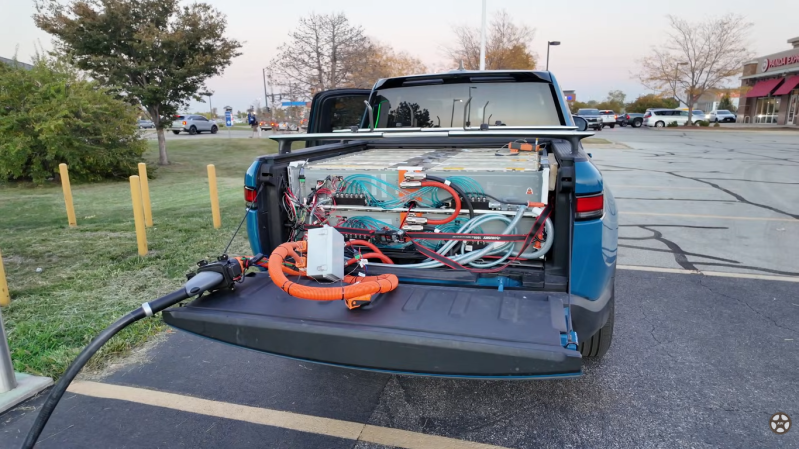
The vehicle used for this trial was a Rivian electric truck, chosen for a number of reasons. Primarily, [Ryan], the project’s mastermind, needed something that could hold a significant amount of extra batteries. The truck also runs software that makes it much more accepting of and capable of using an extra battery pack than other models. The extra batteries are also from Rivians that were scrapped after crash tests. The team disassembled two of these packs to cobble together a custom pack that fits in the bed of the truck (with the tonneau closed), which more than doubles the energy-carrying capacity of the truck.
Of course, for a time trial like this, an EV’s main weakness is going to come from charging times. [Ryan] and his team figured out a way to charge the truck’s main battery at one charging stall while charging the battery in the bed at a second stall, which combines for about a half megawatt of power consumption when it’s all working properly and minimizes charging time while maximizing energy intake. The other major factor for fast charging the battery in the bed was cooling, and rather than try to tie this system in with the truck’s, the team realized that using an ice water bath during the charge cycle would work well enough as long as there was a lead support vehicle ready to go at each charging stop with bags of ice on hand.
Although the weather and a few issues with the double-charging system stopped the team from completing this run, they hope to make a second attempt and finish it very soon. They should be able to smash the EV record, currently held by an unmodified Porsche, thanks to these modifications. In the meantime, though, there are plenty of other uses for EV batteries from wrecked vehicles that go beyond simple transportation.











The huge size and weight of those battery modules perfectly illustrates the sillyness of electric vehicles, and in particular electric pickup trucks. Each one of those 15 kWh modules gets you about as far as a gallon and a half of gas.
That 9 module pack and accessories weigh a literal US ton and still don’t give you more than about 13-14 gallons equivalent “fuel capacity”, which for a pickup truck is kinda small.
The only reason EVs can boast reasonably long ranges is because they basically cheat with skinny low resistance tires and optimizing for the mileage test conditions by taping up door gaps and whatever else that gets you the low nominal drag coefficient used to calculate the load on the test dynamometer. When it gets to the customer, the cheats come off and the actual range drops. In the real world when it’s not ideal NTP conditions all the time and the car actually has to perform some work other than hypermiling down a level highway at 10 mph below the speed limit, the range gets cut by a quarter to a half.
Oh, and not forgetting: the bottom 15-20% of the battery capacity is limited power because that would risk undervoltage cut-off by the BMS. That’s for “limp home” mode, further restricting what you can do with the car.
There’s a road tunnel in Norway (Laerdar tunnel) which is famous for killing EVs because it’s 15 miles long with a consistent uphill grade one way, where the extra power drain on the batteries causes the voltage to sag and that freaks the BMS into limp-home mode, which restricts the power going up the grade and forces the driver to stop. If you go in with half a charge or less, especially on an “older” EV with a slightly faded battery, chances are you need to be towed out.
15 mile hill is nothing to an EV i’ve driven them for over a decade and this would not faze any of them. Constant drain is absolutely normal on motorways.
I couldn’t agree more….
I cannot see that truck doing a cannonball run, crushing amount of weight.
My Dad was a professional Spring car driver.
We would visit my grandparents in Umpqua Oregon…
11:49 from Spring Valley CA to Umpqua OR.
Going on long trips with my Dad was like flying there in your own private plane.
“perfectly illustrates the sillyness of electric vehicles, and in particular electric pickup trucks”
This is one very particular use case (a long duration race) that applies to 0.001% of EV use, I hardly think you can draw a conclusion like that.
If you don’t like EVs, then sure you are free to express that opinion, but if this and below arguments are the best argumente you got, we’ll it’s little more than ranting about EVs…
@Dude, I see and like many of your posts, I am sure you can do better than that :).
Does it need to be anything else? Cannon ball races aside, the Rivian itself is a joke of a car. It’s basically a vehicle made for glamping in a park just outside of the city, for people who don’t need pickup trucks.
“for people… ” like 95% of pickup trucks sold?
Yes.
I was thinking, if I could get it on the license, I would drive a Bobcat loader.
Not that I’d have any reason to. Just on the off chance that I’d need to scoop something up along the way.
As are so many fossil fuel “utility” or “sports” vehicles.
Indeed, only it is made that much sillier by putting in batteries and removing even the shred of possibility that it could be used to carry more than your shopping.
Let’s see: short bed, the 135 kWh battery already in the car eats up on the carrying capacity, the energy consumption is already 48 kWh/100 mi on the level without anything in tow, range is “meh”, cost is astronomical at well over $100k. It’s got 700 HP on tap, but the battery will redline in under 10 minutes at that rate, so you can basically do a couple burnouts and throw away all your range bragging to your mates.
But, you can get a kitchen with a sink installed as an option!
I would call that a very silly car.
While I agree EV are not ideal for everything, with what amounts to an endurance race being a pretty obvious bad fit, an electric truck can be perfectly sane and even the perfect choice. Sure the base vehicle will undoubtedly be heavier than a petrol/diesel equivalent, which might for some places limit the weight you can carry on your particular driving licence for total vehicle weight but it has still got a huge load bed volume and weight capacity potential. So maybe you’d end up needing a commercial license to drive it fully laden with what you are intending to carry, but most user wouldn’t, as things like sofa are volume hogs, but not heavy…
So the only thing that really limits the practically of the EV is how you intend to use it – if all you do is ship stuff long distance its probably not for you, but if you are say a garden maintenance/cleaner/roofer/tree surgeon then you are working in your patch, that is pretty darn small area compared to the range potential, and likely have yard you can charge up in for pennies. Absolutely worth it, just on the fuel costs alone the higher purchase price will be paid back and then some, as you are making heaps of use of the vehicle but well within its range bracket so you can always charge at the cheapest rate, add in all the time saved as it charged up and ready to go while you slept so you don’t have to divert to a petrol station 3 times a week etc…
Also have to say that does not appear to be even remotely true – drive like a hooligan and you won’t match the stated range on any vehicle, but driving normally everyone I know that has used an EV (which now covers a vast range of makes and models) has always found the stated range is fine, if not pessimistic. Certainly not even close to double the real world results…
The regulators are slowly catching up. It used to be much worse with companies like Tesla advertising their cars using the Japanese 10-15 test cycle, which basically amounts to running loops around a parking lot.
https://www.caranddriver.com/features/a44676201/ev-range-epa-vs-real-world-tested/
As for Rivian, it fell in the bottom of the pack with Tesla at -30% from the advertised value. If you also drive like a hooligan, or you’re actually hauling and towing stuff with your pickup truck as it’s meant to be, you can indeed expect to halve your range.
And if you are towing with a combustion engine it ruins your fuel economy too. Who could possibly predict that hauling a giant wind break would hurt your fuel economy…
As for claiming the 13% falling short of the sticker you are quoting, or even your ‘bottom of the pack’ at -30% are as bad as you claimed…. 30% wrong is bad, but you are darn nearly doubling that with how bad you are implying it is… Actually your worst case in that particular publications testing is closer to what you are implying the best possible real world outcome is!
Obviously. Doing work uses energy. That’s why trucks usually have 20-40 gallon fuel tanks instead of a tiny 13 gallon equivalent battery.
Yes, and that’s for a good reason: this is still fair weather driving.
The EPA range represents a very sedate driving cycle with no load on the vehicle. If you fail -30% on that you will be absolutely bogged down when it comes to wind, rain, snow and just non-optimal road conditions off the smooth highway, plus you’ve got to run the heater/AC and do some work on the side too.
For example, air density has a habit of changing between +25 C (NTP) and -25 C by a factor of roughly 1.25 which is directly related to your energy consumption because air drag is directly proportional to the density of the medium. In other words, you use 25% more energy to push through the air when it’s very cold versus the test conditions. This is why car manufacturers like to unveil their new ultra efficient vehicles in Dubai.
The trouble is that all these losses stack up. If you take those two estimates: that the company is cheating 30% on the EPA range, and you consume 25% more energy in the cold or in imperfect conditions in general for various reasons, you can calculate 0.7 / 1.25 = 0.56 which is damn near half the range.
That’s what you can actually rely on, not what it says on the brochure. Then you subtract whatever is needed to haul or tow stuff. Suddenly that 135 kWh battery starts to look mighty small.
Great so take the one worst almost entirely alone outlier case that applies to almost no EV of a rather misleading figure from the manufacturer rather than the pretty darn accurate sticker ranges your own reference finds quite most common and then assume the worst conditions and only consider that one example as valid…
In those bad conditions exact same thing is true of ICE vehicles too, you can’t trust that sticker range to always happen. And that is assuming you could trust it in the first place, not like ICE vehicles have never been caught cheating on the tests!
In the challenging conditions your usually using more energy (unless its visibility making you go slow), but that doesn’t really make a blind bit of difference to the comparison – your 25% “waste” on heat and drag applies to both, and makes basically no difference to how you use the vehicle as in all cases you have to plan your journey enough to be safe – you know with the trailer hitched your MGP drops to x so you need to fill the tank here to make that one stretch with no services etc. And as a rule EV are better suited to those 90% of journey that are so short the battery capacity or fuel tank size is irrelevant, most folks don’t do long haul at all, maybe once or twice a year you’ll go visit that distant relative…
No it won’t. A standard traditional pickup truck will cost you $35k and the Rivian will cost you $135k. You won’t make $100k back in fuel prices – ever.
I’m not talking about this particular ‘premium’ vanity truck being compared to the regular working truck… The regular ‘white’ van or actually working pickup truck spec EV is more expensive than its ICE version (often of exactly the same basic vehicle), but it isn’t 100K extra or even close to that. Probably more like 10K of extra cost to go electric.
My buddy has a f150 lariat, just barely nicer than my 24 flash, i paid 70 minus the rebate amd it was 62,500, his was 85, 000 no rebate. I can drive over 200 miles easy for about 4.50. Summer time a bit further. I have an 02 ram 1500 that got 10.5 mpg and when pulling a trailer i would get around 6 to 5.5 and with a headwind, forget it, it has a small tank and it cost a small fortune to go anywhere pulling a trailer in it. Love my flash, best truck ive owned. Looked at a 24 ram w a cummins before I bought it, damn, they wanted almost a hundred thousand dollars, crazy. Have a nice day.
Sir, when is the last time you bought a new truck?
The base f150 (not really comparable because it only has two doors) still starts at $37k, and the base Rivian R1T is $72k, with used examples of both available. If you can’t diss electric trucks honestly, maybe you should stop trying. In the words of Eminem, “know your facts before you come at [them], little goof.”
Alright, but if you pick the base Rivian you lose a quarter of the battery capacity, making it even less useful than it already is.
So it’s twice as expensive and performs no real function as a working vehicle. Why would you buy it? Bear in mind that in this comparison, the real answer is “If a Rivian is the truck for you, you don’t need a pickup truck in the first place.”.
Send a link to that brand-new 35k$ truck.
I will even accept it if it’s the base version, which IRL is unobtainium.
Indeed: the 2011 tundra I drive (SR5 with the and towing package) ran me $37K back then; I can’t replace it with a new one for ~$50k, and even then I can’t get the 8 cylinder engine- I’m stuck with the twin turbo v6 that has reliability issues.
Then it’s good that this thing has a full sized bed that can fit a… oh, wait.
Again – general vs specific – this specific truck is not a working vehicle, and clearly was never meant to be! Good news being you are pretty certainly not going to be able to put enough weight on the back to need a commercial licence with one of these.
This particular EV appears to be a luxury family car with a little added versatility by design – at which its probably pretty darn good really. As you are certainly not fitting your mountain bikes or a sofa in the back of the luxury BMW/Merc saloon, probably going to find it tricky even in the very spacious luxury Landrover type things. And it appears the seating room of the crew cab is actually rather generous. Still stupidly overpriced, but so are all the vanity vehicles really no matter what their power source.
Rivians are overpriced ‘mall utility vehicles’, like the castrated Range Rovers currently sold.
Insane construction.
Bed integrated w cab.
Uneconomical to repair/insure.
Rivian still not covering marginal costs.
They appear to not understand manufacturing realities.
Makes a Ridgeline look like a work truck.
Ford is in the process of closing down F-150 lightning production.
Can’t afford the losses to just let them sit on dealer lots.
Being deeply discounted right now, 25% off list and falling.
Still 60k$+ for the ‘flash’ trim, more if you want the fancy plastic interior.
Plus usually bs at stealership…
e.g. not shoving red hot poker up customer’s butt fees.
‘They won’t insist, but you should at least pay for the heating of the poker, to be fair.’ para Ben Franklin
Exactly. That’s what I’ve been saying. It’s a silly toy car.
That describes electric pickup trucks to a T.
Might describe this one, in fact that is the one thing so far I actually think you have a point on.
But there has to be practical work truck versions out there, that are not conversions of the old classics too (as the conversion is always going to be expensive for what you get).
Here we don’t really do pickup trucks much, but the whitevan EV exist, are darn good and so are becoming pretty common to see (though you have to look darn hard to notice as they usually look 100% identical in body shape to their ICE brothers). Looking at the list of available EV pickups here there really isn’t many options, and none of them I’ve spotted are crazy vanity vehicles at stupid prices at all either – just a small premium as expected to a new ICE vehicle still. Probably because the vanity ones made for the US’ huge pickup market wouldn’t even be road legal here.
I think we all just need to face the harsh reality that EVs are really only any good for 90% to 97% of drivers in these so called “developed nations” excluding commercial driving of course.
Personally, and however paltry, I’d take the 90% reduction in passenger car emissions in my country.
Seriously, every time the range discussion comes up, suddenly everyone drives 200 miles both ways to work 7 days a week.
For the future EV owners who are prone to be naysayers, remember that the technology is still in its relatively early ‘mass market’ years.
For a bit of context WRT ICE vehicles, I recently found my dad’s mileage log from his 1966 V8 Impala (20 gal tank, 10-12 MPG) – this ‘estimated’ range was quite comparable to the $70k Rivian. On a summer road-trip camping with my Mom around Lake Superior there were necessary stops made every 190-225 miles to fill up (~1400 miles total). The trip was always fondly remembered and set the stage for a lifetime of road-trips around the country during the rest of their marriage.
This shows that a non-tricked out Rivian EV is completely functional here in 2025 from a transportation perspective (for a patient driver who keeps it under 75mph) – with an obvious expectation of lots of improvements ahead. Just like the green Impala my dad had, my Rivian (with all of its supposed unacceptable range limitations) will be remembered as a great vehicle for its time.
BTW, Currently there are more than enough charging stations on that route in the US and Canada to make it stress free from a fuel perspective (all stations open 24-365 too!) (and with a bonus of none of the emissions associated with the exhaust of ~100 gallons of burnt fuel used along the way).
I mean, I don’t know which EVs you’re talking about, because at least with Teslas the tires are pretty fat (especially the Plaid models) and the mileage is close to or better than advertised, since updates to the controllers have helped the motors be more efficient after many people’s purchase.
I know you don’t like electric cars on principle, but the fact is they are way more energy-efficient than any gas car (up to 95% of stored energy converted to motion, vs 40% in a really efficient ICE). Yes, a 2016 Nissan leaf might struggle on a long uphill, but most electric cars are more than ready to handle any type of terrain for 300+ miles.
Was gonna say. Our car actually has fat rear wheels, ironically to support the extra weight of the batteries. It’s kinda porky. But still, 18 kWh / 100 km = 3.5 miles / kWh real-world average across summer and winter. No taped anything. Normal family sedan/SUV thing.
(Skoda Enyaq if you want to look it up. Same basic vehicle as VW id4 and some Audi.)
But we have no problems driving up and down in the mountains, over distances and grades that make that tunnel’s 8 miles at 2% look entirely negligable. The only way we could get stuck in that tunnel is if we started off nearly empty.
If anything is the sillyness of americans and their car culture.
Is a miniature turbine generator APU allowed for these events or not? Those things can give tens of kilowatts and weight tens of kilograms.
And consume hundreds of gallons of fuel…..
Are We planning on Mid Highway Refueling????
Allowed? There’s no organization setting rules, they’d be in a heap of legal trouble for promoting such unsafe activities, nothing about cannonball runs are legal, save for a few niche categories that happened to not speed, like a solar vehicle.
Depending on the setup it would likely get classified as a hybrid. There’s no direct drive turbine vehicle records currently.
Might be because normal registration direct drive turbines are super rare
There was that one fellow who installed a diesel generator on a Tesla and drove it for a thousand miles or something.
‘Cannonball Runs’ are pretty illegal.
The current record is 25 hours and 39 minutes, which is an average speed of 112mph. Which means they were breaking speed limits (and potentially putting other people at risk) the entire way across the continent.
So, what’s ‘allowed’ isn’t decided by any governing body, because there isn’t one. It’s down to the court of public opinion.
Until there is another pandemic, that record will stand.
Same as the one for parameter of Manhattan island, Paris ‘Rendezvous’ route, Marin highlands to Oakland, etc etc.
Wuhan flu pretty much ended day to day attempts at all that nonsense.
I love the creativity of people.. They used our company’s power converters and charge controllers ( https://advantics.fr/ ) – they are meant for integration into complex projects (charging stations, power generators, marine, mining). Not for DIY :)
A Rivian climbed pikes peak (12.4 miles up hill in under 11 minutes) (https://www.motortrend.com/events/2024-rivian-r1t-electric-truck-pikes-peak-record). I imagine it would have handled a slightly uphill tunnel without complaint or needing a tow.
I’ve driven my 2022 R1T almost daily for a couple of years and have few complaints. I’ve climbed mountains, taken several thousand+ mile road trips, hauled loads in the back, and pulled a trailer. The road trips took a little longer than they would have in a gas car because charging takes longer than pumping gas, but that’s about the only downside in my real world experience.
Two of my favorite things: On the roughly 360 days a year I’m not distance driving, I can charge it in my garage, getting about 300 miles of range for about $10. Distance for dollar is much more relevant to me than distance per kg. And it’s so so fun to drive. All that power and stability makes for smiles on road and off.
@Dude, you ought to scheduled a test drive. It might change your mind about the practicality and it’s cheaper than a therapist.
Surely it would have been more achievable if they’d engineered a way to swap charged batteries into the truck from a support vehicle instead of trying to make it non stop instead of relying on charging? (Which ultimately ruined their effort)
Needing extra batteries and a larger pre-deployed support crew would make that battery swapping a more expensive way to approach the challenge.
Though I do agree, its how I’d approach this challenge if I could – I’ve been looking idly at an EV converted classic Landrover mod along those lines – small ‘fixed’ battery good enough for the regular short hops in the cab/engine bay and a hookup in the bed area to take swappable battery modules, idea being I can have a few of those that are augmenting the house battery, acting as portable ‘generators’, maybe powering a techies camping hub, or just extending the range as needed… Not something I can really afford even if I could find time for doing the work myself right now, but its a fun concept to play with as the relatively modular nature with a strong frame makes a Landrover a good base vehicle for doing very crazy things with.
If only there could be a company that could swap charged battery packs for discharged ones, and had stations across the country to do this.
Keep pulling that thread.
Once you realize why there isn’t, you will have made a step.
There is absolutely no reason that couldn’t be done – exactly the same as getting my welding gas bottle ‘refilled’ as an economic model – in effect I drop off the empty, in exchange for a full one and the company deals with the wear and tear – either you pay per week rent or ‘buy’ the bottle. Which means the company at the end of the day has a heap of old dead batteries its pulling out of rotation in large enough bulk of a consistent design that tooling up to make recycling efficient is worth it too.
The only thing making it impossible is the vehicles are not designed around swapping battery at all, and even if they were to start doing that no doubt at least a few competing standards that are not compatible would arise. It would also be darned expensive to put the infrastructure in widely, especially for really really fast cycle times as might be demanded on the busiest routes, but its not like petrol stations are cheap to build properly either and they have way higher refilling costs.
Make up your mind.
Para one: ‘no reason that couldn’t be done’.
Para two: Some of the reasons it can’t be done.
Completely missed: battery packs NOT fungible, even if they were someday standardized.
They really don’t need to be, in fact I’d hope they are not as that implies the standardised battery is a design bottleneck that can’t accept improving battery tech or has requirements to be a valid pack so close to the limits that the battery can’t stay in spec for long…
At least if I’m following the point you are trying to make it is just like the welding gas bottles they are not all really exactly the same but you can exchange empty for full paying for the gas charge, you don’t take back the same bottle you brought in… And it really won’t matter to the users at all, that quick change battery you just got isn’t quite as peppy as the last one, but as long as it still has the energy you paid for in it it doesn’t matter to you at all – at any point you can go exchange it again for another one paying only for the energy in it (or maybe if we are lucky the energy differential between your ‘depleted’ and the charged one). No doubt with the option to pay for that 100% maximum charge potential of the 100% battery health brand new battery if you want to (assuming the quick change station has one that good in inventory at the time). But if you are the sort to be doing long haul drives often you are not going to care at all – I’ll take that 70% battery heath x charge from the stockpile as it will get me where I’m going and back here to pick up another for return journey tomorrow etc.
With Gas tanks, the welding shop is covering the cost of recertifying the tanks (including junking some) w the refill cost.
Mine won’t take a rando tank, you have to have bought it from them, still have their sticker on it.
Give me the stink eye, I don’t weld enough, ITHO.
Even assuming a universal form factor and connectors for packs.
Some sort of genius quick swap design.
That still protects the battery ‘well enough’.
Your battery swap station will soon go broke on ‘home chargers’ only using them once every 10 years.
Paying the low paid pack schlub $100 cash to get a brand new battery.
The fact is that battery packs are not fungible.
No amount of arm waving will change that fact.
A worn out battery pack != a new battery pack.
If you pretend they are, someone will game the system.
The pack swap shop for honest people will never pay for inventory or disposal.
Otherwise they’d go broke, not enough ‘honest people’ for legit business to survive.
Like ‘retail’ metal recyclers.
They do exist, just not in the US, and not in large numbers yet.
eg: https://www.nio.com/nio-power
Shoved a Kostov and volt pack in the Ford Ranger I have. Lots of room for 3X more stuff mostly hidden underneath
So two batteries can take roughly 500kW total, that’s impressive but technology marches on. EV manufacturers are working on faster and faster charging, I think 12C charging is making it to production cars meaning they can take 1MW+ if you can find matching infrastructure.
Charging at 1000V, a 1MW charge cable would weight about 15-18kg/meter, for the copper.
1000V might be a little ‘arcy’, unlikely to deploy into hands of the general public (read ‘idiots’).
Pick a voltage, your granny ain’t ever plugging that in.
Truckers, perhaps, w some new standard pivoting thingy including counterweights and computer failsafes.
10% waste heat from a MW would be about the same as a thumping V8 at full throttle (100kWish).
Your going to need a way to cool the pack.
Now you have coolant tubes (similar to radiator hoses on rats) in the charge cable.
And leaks, inevitably leaks.
15 kg/meter of copper?
Every tweaker, for miles around, is suddenly stopped by a disturbance in the force.
Educate yourself!
https://www.phoenixcontact.com/en-de/technologies/high-power-charging#ex-jvx4k5e
There is even a picture of granny holding the connector. It’s the standard European connector style, with 20% less weight than before!
1 MW for 5 min, then 800kg indefinitely.
This is with active cooling.
800/600 with passive cooling.
You realize that’s an ‘artists conception’ of a product they promise will be developed ‘real soon now’…
Also: weasel words a poppin on that site!
You’ve got to drill down to get a promised weight/m.
Then you only get the weight of the conductor (1.8kg/m).
Not the coolant hoses, which only cools the cable, not the pack (where most of the heat will be).
They’re also expecting 0.1% loss (1000W heat) in the 5 meter cable.
While pushing 800A through a cable that is conventionally rated for 150A, but cooled.
BS on 600W ‘passive’.
150W limp when cooling not working.
Read your own link.
Edumicate yourself!
800v charging is common, at rates up to 300kW or so
Not “common” here in Germany, but not impossible to find either. YMMV, etc.
That ‘up to” is tricky though, and depends on the temperature and state of charge of the battery. Our car charges at 125 kWh “max” at 400 V, but we often find that we’re only pulling 100 kW unless we start off at around 10% charge, with it already warmed up.
And the last 10%, from 90% to 100%, is always much slower, so we usually end up stopping short of full and just rolling on.
Good news: that’s entirely moot because we charge 95% of the time at home where it’s 2x cheaper and we don’t care how long it takes b/c a full tank takes less time than “overnight”.
But on road trips, it means one or two 30 min breaks per day. If you call them “meals”, it’s painless. But to really cover distances more than 300 miles without stopping for more than a couple minutes, like a Cannonball-run type scenario, it’s not the right vehicle.
Indeed, though I would caution that “30 min meals” is perhaps still optimistic as finding an available fast charge, especially in the places that are less well developed to support the EV driver could bump that up further. But even if it turns into an extra hour you were always spending basically the whole day driving on these trips anyway…
So I still wouldn’t call it painful for most occasional long haul drivers – I know Dad used to stop when we went on holiday twice for at least an hour, usually longer in one adventure part spot to let us kids out and stretch his legs, though I don’t know if those sort of places would have charging infrastructure themselves these days, but being a stop along a fairly major road something nearby must.
Homer really was onto something with the separate passenger compartment car idea.
Then you could drive much further between stops.
Throw some meat to the savages once in a while.
Electric cars should be ideal for the French.
Nice slow charge allows for four hour ‘working man’s lunch’.
After four hours, they need a break before going back to ‘work’.
Wine makes a person sleepy.
Lol, reminds me of the first EV cannonball run from MIT to CalTech back in the ’70’s! They also had a support car with ice bags for faster charging.
Just saying, my pickup gets 21 mpg (16.5 tank size), i slap a 275 water tank on it, i can do the the cannonball run and back. This is really cool tho!
I’d hate to be the vehicle that this one hits going 100mph. I know, the v squared is more important, but this thing has to weigh an incredible amount. This is the vehicular equivalent of a sledgehammer.