
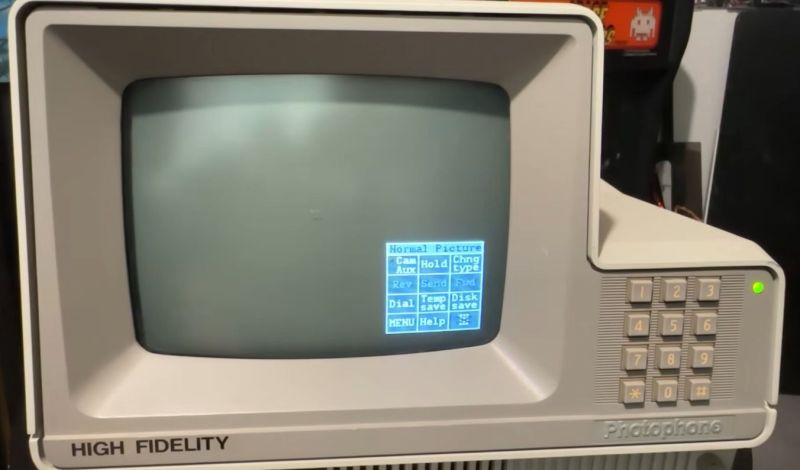
 The concept of remote video calls has been worked on since Bell’s phone company began pitching upgrading from telegrams to real-time voice calls. It wasn’t until the era of digital video and real-time video compression that commercial solutions became feasible, with the 1985 Image Data Corporation Photophone CP220 being an early example. The CP220 is also exceedingly rare due to costing around $25,000 USD when adjusted to inflation. This makes the teardown and repair on the [SpaceTime Junction] channel a rather unique experience.
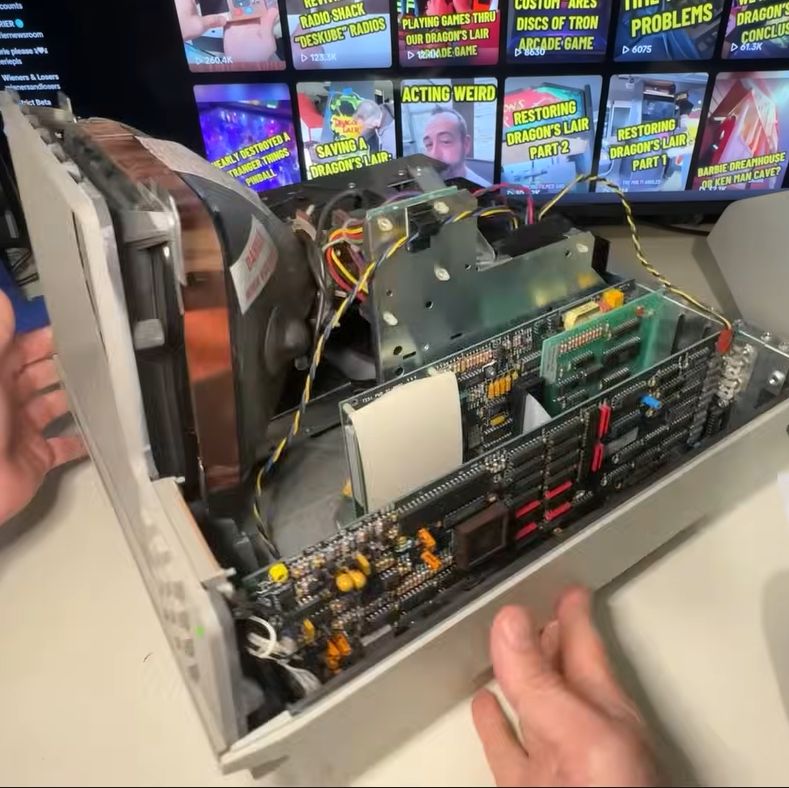
Perhaps the coolest part of the device is that the manual is integrated into the firmware, allowing you to browse through it on the monochrome CRT. Unfortunately after working fine for a while the device released the magic smoke, courtesy of the usual Rifa capacitors doing their thing. This is why a full teardown was necessary, resulting in the PSU being dug out and having said capacitors swapped.
After this deal the device powered on again, happily accepting a video input and saving screenshots to the floppy drive before it was replaced with a FDD emulator running FlashFloppy firmware. Unfortunately no video call was attempted, probably because of the missing camera and having to set up a suitable POTS landline for the built-in modem. Hopefully we’ll see that in an upcoming video to see what we common folk were missing out on back in the day.












the actual content was interesting less so his annoying rambling, stupid jokes, and obvious use of AI for a script.
I found his rambling enjoyable and his jokes funny. Also, he has a video where he shows how he writes his narration and no AI is used.
Quite a contrast with today’s free video calling. 1985 was well after the Moon landing and I can’t help thinking of how compression and inexpnsive video processor chips have completely eliminated the cost of video calls. Thanks, technology!
You take me back to the horrible days when computers were new and going to save trees! So we bought them and they sat in empty bedrooms until someone’s neighbour’s uncle could help. Thank you for providing evidence that they were not the machines we were promised. That would take another fifteen years. Yes, I became a Luddite during this period.
That was a good time to be a Luddite.
The Connections Museum is Seattle has a pair of working original AT&T picturephones that visitors can walk up and use, (among many amazing things) and the whole place is located in an active central office.
I don’t really expect to ever go back to Seattle, but if I do I sure hope I remember having heard of this place.
To be honest, the system looks a lot like a custom PC running custom software.
At first blush (trying to get a good view in the fast pans is hard), there is an AMD x86 processor, some BIOS chips, probably 256k of RAM, and a bunch of ISA slots. That floppy controller looks very much like a PC controller for the original 5150!
Personally, I would be very tempted to have a close look at the layout of the slots: could they be ISA pin-compatible? Would the cards be recognized in a standard PC? Sure, the advanced frame grabbing or keying functionality may not work – but would it output any video?
To be nitpicking, they’re PC bus slots or PC/XT bus slots (or just PC/XT slots, PC slots, XT slots etc).
ISA refers to the full 16-Bit bus introduced with the IBM AT Model 5170.
When the Gang of Nine created EISA in 1987, they named the basic, underlying AT bus “ISA”. Also in order to avoid IBM ownership claims.
Again, just nitpicking here. It’s no criticism, just a comment.
Most people call the 8-Bit port of the ISA slot as “8-Bit ISA”, anyway.
It’s virtually same thing, except for some details (zero waitstate pin, MHz frequency etc).
I can’t believe he replaced the exploded RIFA capacitor with another RIFA capacitor. They should be replaced with a suitable polypropylene X or Y class capacitor.
Someone 40 years from now will have to worry about that.