
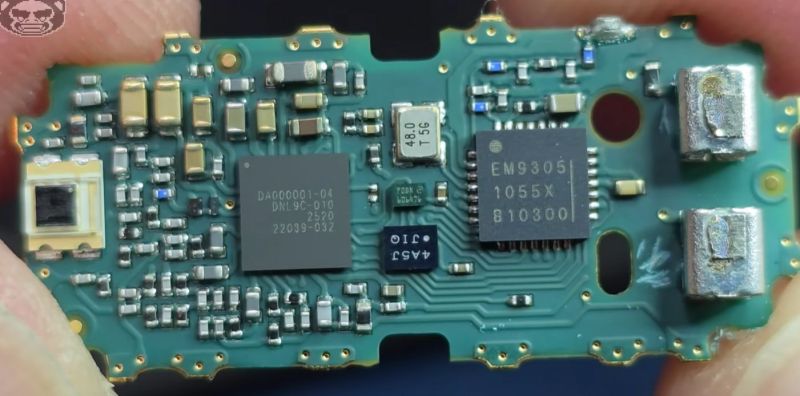
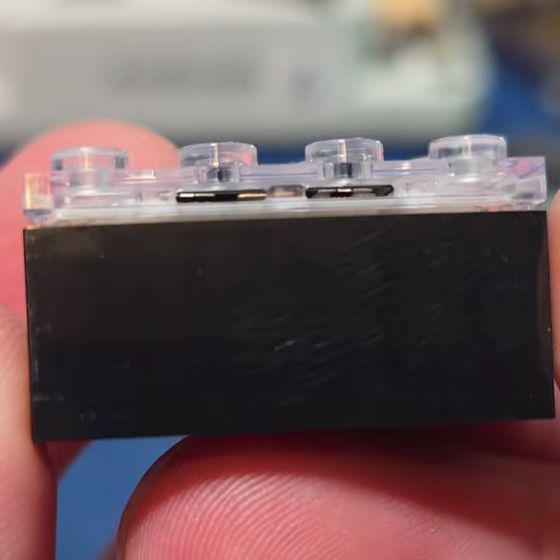
At the beginning of March this year LEGO released their new SMART brick, which looks like a 2×4 stud brick and is filled to the brim with sensors, LEDs, NFC and Bluetooth functionality, as well as a purported custom ASIC. The central idea behind it appears to be to add a lot of interactivity to LEGO builds while allowing for mesh-style communication with other SMART bricks. Naturally, this makes it a great subject for a teardown, which is what [EvilmonkeyzDesignz] over on YouTube did in a recent video.
Normally the only way you can purchase one of these new bricks is by buying them as part of a ‘Smart Play’ set, but someone was selling singular bricks on EBay. As the brick is inductively recharged, it’s pretty well-sealed, requiring a fairly destructive opening method.
Directly below the transparent top is a speaker, with the opposing PCB on the main body containing a microphone as well as a number of RGB LEDs. On the opposite side of this PCB we find the photo sensor, but to get to this part of the PCB the copper wires that wrap around the entire main assembly have to be disconnected from the PCB’s side pads with some force as they’re apparently pressed in place without the use of solder.
Freeing the main PCB from its plastic enclosure also ended up being fairly destructive, but gave the first good look at its guts. Courtesy of Redditor [PsychologicalYak4619] who previously did a teardown and analysis of such a brick, many details are already available. There’s a separate Bluetooth 5.4 SoC marked EM9305 from EM Microelectronics as well as a 16 Mb Winbond SPI Flash memory chip.
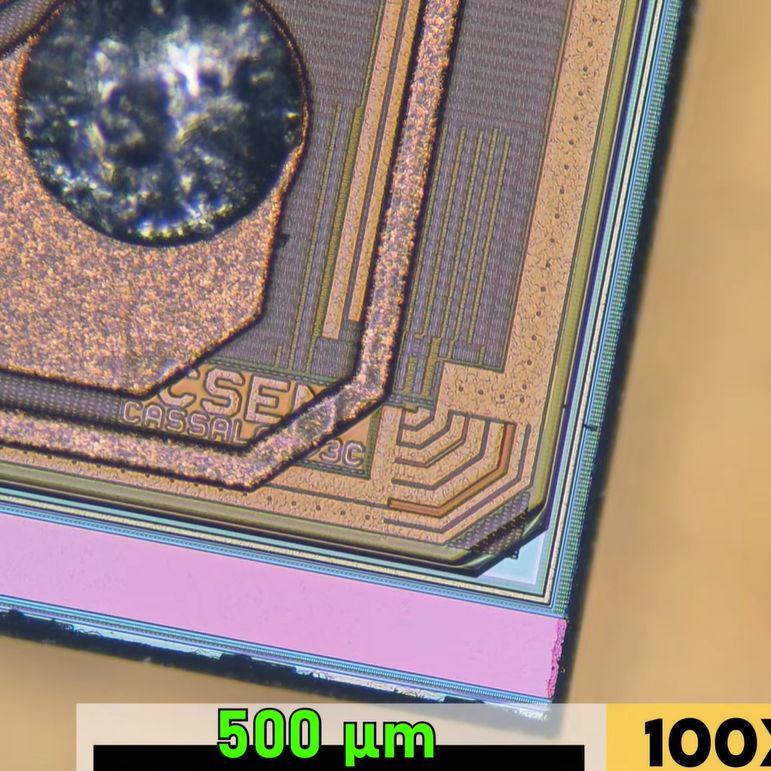
The main application ASIC – marked as DA000001-04 – is the real mystery, which is the marketed custom ASIC. Since this is a flip-chip package, taking a look at the die is super-easy, barely an inconvenience.
On this die shot we can see what looks like CSEM along with some additional letters that may or may not give a hint as to its design origins. This unfortunately means that we do not get any in-depth details on what this ASIC contains and what its capacities are.
Since there is no RAM on the PCB, it appears to at least contain some amount of RAM inside, so assuming that the SPI Flash IC is used by it and not the Bluetooth SoC there might be some hints in the firmware if it were to be extracted.
It’s also of note just how well-sealed these bricks are, making them instant e-waste if anything were to go wrong with any of its components. Considering that the lifespan of Li-ion batteries is generally 2+ years before they begin to significantly degrade, its built-in battery might be the thing that these bricks become the most famous for, not to mention make it run afoul of EU regulations that come into effect next year.











The firmware to be extracted: Well, this has already been done. At least from the firmware update files available in the Android app’s APK file.
Good notes are here:https://github.com/nathankellenicki/node-smartplay/blob/main/notes/FIRMWARE.md + the surrounding repo
And people have started building tools for analysis, like https://github.com/marcinruszkiewicz/lego_smart_brick or https://codeberg.org/maehw/SmartBrickToolkit
Happy for others who’d like to join in…
Thank you for those references. Good to see that most of the legwork has been done already.
Not shocked to see that the custom ASIC is some specific functionality for these smart bricks while the BLE SoC provides the brains. Definitely makes further reverse-engineering much easier since it’s a standard SoC with an existing toolchain and libraries.
For the uninitiated, what are the EU regulations that come into effect next year, that this will run afoul of?
AFAIK certain devices have to be repairable and the battery has to be somewhat easily replaceable by the end-user.
As linked in the linked article: https://prodlaw.eu/2025/02/eu-battery-regulation-removability-and-replaceability-requirements-explained/
But note that there are exceptions, and specifically these ones seem relevant:
Primarily use in wet environment
Washable or rinseable
Battery replaceability and removability by end-users would compromise the safety.
And seeing LEGO bricks are to be used by children and have to be rinseable and it would be unsafe if kids could open them easily I think the exception is applicable here.
But there are other lego parts that also include batteries which are easily removable so the safety argument would not be work.
This is a rechargeable Lithium-ion battery and the design is condensed and complex and has various coils that would not make it practical to design a way to exchange the battery while retaining its LEGO brick design.
And because it’s Lithium-ion it poses a risk compared to a regular battery when exposed to water.
Anyway, I think they thought about it in advance at the company and they know it will be cleared.
It’s the non-rechargeable lithium batteries that react violently when their contents are exposed to water.
Rechargeable lithium ion batteries don’t contain any metallic lithium.
This is entirely nonsense. These batteries are not an explosion risk with water. Certainly no more dangerous than a 9 volt battery, and making it non-replaceable has nothing to do with safety, just forcing you to buy another in two years.
OK why don’t you take a 9v battery and short it and see what ensues, then take a lion battery and do the same, have fun.
And do it in the order I outlined please, reasons.
Then get some fresh ones and do it by putting them in your mouth one after the other like a kid might. And please report back because I’m rather curious about that last experiment.
All experiments are done solely on the responsibility of those doing them, I (and HaD) do not take any responsibility for any damage or injury.
So you have one example of military technology that exceeds one made up civil requirement and you decide that all EU law is stupid?
I am not commenting on that, just pointing it out.
It’s not the EU making connectors, they set regulations, and now the Macbook Neo has screws and the battery is screwed in instead of everything being glued in place.
And yes there are European designed and used waterproof connectors and there have been for many decades. Bloody duh.
The smart brick is definitely not rinsable. It has holes for the audio to come out.
Good point bebop, but is the speaker cavity exposed to the rest of the case though?
Of course it also has a microphone, so that must have a hole too, and that just sits on the PCB if I recall correctly.
Either way it would be a strange oversight to make a LEGO brick like this then close it up like that and not have the ability to clean it, odd. Maybe there will be an EU edition that you can rinse.
Who knows if there will be such a rinsable brick, but this one certainly isnt. It doesn’t really matter if water will get past the speaker, because it will most certainly destroy the speaker.
You have this entirely backwards, the EU laws are necessary to force companies to make things repairable and accessable, and honestly they don’t go far enough. Why exactly are you thinking the law is a problem in a vacuum?
new EU regulation No. 2023-1542 of 12 July 2023 : Batteries must be removable from the equipment and replaceable by consumers, which is not the case here.
So, for the purpose of EU regulations, this could really just be a “smart battery”, right? The electronics that are in it are not significantly more complex than any larger battery with a full Bluetooth BMS in it.
So why can’t you call the whole thing “battery” and make that brick the consumer-replaceable unit?
Not really, the markup is significant, and because it’s not user replaceable. Even if you argue the brick is the battery you can’t buy them directly on their own, it’s Lego’s vendor lock-in.
Just occured to me how neat would an entire stack of 6×2 bricks with microcontrollers each bump a different pin.
You could even have battery bricks.
Led bricks
They launched a very early version of that in 1985 – the “Light & Sound” series. They had conductive bricks, and bricks that held a 9V battery, and bricks that held one or two incandescent bulbs, and bricks that held an annoying beeper.
I loved that beeper.
– Now my kids have my LEGO…
That was a pretty cool system, also compatible with the 9V connectors that e.g. the Control Centre uses. If I could have a nice adapter for this to connect my MicroBit to it, that would be grand. Yeah, I could cut apart the power connector cables, I just don’t have too many of those.
A lego train set I had as a child that was my fathers when he was a child. (so probably around 1965) Had a motor brick. With metal studs that were to be used as connectors. https://www.brickinvesting.com/lego/100
Lego had a solution to this back in 1966. I think these sealed units are planned obsolescence. https://www.brickinvesting.com/lego-theme/Trains/1966 https://www.brickinvesting.com/lego/100
Of course they are, that’s always been the problem with powered Lego.
off-topic
Does anybody know of alternative bricks that use 1cm as base unit ?
Modulex are 5mmx5mmx5mm but they have been out of production for a while. LEGO bought them out and it was sold under LEGO name for a while even though LEGO bricks and Modulex bricks aren’t compatible with each other.
They sold Modulex before they bought it back.
On that Reddit link it is written that the Lego Smart tags are normal NFC tags, which makes me wonder it’s possible to write Darth Vader sounds onto my writeable NFC keys. And maybe reverse-engineer sound format for good measure.
since this is Lego and designed to snap onto other devices, why can’t the battery be a separate brick that connects via the studs at the top? geh, internal non-replaceable batteries are the devil. I’m so glad Europe is taking the lead on getting rid of them. I understand they are also working to wean themselves off other American atrocities like Microslop Office (which is now a security risk due to the suddenly — and completely unnecessary — adverserial relationship of the United States). If they could just NOT ENFORCE our imperialistically-imposed IP laws, we would finally have the only kind of golden age we care about.
Probably to eliminate “this doesn’t work” complaint because the battery brick wasn’t lined up right, attached too loosely, or not connected at all.
Given how LEGO has made bricks with springs before, I think jamming a bigger battery into a brick with underside spring contacts in the studs could have worked, so its likely more to be able to sell it as just a brick and a charger rather than as a brick, battery brick, and charger which is just one more part.
Wait, so when this thing stops working, we’ll say it’s “bricked”?
A broken escalator is still a set of stairs.
A broken cock still shows correct time once a day.
👀
6 instead of noon lol
Cock?
Twice a day
Depends, if it’s a rooster. And rail clocks are often 24 hour dials.
Cockwork Orange?
Amazing article, I’ve been working on reverse engineering the board itself with EvilMonkeyzDesignz’s discord server. If anyone wants to check out the open-source repo it’s here: https://codeberg.org/shelfofsheelfs/SMART-Brick
What has been found so far is that the LEGO ASIC is responsible for synthesizing the NFC tags, sensed colors, and accelerometer motion into sound. All of the synths are fairly inductor heavy, but at the same time they are mostly straight forward. One thing I will say is that there are many pads that have similar circuits to the synths but connect to the copper caging around the brick, maybe that will be discovered later but I am not sure currently what it could be used for.
The EM9305 is all the brains of the chip, has connections for the antenna, and is the only chip connected to the brick’s onboard 16mbit memory.
PCB is likely 3 routing layers, 1 ground layer, and 1 to 2 power layers (VSS/VCC/VDD, not sure of which combination yet because I haven’t fully routed the board yet).
The pads on the back, there’s 26 of them and two power pads, are the programming pads. They power the board through the two big rectangles on the back, then program the rest through the 26 pins. These pins are not yet routed so I can’t say for sure what each do other than the big power pads.
It’s super easy to spot a Pitch Meeting fan, barely an inconvenience.
CSEM is “Centre Suisse d’Electronique et Microtechnique”, a swiss company based in Neuchâtel, Switzerland. (csem.ch). I used to wirk for that company. They develop ASICs…
CSEM and EM are based in the same area: distance around 8 kms
Neuchâtel et Marin-Epagnier, that could fit
Because BLE and Tags are made by EM
JerryRigEverything did a video on the Smart Brick last week: https://www.youtube.com/watch?v=VcAytfrHL20
CSEM and EM are based in the same area: distance around 8 kms