
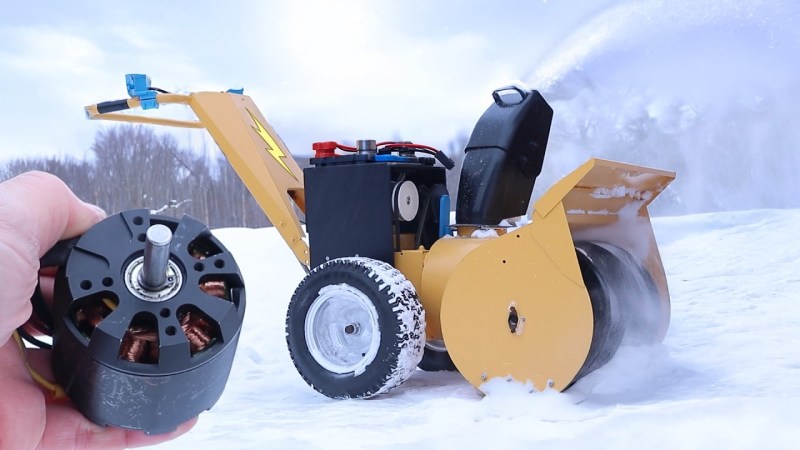
If you live in snow country and own a home, you either have a snowblower or wish you did. The alternatives are either an expensive and potentially unreliable plow service, or back-breaking (and heart-attack inducing) shoveling. [RCLifeOn] was one of those people in the second category, until he decided to do something about it: electrifying a scrap snowblower with a blown engine.
The usual brushless DC motors and electronic speed controllers [RCLifeOn] has on hand to get his R/C life on with don’t quite have enough oomph to handle both functions of a snowblower. For those of you cursed to live in warmer climes, the modern snowblower is both self-propelled via its twin wheels, and generally has a two-stage powered snow-removal “blower” consisting of an auger to break up the snow and an impeller to blast it out of the machine and many meters off the driveway. On the traditional gas-powered models, these are both powered via belts off the same motor, but that wasn’t going to work.
He kept the belts, and simply used a pair of motors, each with their own ESCs that are controlled via oversized thumb wheels on the handles. The belts couple to the motors with 3D printed pulleys. Belt tension is achieved in the case of the wheels through a simple and sensible shimming arrangement. In the case of the blower motor, he uses a 3D printed adjustable mount to get the appropriate tension. To help it hold long-term (given the issues with creep in 3D prints) he’s got a bearing on a second mount opposite the motor. It holds up for his demo, which consists of clearing a driveway of 10cm of snow and then plowing through a pile larger than the mouth of the machine. In other words: it works.
The build, as unfortunately common on YouTube, is shy on specific details– but in this case that’s fine. Even if he’d open-sourced everything and posted STEP or STL files, it wouldn’t save much time since you’d pretty well have to re-engineer the build to fit your own snowblower, if you were so inclined. As with many hacks of this nature, the point of sharing it is to show how easy it is and provide the inspiration. As the cartoons used to say, “knowing is half the battle.”
If one was to re-implement this hack, we could not encourage you strongly enough to put in the standard dead-man’s switch, a feature commercial snowblowers share with things like lawnmowers. As annoying as it is to hang onto with frozen fingers, that safety feature is there for a reason.
If your driveway is short, you can save on gas and fuel costs with an extension cord. Or you could just stay inside and do the job by remote control, but that comes with its own pitfalls.












If I was so inclined to build an electric snowblower I’d simply buy a standard Besel 2,2 kW 3-phase industrial motor, matching switch, a length of OW 5×4 mm² cable and IEC 60309 plug. No need to keep a lithium-ion bomb around my house.
Feeling hyperbolic and fear mongery today are we?
“simply” is doing a non-simple amount of work there.
Anyway, I’ve made a couple attempts at trying to make a pedal powered snowblower and that turns out to be not easy at all. Separate motors for movement and blower makes a lot of sense, solves a lot of problems.
Who in the US has 3ph residential power?
Likely the same question in the rest of the planet
Farmers.
It really needs a dead man’s switch so it will stop if you let go of the handle.
Lets see… What weather do batteries perform the worst in?
Just add a gas-powered battery heater!
Really? They are being used for minutes at most, not like he is driving at on a road trip. Can literally most a few feet and plug them back in. He actually said his batteries would do something like 3 times the size of his driveway.
I dont think that is as much of a problem as you think it is
That really isn’t a problem. The batteries have a know performance at low temperatures, so it is easy to compensate for that.
The dead-man switch won’t save your fingers when the auger picks up a stick and gets jammed – if you reach in to pull out the stick, it can release the tension and you ain’t fast enough to get your hand out of the way, Frodo.
I don’t think you are understanding the point of the Deadman switch. On modern snowblowers, as soon as your hands are off the handles the auger has no power to it. Nothing is trying to turn the auger.
If you somehow wound a rubber band in the thing enough to store up tension… Well I guess your doomed…
I don’t know how commercial electrics do it, but I would go a step further and figure out a mechanical brake on a home made one because electrics are scary sneaky and with no engine running could be in a state of applied power – too easy to do a dumb but that’s just me – I tend to overthink and over engineer. :)
Usually the “drive” connection between the auger and the driveshaft for it, is some dowels or bolts made of soft material that’d shear in half in such scenario.
Though not uncommon to see it being replaced by hardware store bolt & nut.
Having never used a snowblower before, despite living in Michigan for years, I question the necessity of having it self-propelled. Sure, if you’ve got the power handy then why not? But, if you are having to add an additional motor just for that, then why can’t you just push it along? It’s still a lot less heart attack inducing than shoveling.
I’ve used plenty of gas and electric lawn mowers that were human propelled as well as self-propelled and the difference wasn’t really all that much.
Two things worth considering are: 1) Snowblowers tend to weigh more than even the heaviest gas or electric lawn mowers, and 2) Unlike a lawnmower which moves over a lawn to cut the grass blades, a snowblower will encounter more resistance when moving forward since in needs to gather the snow into the auger blades for it to be propelled out of the chute.
A better comparison/analogy would be if you were mowing an unkept yard with REALLY tall grass… you’d be missing your self-propelled lawnmower real quick in such a situation :)
A few winter seasons ago, my friction wheel in my snowblower was so worn down that it no longer transferred power from the wheel plate to the drive wheel axle (essentially rendering it a self-propelled snowblower). I can confirm that pushing a 250lbs piece of equipment around a slippery driveway is no fun and I quickly bought a new friction wheel to rectify the situation!
Try pushing a several hundred pound snowblower into snow.
There is a reason they almost all have power assisted movement.
Light fluffy snow, you can push them yourself. As snow gets more wet and dense and if you have hills, that propulsion makes a world of difference. There is more mass to move and push into than most lawn mowers see in a typical lawn. I actually have chains on the tires of mine!
Example posted here is the light side. This machine is actually overkill for this tiny driveway. (But still neat as a project!)
Snow blowers weigh more and move over worse terrain, you can also easily slip trying to push it into semi-solidified snowbank (you typically don’t need to push mower into grass). Different forces at work require different machines and engines.
L.O.L. I have a 30″ 2-stage snow blower powered by a 20hp gasoline engine which is self propelled and the drive wheels have snow chains. If we get more than about 6 inches of wet snow, I often encounter traction issues on flat ground, forget going up hill. Equating pushing a sub-50 pound lawn mower across flat grass to a multi-hundred pound machine designed to displace heavy wet snow is ludicrous. Simply pushing my snow machine across a completely clear driveway without it running is like pushing a loaded wheel barrow with a flat tire.
Sleigh shovels are pretty easy too.
Here’s me feeling sheepish for buying a Yarbo autonomous snowblower. If only it didn’t also function as a lawnmower, a leaf blower, and (eventually) a weedwacker…
If the original motor was a Honda GX clone, then except for freak scenarios, only way to seriously hurt the internals (ie: expensive and time consuming parts to fix, if it’s even possible) are if it’s run out of oil, got water into it or overrevved due to bumbling with the governor rod.
Rest are surprisingly easy and cheap to fix.
Got into the video far enough to see him doing some welding and then later complaining that the 3D printed motor mount sagged… So, if you have a welder, why 3D print the motor mount?
Gotta work those YouTube®©™ Engagement Minutes to please The Mighty Algorithm and earn penis on the dollar from suckers wasting their time in front of the screen.
Giggity
One word, prototype (or prototyping)
Welder but no drill press?
Clickbait is more likely.
I have an 8 hp Toro. I’d love to put an electric motor in it but he gives no information on motor size and cost. 8 hp dc motors are hugely expensive. Anyone have experience in this area? I understand he used two motors which is the way to approach it but which motor? What size? Lots of questions…