
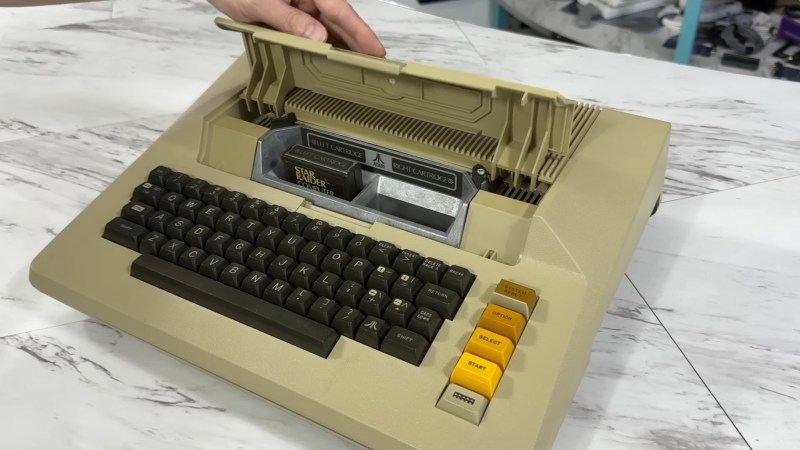
[The 8-Bit Guy] tells us how 8-bit Atari computers work.
 The first Atari came out in 1977, it was originally called the Atari Video Computer System. It was followed two years later, in 1979, by the Atari 400 and Atari 800. The Atari 800 had a music synthesizer, bit-mapped graphics, and sprites which compared favorably to the capabilities of the other systems of the day, known as the Trinity of 1977, being the Apple II, Commodore PET, and TRS-80. [The 8-Bit Guy] says the only real competition in terms of features came from the TI-99/4 which was released around the same time.
The main way to load software into the early Atari 400 and 800 computers was to plug in cartridges. The Atari 400 supported one cartridge and the Atari 800 supported two. The built-in keyboards were pretty terrible by today’s standards, but as [The 8-Bit Guy] points out there wasn’t really any expectations around keyboards back in the late 1970s because everything was new and not many precedents had been set.
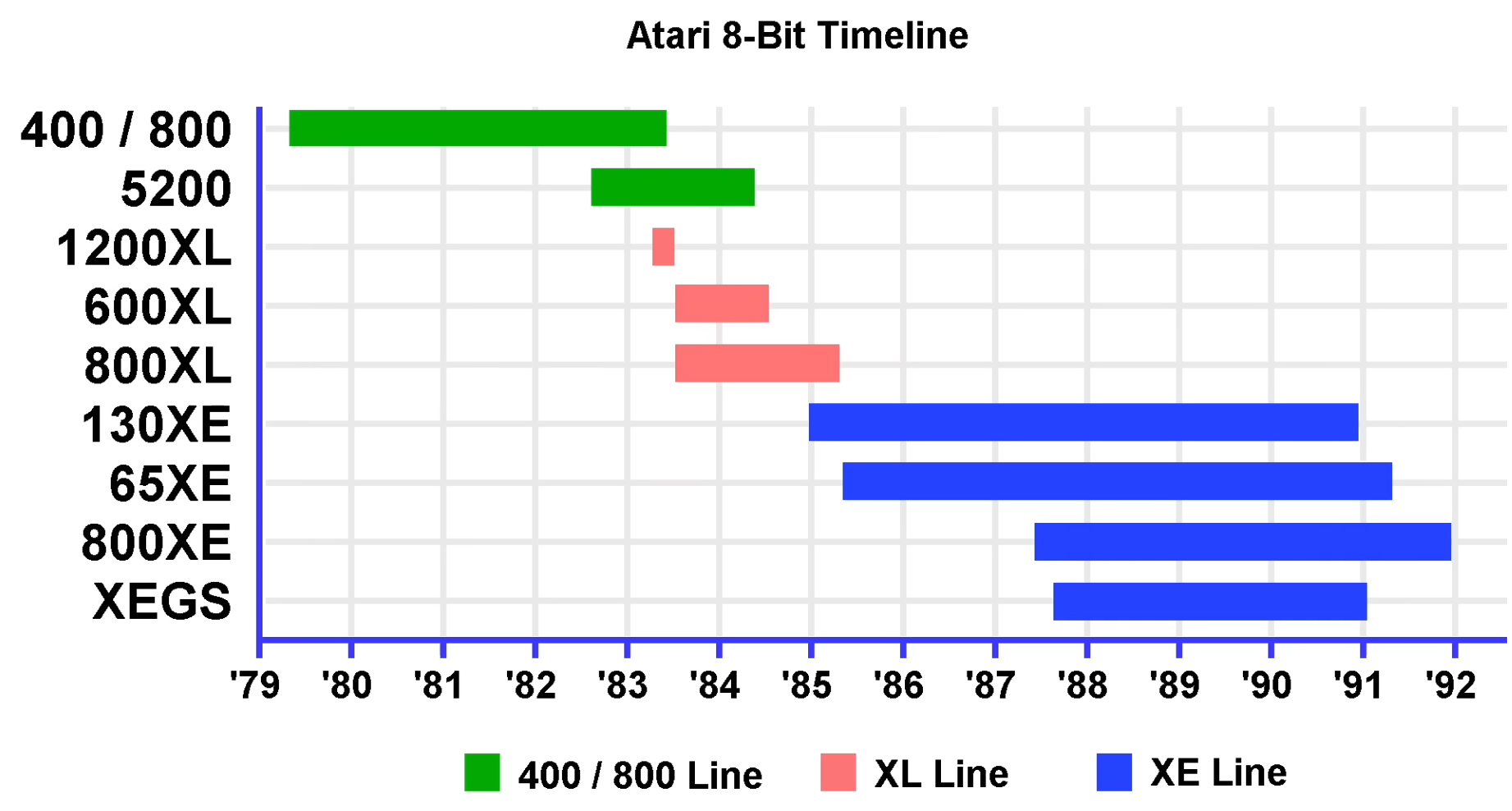 [The 8-Bit Guy] goes into the hardware that was used, how the video system works, how the audio system works, and what peripheral hardware was supported, including cassette drives and floppy disk drives. He covers briefly all ten of the 8-bit systems from Atari starting in 1979 through 1992.
If you’re interested in Atari nostalgia you might like to read Electromechanical Atari Is A Steampunk Meccano Masterpiece or Randomly Generating Atari Games.












The 400’s keyboard is terrible because it’s a membrane keyboard, but it is a thing of absolute beauty. The 800s keyboard is excellent, have one here and at 45 years old it still works perfectly, and still feels better than many more recent keyboards.
I had callouses on my fingertips as a kid from the atari400 keyboard. It was a brutal experience. I wanted an 800 so badly.
My first computer was a Sinclair ZX81, again with a membrane keyboard – I can sympathize.
It says a lot about that keyboard that my subsequent Sinclair Spectrum+, with its plastic keycaps (not the rubber membrane of the earlier non-Plus model) was a huge upgrade.
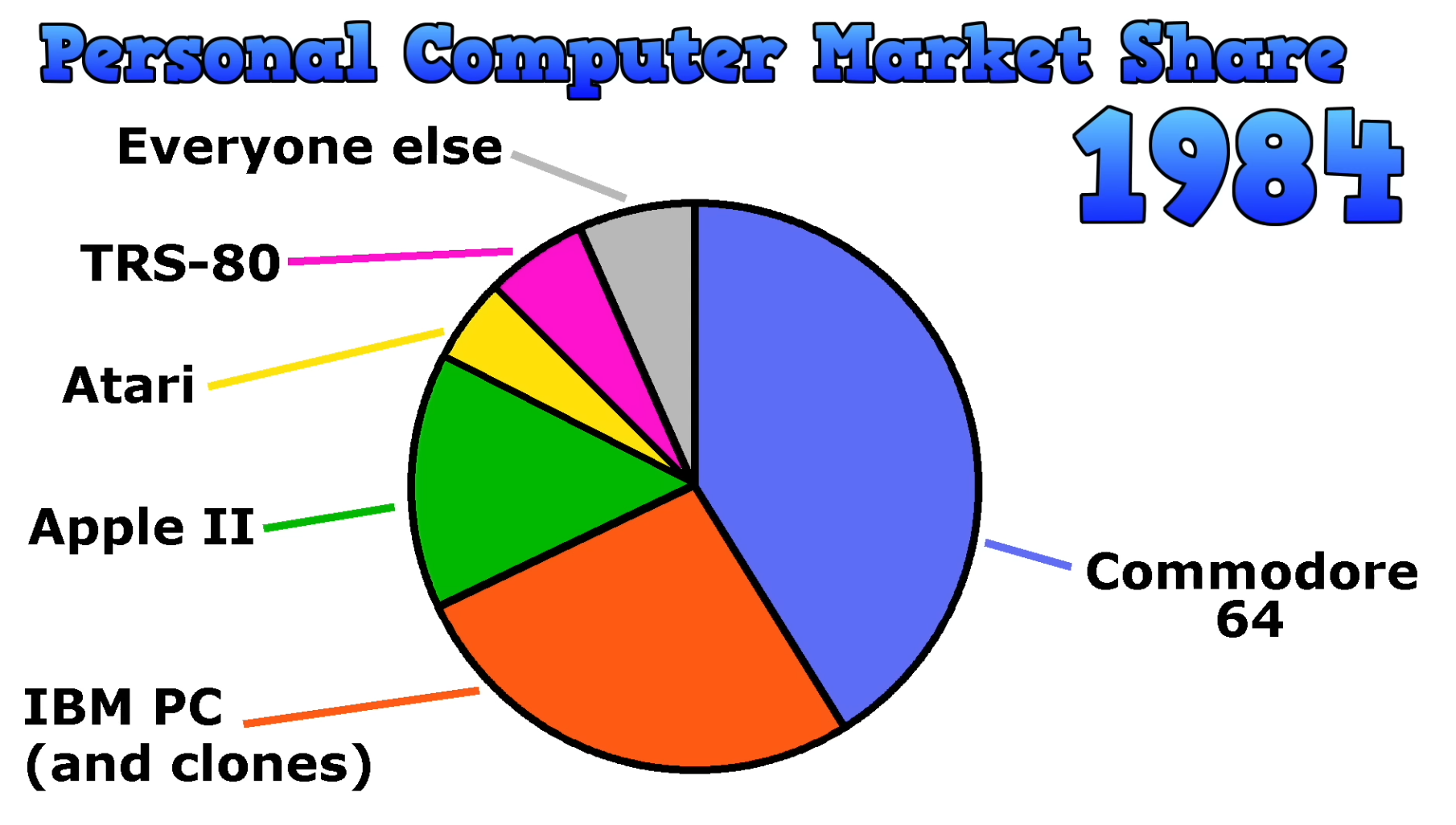
As an aside, is that graph of 1984 market-share in the article for the US market only? It doesn’t bear any resemblance to the UK/Euro market that I recall. I had friends with C=64s, Spectrums, Dragons, Vic-20s, Orics; one oddball who had a TI-99/4, one or two kids with parents rich enough to afford a BBC B – but no-one I knew had an Apple II or an IBM.
Definitely the US. Totally different from Europe and the UK scenes, as hardware prices and availability were different.
Plus, software rights were divided up by region and media types, further separating the markets of the time.
Same here. I ended up getting an Atari 600XL a few years after the Atari 400, only for the better keyboard.
The Atari lacked any real programming documentation and I didn’t really have access to assembly language for it, so I ended up getting with a C64 which had an excellent programming manual, and I stayed with Commodore through the Amiga era.
The Atari 800 was a great little machine.
Too bad home computers are merely being remembered as video games, though.
There were so many more fascinating things that they were used for.
Such as calling computer mailbox systems, amateur radio, measuring&control, solving equations, running simulations, calculating filters etc, predicting satellite orbits, astronomy, Eliza..
If you had a printer you could awe everyone with your printed banners and reports.
Ti should have actually used it’s 16 bit processor at 16 bit instead of just 8 bit.
Same can be said of Intel and the 8088…
Imagine how frustrating it must have been to be in a world where a significant limiting factor was the cost of memory, and designs were having to be restricted & limited to work around that.
Thank goodness we now live in a world where memory is cheap and abundant and there’s no shortages, eh? (← sarcasm)
It’s so sad when people think they have to tell people that they are being sarcastic.
I think both sarcasm and irony never exactly went well over the internet to begin with.
It was sort of a classic internet rule, even, I believe.
Think about all the innovative hacks that were invented because of those limitations. A new golden age is upon us! (←sarcasm)
It couldn’t. The necessary electronics on the motherboard would have been cost-prohibitive. The 16-bit processor was tethered to an 8-bit architecture. Had TI been able to build an entire family of computers with the TI 99-4/A as the base model, offering more advanced machines available at a higher price point, it might have worked out. It’s a shame because TI sold A LOT of 99/4A’s. If nothing else, we got a phenomenal game of Space Invaders in TI Invaders.
I had the impression at the time (early 1980s), that the TI 99-4/A really only reached peak popularity after it had already been discontinued/orphaned and they were being flogged-off as remainders at “rock-bottom” prices, my Dad bought one for $100 and whole pile of accessories in short order, when they went on discount sale.
My Dad got one for $50!
The Atari 800 was my first computer, which I choose after doing a lot of research and realizing that it really was leaps and bounds above other computers of that age like the Apple 2 and TRS-80.
I used to get so mad at Apple owners being so smug and acting like their computer was the best in the world.
Apple barely had sound, when Atari had 4 channels! Apple didn’t have sprites, and only had 8 colors, when Atari had 4 sprites and 256 colors!
Atari had a plug and play I/O system that didn’t really get an equal until USB was invented, decades later!
I feel like people barely scratched the surface if what the Atari was capable of because they kept on doing bad, low effort ports from the Apple 2.
If only Atari had been run better… If only Warner respected what they had instead of treating it like a money printing machine and dumping it the moment the market hiccupped, a hiccup of their own making.
I still have an extreme dislike for Apple, but I now understand Atari managements role in their own downfall.
The Atari 800 actually had 5 channels of sound :). The 5th was on the GTIA and was analog instead of digital like the 4 sound channels of pokey. The keyboard speaker under the keyboard on the 800 used the 5th channel.
“Beeper music”. The GTIA wasn’t calculating anything, it just let you flip the bit attached to the speaker. You had to implement PWM in software, same as the Apple 2.
Since that speaker was inside the machine and didn’t mix with the other sounds channels (on 400/800 at least), so you couldn’t really adjust the mix or volume.
For people like me who liked to stay up late while the family slept, the first thing I did with a new machine was to rip that speaker out!
I was and still have the same mindset.
The very first computer I really played with was my neighbor’s Atari 400 with the chicklet keyboard. We didn’t know better and thought it ok for the most part. Maybe two years later, got to play with Apple II’s in a math class which was fun but very, very basic (no pun intended).
My neighbor (who I just found may have passed away sadly) got a nice Apple II setup. He and I would dink around with that. Occasionally got to play some games too.
My own first computer was an Atari 800XL. I too had done a lot of homework reading everything I could, talking to friends and hanging out in stores. The Apple II was just too darn expensive. But it was the go to for parents since that is what the schools had to was considered “safe”.
Since my parents did not believe in computers (and I might “hack” something which was parallel to their thoughts of my electronics tinkering would cause the house to burn down!), I was on my own to raise the money. I got a sweet summertime job that would serve as the core of the money needed! Plus a few lawn mowing jobs, installing a car radio in a neighbor’s Volvo, etc. Just had to decide what to buy…
Again, the Apple II was just too much money! The IBM PC was just too business targeted. Color graphics? Pfft. Sound? Not needed for an office appliance. The Commodore was kind of similar to the Atari but just not the same in graphics and sound. Similar with the TI-99 and TRS-80 (though I did bike to the local Shack a lot!).
So I got the 600XL. But I boxed it up just two days later. It was fun and I was going to need more memory! So I brought it back to the store and got the 800XL. Served me well for many years through high school and college. Lots of homework done on it with a questionable third party dot matrix printer. Even in to college still used it (though with some close calls in the dorm room during parties). We even ran World Series game bracket competitions for those interested in the hall. Money may or may not have been exchanged…
But back to the Apple II, the cult definitely existed back then. They were superior to everyone else. Parents had the Apple credit card and put the Apple sticker on their cars to show the world they only had “the best”.
I too was sad and mad by Warner Brothers management of the product line. Between that and the rampant program copying (which I was a receiver of) really hurt the brand. Developers reluctantly released Atari ports as it would be shared via sneakernet in short order.
Thanks. I just got that “raspberry” sound resurfaced and lodged in my head now!
Yes that Star Raiders game was fantastic! My neighbors had it first and we spent hours playing that.
Perhaps not well known, we liked “Kingdom”. No fancy graphics. Just had to budget and manage your “kingdom” to stay in power, grow it and avoid being taken off the throne. We loved that one too!
I couldn’t afford an Apple, and the Altair was way out of question, so I purchased a 400, mostly to play games, but soon found out it was much more powerful. Where I worked, we had mainframe minicomputers to run test programs for production, but the 400 was way more powerful that that system and I soon started doing all kinds of programming. I really liked the joystick ports since they could be used for digital I/O and I used them to control all kinds of real world stuff. I had not problems with the keyboard and found that I could touch type easily. I eventually upgraded the 400 to 48K, and a few years later got an 800, but I still liked the 400 with the exception of it having no monitor support. I still have a 400, 800, 800XL, and 65XE and still enjoy gaming and playing around with programming, but the ESP32 is my controller of choice these days.
I wonder what would have happened if Atari survived and had been around to make and sell 64-bit home PCs. I imagine these would cost around ~$400 per and do things like quantum computing no problem.
Considering how their “64 bit” gaming console fared, it would have crashed and burned.
These days, Atari users use a FujiNet to connect to the Internet for loading software and connecting to services.
And it’s fantastic! Thank you for all the hard work. :-)
!!! 100% !!!
The fujinet is the best thing to happen to old computers since FOREVER. Well done Thomas!
In 85 I had an Atari 130XE, that machine rocked. IIRC the keyboard wasn’t awful either. Spent hours playing “Spy vs Spy” with my little sister :-). Mostly I used for programming, I remember slaving over a 6502 assembly routine to scroll a player vertically within the sprite (players/sprites on Atari took up the entire length of the screen). Great fun. Would have loved to have an 800 even then, that was one solid beast of a computer in terms of construction / expandability.
The Atari 800 was my first computer. One of the things not mentioned about the sound made when doing I/O, was that you could tell when something went wrong during the I/O. For example, if there was an error when loading from the floppy disk, the sound would change to a “rasberry” and you knew something had gone wrong.
There was a company that developed an 80 column display cartridge that I purchased. I then wrote a program for a terminal emulator for the Control Data terminals that we used at work. I was then able to dial in using the Atari modem and edit files from home.
I must admit though, that what originally sold me on the Atari, was the Star Raider game that I saw being demo’d at the local science museum.
I still have my 400. My friends thought I was mad when it was still under warranty I took to it with a soldering iron and expanded its memory from 16KB to 48KB so that it could run everything the 800 could, no longer the poor little brother except for the utterly terrible keyboard. Still works to this day.
About Me. I started by having access to a IBM AS400 with paper tape in 1966 in elementary school. Wanted to have one. Years later I had the Timex Sinclair. My first Atari was a 800xl. Had to upgrade and bought the 130XE, Ram drive MIO and started one of the first BBS in Tucson AZ. Things happen and I periodically would check it out. I bought a 1030 SD drive and that changed everything. I pulled out De Re Atari and started to write a real subtractive analog synthesizer, which I truly enjoy. Pokeys 4 voices lend themselves to 3 VFOs and I made 1 VFO a ring modulator. I copied the ladder filter in my Moog 203a (Think Gary Neuman-cars) I added filters and more modulators in software. I am using a 850 interface for midi for external keyboard. I need to now port the code to MAC65 and compile followed by some tests for debug. Solid code should be good.
If successful this program will make a true serious instrument worthy of an artists use and not just a simple toy music box.
Yeah, Atari rules and Apple/Commies/Trash80s can go eat crayons. Take that Jack Tramel!
I had both the 400 and 800 and a 130xe. I love Atari. Even though I use Windows and Linux now, I still miss my 800. Likewise I also ran a Atari BBS in Tucson AZ. Wish I could find another 800.
I was a commodore 64 guy but the Atari 1040st the computer after the 800 is the most complex 16 bit computer in existence I would say better than the Amiga and way better than the Apple IIGS or Laughable Macintosh.
No way was the Atari 1040st better than the Amiga, in every way. Amiga had stereo sound, Atari did not. 4096 simultaneous colors and lots of resolution options. AmigaOS was far, far ahead of Atari’s GEM. But this is an old religious war that we probably shouldn’t have on hackaday.
“an old religious war”
You’re not wrong. Although these days, we appreciate ALL the old systems. I was a C64 guy back in the day, but love my 800XL now, alongside my C64. I still use both on a weekly basis.
Yeah, we can lay those religious wars to rest now. I bought a 520ST at launch and eventually bought a Mega ST 4. I also eventually owned at Amiga 2000 and 3000. Jay Miner was a genius and just like the Atari 800 with a GITA could do many things a C64 could not do, the Amiga he designed could do many things the Atari ST could not do. Honestly, other than MIDI and the graphics tricks aided by a blitter chip (which sadly the Amiga never added), the Amiga was superior to the ST in just about every way. I’m not saying the bitplane graphics were easy to program for vs the ST because they weren’t, but you can’t argue with the results.
I remember playing M.U.L.E. and getting a card that said someone bought my Atari at an antique auction or something like that. I laughed then. Now I laugh that I laughed.
Cartridges weren’t the main way to get programs into the Atari 400 and 800 in 1979. Tape and Disk drives were available at launch and most programs could only be loaded into a 400 or 800 that way. The keyboard on the Atari 800 was actually quite good for the time, but it hasn’t aged well and typing on one today can be quite difficult. I added an aftermarket plastic keyboard to my 400 and it still types as well today as the day I bought it. Yes, it’s not as good as a mechanical keyboard you can get today but it is surprisingly usable. Finally I will say that the sprites (player missile graphics) on the Atari 400/800 were actually far better than the ones available on the Trinity of 1977. They really would not be matched in any home computer until the Commodore 64 came out 3 years later. That is why most good games from 1979-1982 were made first on the Atari 400/800. After the C64 released that began to shift over and in a few years, almost all games were made first on the C64 except for in Europe.