
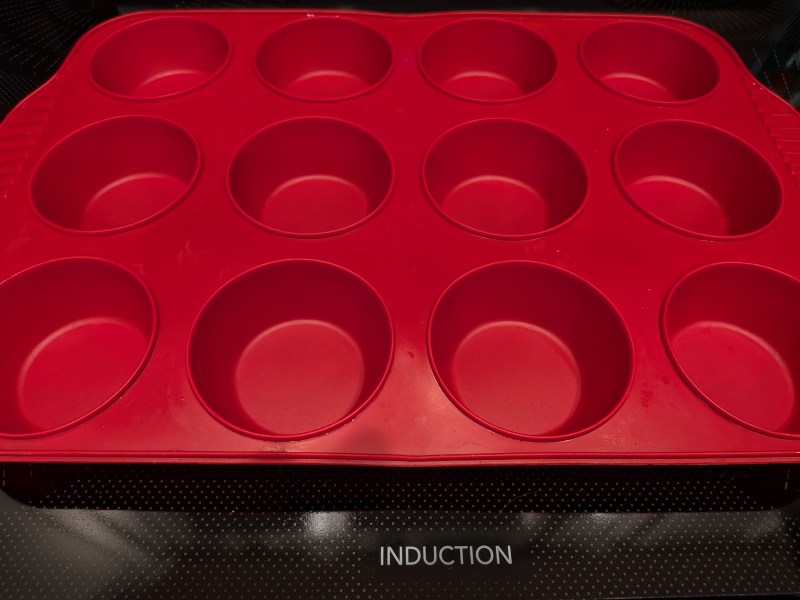
Silicone bakeware has become a staple in many kitchens due to its flexible, yet temperature-tolerant nature. New research from Canada shows it could be causing trouble for your liver and lungs, however.
The siloxanes that make up silicone bakeware can target “the liver through oral exposure, as well as the liver and lungs through inhalation exposure.” The fat content of the food being baked is also a factor as these compounds are lipophilic, so higher fat foods will absorb more siloxanes than lower fat foods.
Don’t throw out all your silicone yet, though. The researchers say, “the results showed a consistent decreasing trend in migration levels across consecutive weekly baking sessions, with no increase after the seven-month interval.” So, that dingy looking silicone mat you’ve used a hundred times is safer than a brand new, brightly-colored one.
This seems like an example of how glass and (non-heavy) metal are usually the best way to go when handling food. While we’re talking about ovens, do they really need to run a connectivity check? They certainly could be improved with a DIY thermometer or by making a more practical solar-powered example.











The older I get, the more it becomes apparent that someone is always trying to convince me that whatever I’m doing is killing me. Unfortunately living leads to death with 100% certainty.
Science journalism is the boy who cried wolf. If people wonder why the average peasant now has doubts about things like germ theory and vaccines, look no further. Should’ve just kept their mouths shut.
Results from the past are no guarantee for the future; and assumptions are the mother of all f*ck-ups.
Go ahead and smoke and drink.
Science journalists are the boy who cried wolf. They shouldn’t act confused when the average peasant stops believing in science, when they’ve been sensationalizing it for decades. Coffee is good for you. No, it’s bad for you. Same for eggs, and so on. At some point people just tune it out.
Reposting this because apparently it hurt someone’s feelings, so I’m making them delete it again. Have fun!
” Repeated baking shows a steady decline in migration and emissions, suggesting depletion of siloxanes in the products over time. ”
Having worked in silicone medical device manufacturing for 2 decades Id like to offer a probable explanation. Low quality silicone, and poor post cure procedure in budget oriented manufacturing facilities lead to excess residual siloxanes.
Depending on the type of silicone used baking for somewhere between 2 hours at 177°C to 4 hours at 200°C would virtually eliminate any residual siloxanes. Naturally you would want to have good ventilation and avoid inhaling any potential fumes emitted to sidestep the respiratory risks implied by this study.
How does this relate to silicone lube on condoms and such? You literally stuff that inside of your mucous membranes. Makes me wonder a bit about the safety of that.
It doesnt.
The issue is with uncrosslinked siloxane molecules (monomers).
In the most basic terms, a bit inaccurate but simple to understand, If you have to have absolutely precisely 1:1 part A to Part B to have a fully cured part. If you have 1.00000001:1 you will have some residual free siloxanes that need to be removed during postcure. Similar an mSLA print going into a UV postcure oven, in medical device manufacturing we place silicone into vacuum ovens to purge any residual free siloxane molecules. Bakewear manufacturers are using lower grade silicones and not adequately post curing their products leaving excessive free siloxane monomeric molecules to “post cure” into your meals and homes.
Silicone lube is made of silicone POLYmers like dimethicone, cyclopentasiloxane, and dimethiconol. These tend to be quite pure as they are isolated through distillation. It is possible that some manufacturers of silicone lubricants could skimp buying low purity industrial grade silicone polymers but the likelihood of tissue sensitivity being exposed and them being sued to high hell is obviously much greater.
Thank you for posting actual information rather than some rant. This is yet another tidbit going into my nerd OneNote
The rest of you can go back to drinking out of your lead mugs.
Makes the wine sweeter, dontcha know.
Let me just say, +5 points for an on-the-point user name.
Only thing I really have is one of those that allow one to pop popcorn in a microwave.
The (other) problem with silicone mats/forms for cooking is that it always rated at 220C max, and as the heating element kicks in it constantly gets temporarily hotter than that.
So if you want to be within specs it’s only useful for a subset of ovens that are large and have a non-direct heating system.
Silicone mats for soldering are another story though, those are good for above 450C and now I’m wondering if you have to worry about the gasses mentioned with these. Although even with hot-air the heat doesn’t hit the mat that much normally, and only locally.
Plus you often use devices to suck the air away anyway.
The difference in these ratings is duration. Bakewear’s temperature ratings are for continuous use, they can withstand short bursts of temperature of a hundred degrees or more above that rating. The spikes in temperature in domestic and commercial ovens are well within safe range for these silicones.
Soldering mats ratings are not for continuous use, but rather their maximum temperature tolerance. If kept at these temperatures for an extended period, they too will breakdown.
What happened to the ozon hole?
We stopped using CFCs in great quantities, and it largely closed up. It’s a tremendous success for concerted action in light of proven human pollution.
But companies like those that rhyme with Bunnyhell are still producing propitiatory gases which are unhelpful when things like Butane/Propane have been known to work for decades but the corporations & NGO’s have pushed people away from them.
R1234yf vs R600
For some reasons we wont use R600 in cars because it’s “flammable” but hey ho, gas tank enters the chat.
It just so happens that R1234yf is ridiculously expensive. Funny that.
GWP similar.
This silicone thing is another example – and ensh*tifcation . In fact ever since we moved away from sustainable materials for “ease of use” it’s been a giant cluster fudge and few key companies have made bank.
Wrapping things in wax paper.
Packaging in wooden boxes.
Glassware bottles.
Hessian sacks.
All replaced with plastics – remember kids – for your benefit.
Meanwhile the one thing we wont do in recycling: go back to sustainable materials ie: stuff that grows.
The one thing we wont look at to repair nature is…. nature.
rant rant rant
You do have some good points, however
not so much – The population of the world with so many cases being single use would make using wax paper and wooden boxes for everything impossibly expensive if it is even possible without causing mass ecological destruction – glass and hessian sacks that are likely to be reused and recycled relatively locally and readily isn’t so bad, though likely bulkier and heavier than the alternatives so the shipping cost gets higher. Which is why we do still see lots of glass bottles and jars.
Plastics done right are a good thing, long lasting, in theory very recyclable when they hit EOL, chemical resistant, good mechanical properties, cheap to work with etc. So while I do agree more can and should be done with more directly biologically derived ‘plastics’ of the fast growing sorts like bamboo, hazel, and hemp (and maybe bacterial colony produced stuff too) its not going to replace plastics in large part. What we do really need where plastics are concerned is mandatory plastic content for single use things like food packaging, perhaps colour coded to make it easier to sort for recycling – so all HDPE is dyed Green, ABS Black, etc and/or all x type of items are made of y.
https://ozonewatch.gsfc.nasa.gov/statistics/annual_data.html the hole is about as big now as it ever was. I’ve read predictions that it will close up in about fifty years if we keep a lid on CFC’s and other ozone depleting gasses, but whoever told you that it was a solved problem was seriously wrong
You’re right! I totally misremembered. It’s not that the ozone hole is closing up, but rather that the rate of growth has basically stopped.
This graph makes it most clear: https://ozonewatch.gsfc.nasa.gov/facts/history_SH.html
From rapid rate of depletion to stable inside of a 5-10 year period (that second knee in the mid-90s) is pretty remarkable.
But you’re right that we’re still down a bunch of ozone, and that a full recovery to pre-1970s levels looks like it will take a long time.
https://www.csiro.au/en/news/All/Articles/2019/July/eastern-china-pinpointed-as-source-of-rogue-ozone-depleting-emissions
China is “cracking down” on the illegal use of ozone depleting solvents and chemicals in production of electronics, but you know how it goes… cheaper is cheaper, and cheaper is what keeps the whole business in China.
And here’s the reason why it has flatlined: the emissions reductions have flatlined.
https://www.csiro.au/-/media/WordPress/ECOS-2/graph-2.png?mw=800&hash=405F851CF3C08A66D0C7BA43AD343B29
Newer report:
https://eaps.mit.edu/news-impact/tracing-persistent-ozone-depleting-emissions-to-their-source/
The problem is that there still remains a whole bunch of legal and unregulated uses of various ozone depleting chemicals in China that they were supposed to phase out ages ago.
One of the major sources of CFCs is…. drumroll… silicone production.
Never trusted these in the first place, steel bakeware all the way
“Non-heavy” metal… so perhaps stick with Cinderella and Winger for a bit more safety when working in the kitchen. (But perhaps no Ratt?)
best comment! thank you
Yeah, I’m sure there are all kinds of bad things in our modern environment.
2024 study:
Median of 6.5 grams of microplastics in a human brain. (heavy duty plastic spoon 4-6 grams)
Median of 34.5 grams in a brain with dementia.
What’s strange is that the next organ with the greatest concentration is the liver with only 0.65 grams in a greater mass and volume and that figure is much higher than all of the other organs tested, so the brain is where it REALLY seems to concentrate for some reason… for some reason… for some reason.
Forgot to mention that a 2025 study in Nature produced and even higher figure.
You don’t have a plastic spoons worth on the brain. They slipped a decimal or unit somewhere.
Not unlike the study with black plastics being the end of us in kitchenware, 3-4 months later after people disposed of their black plastic kitchenware they realized they used the wrong units somewhere and the slightly elevated numbers for black plastic were still under safety limits.
Anyway, I prefer to have a plastic spoon than a metallic knife in my brain. Thank you.
A number oft quoted, less frequently questioned.
Why, and more importantly, HOW, can a brain be measured to contain 5% plastic?
Short answer: “We don’t know.”
Longer answer, direct from the authors: “…unknown organic molecules likely remain and influence the resultant Py-GC/MS spectra.”
Note they don’t include error bars or uncertainties in their measurements, and that number has not been replicated.
But it’s sensational, so people keep repeating it.
Parchment paper, or paper infused with silicon to make it an oven durable cooking material, is really handy… Now I have to check if that’s another environmental poison killing us just a little quicker. Any material savvy folks know much about that here?
Note that silicone impgregnated baking paper / parchment paper is something to consider and generally won’t ‘bake out’ since it’s disposable
I use silicone muffin cups to hold bits during my board game sessions. I hope that’s safe. Sometimes things get heated when one of the players pulls an unexpected combo for a bucket of victory points.
Sigghhhhhhhhhhhhhhhhhhhhhh… I’ve been waiting for this day with concern and trepidation. Glad to hear, though, that it’s a matter of post-processing. I’d like to learn more about post-cure processing because I’ve been producing silicone foot orthotics for friends and family, and now I’m wondering if that was such a good idea…
silicone post curing is simple. Bake it. Your material supplier should be able to provide you with specific times and temps for your particular silicone composition. HCR typically requires longer hotter bakes than HCR. In medical manufacturing we use vacuum ovens but as far as I know thats not necessary, just expedites the affair.
I have a whole tray of jello shooters every night for dinner that I make in a silicone ice cube mold. A bunch shaped like ice bergs and one shaped like the titanic. It’s adorable. Anyway. Maybe this explains why my liver has problems. The silicone mold I mean.
Wait.. did you remove my very general comment that had nothing inciting or anything like that in it?
WTactualF
I think someone in the HaD staff needs an intervention to cart him/her off to an asylum for a few years.
Not the big white one in Washington DC though, let me be clear.