
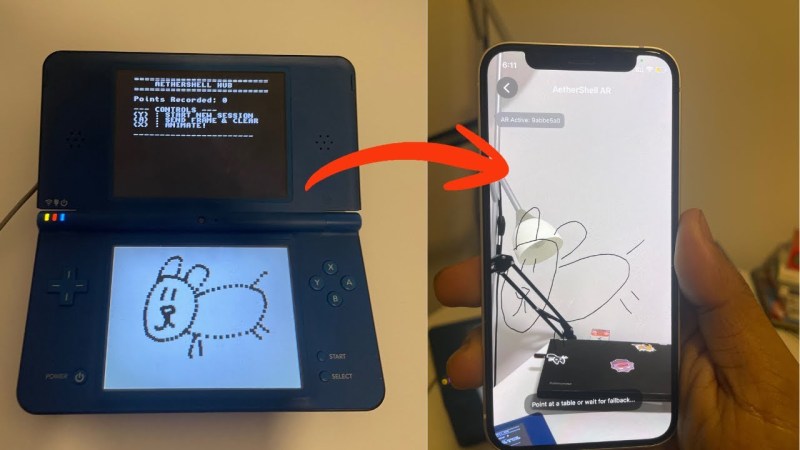
[Bhaskar Das] has been tinkering with one of Nintendo’s more obscure handhelds, the DSi. The old-school console has been given a new job as part of an augmented reality app called AetherShell.
The concept is straightforward enough. The Nintendo DSi runs a small homebrew app which lets you use the stylus to make simple line drawings on the lower touchscreen. These drawings are then trucked out wirelessly as raw touch data via UDP packets, and fed into a Gemini tool geometric reconstruction script written in Python which transforms them into animation frames. A Gemini tool is used to classify what the drawings are in order for a future sound effects upgrade, too. These are then sent to an iPhone app, which uses ARKit APIs and the phone’s camera to display the animations embedded into the surrounding environment via augmented reality.
One might question the utility of this project, given that the iPhone itself has a touch screen you can draw on, too. It’s a fair question, and one without a real answer, beyond the fact that sometimes it’s really fun to play with an old console and do weird things with it. Plus, there just isn’t enough DSi homebrew out in the world. We love to see more.












i have only one question: why? and a whole gemini task in the pipeline???
Because anyone who’s not using AI in their projects (either by making the LLM write the code, or in other ways) is lagging behind and will soon be unemployed at worse or at best waste their time learning something on their own
At least that’s what most people think. I think.
Ai generates SO MUCH shoddily created stuffs, people like me will probably have some job security fixing obvious mistakes made. Like, LARGE mistakes, not some yadyada any high schooler can fix. Massive mistakes.
(i’ve fixed those before, massive mistakes, and theya re not going away any time soon – actually, they keep on growing even worse).
With the added problem that LLM produces errors that are harder for humans to detect. If a human produces things that look good they likely understand the problem and the errors are likely to be one of a few types, while the LLM can produce things that look real good although it doesn’t understand anything.
Well, yes and no.
Some mistakes are easy to spot – does the solution deliver the results it suppose to or not. Others are subtler, tallies are off, indirect sign. Others are buried within – those are tougher still, may require quite a few man-hours untangling the unholy mess within, but still doable.
The ones nobody could figure out, not even another LLM, will be the prime target for the favorite pastime of the managers – destroying projects that don’t better their careers. Like throw away a perfectly working thing nobody understands (because original programmers died of old age, or retired and moved to Florida, etc) and replace with the contemporary glitch/fudge. Same managers will be throwing away LLM solutions about the same way, without thinking. That kinda saves us, lowly grunts, though, it remain to be seen if it would make us better off or worse off.
I work with databases all the time, and I can tell that 2/3 of them were baked by a high schooler learning how to database on his/her own. That makes LLM solutions look better, but not by a lot, since LLMs are mostly trained on the high schoolers learning to to database on their own.
I am still an optimist, just in a different way.
That is so true! That’s exactly why I didn’t let the AI touch the drawings. I wrote a specific script that maps the DSi screen pixels directly to the AR environment.
Haha, the ‘Why’ is because I love this old DSi! It was a fun challenge to see if I could make such an old console talk to a new iPhone. Also, just a heads up: I actually wrote the math code myself to make the drawings look good. I’m only using Gemini to help the app recognize the drawings so I can add cool sound effects later!
Pretty kewl, though, I’d go for a larger real estate, like one of the cheap eInk tablets.
Actually, there was one thing I was looking into converting, the boogie board. Since all boogie boards I looked into absolutely required their proprietary softwares, which I am also sure come with all kinds of software-as-subscription b****t, this was what kept me from buying their “solutions” that supposedly spit out PDFs. I mean, I can take a photo with my cell phone and have PDF made out of that, and I do that all the time, but that’s batch processing, not live processing, which is actually needed.
I think I found myself a project for the month of march and thank you for sharing :- ]
Thanks so much! I’m really glad you like it. I can’t wait to see your project if you end up making it in March! Good luck!