
Although there are a few hobbies that have low-cost entry points, amateur astronomy is not generally among them. A tabletop Dobsonian might cost a few hundred dollars, and that is just the entry point for an ever-increasing set of telescopes, mounts, trackers, lasers, and other pieces of equipment that it’s possible to build or buy. [Thomas] is deep into astronomy now, has a high-quality, remotely controllable telescope, and wanted to make it more accessible to his friends and others, so he built a system that lets the telescope stream on Twitch and lets his Twitch viewers control what it’s looking at.
The project began with overcoming the $4000 telescope’s practical limitations, most notably an annoyingly short Wi-Fi range and closed software. [Thomas] built a wireless bridge with a Raspberry Pi to extend connectivity, and then built a headless streaming system using OBS Studio inside a Proxmox container. This was a major hurdle as OBS doesn’t have particularly good support for headless operation.
The next step was reverse engineering the proprietary software the telescope uses for control. [Thomas] was able to probe network traffic on the Android app and uncovered undocumented REST and WebSocket APIs. From there, he gained full control over targeting, parking, initialization, and image capture. This allowed him to automate telescope behavior through Python scripts rather than relying on the official Android app.
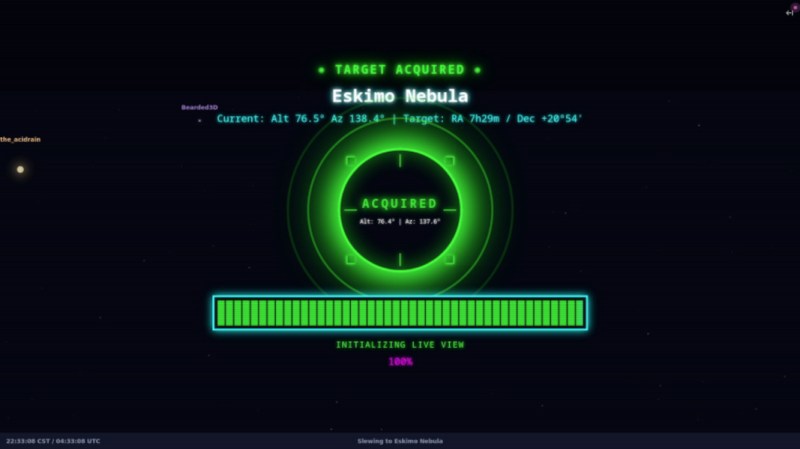
To make the telescope interactive, he built a Twitch-integrated control system that enables viewers to vote on celestial targets, issue commands, and view live telemetry, including stacking progress, exposure data, and target coordinates. A custom HTML/CSS/JavaScript overlay displays real-time status, and there’s a custom loading screen when the telescope is moving to a new target. He also added ambient music and atmospheric effects, so the stream isn’t silent.
If [Thomas]’s stream is your first entry point into astronomy and you find that you need to explore it more on your own, there are plenty of paths to build your way into the hobby, especially with Dobsonian telescopes, which can be built by hand, including the mirrors.












Well, it’s an admirable effort, but I just don’t get smart scopes. If you want to see something on a screen, anything you’d want is available much clearer with the click of a mouse. Part of the attraction of amateur astronomy is the direct connection with objects light years away.
And, his expensive scope has an objective lens of only 50mm. That’s going to limit resolution.
I feel the same way about imaging / electronic viewing. I don’t want electronic imaging or aiming.
But it is still a more direct connection than through a website. Even with the machine in the way, these things view your own sky. Like if you look at catalogues made by better telescopes, they’ve mostly abstracted away the navigation component, indexing according to a canonical sphere and an ideal observing circumstance. For us amateurs, we get to contend with where the moon and planets are tonight, and clouds and skyscrapers and light pollution and so on as well. While those factors are mostly downside for image quality, they are key for the relative directness of the connection.
But the other thing is, the catalogs are not very thorough. Like, the famous hubble deep field photos were taken over weeks or months, and focus on tiny regions of the sky. It’s not really practical yet to take a particularly high quality survey of the entire sky in a reasonable amount of time. The whole-sky surveys are not really any high quality in any one place. You can invest your effort into something no one has published a ready image of yet, and produce a notably high quality product.
And the other thing is the simple immediacy of it. Jupiter’s clouds are always changing. The solar system objects are always changing. I don’t know if it’s still true but at least 10-20 years ago, a typical backyard imaging setup could make meaningful contributions to asteroid tracking. Anyone can easily make a novel image of the ISS occluding something new. And there’s always a chance to be the first to observe a nova, no matter what your equipment is.
Underlying it all, the whole hobby is kind of stupid if you are using a productivity metric. IMO it’s all experiential, a pastime not a knowledge-factory. Even if I was imaging, I think if i actually did it, it’d be because it’s a good way to pass a bit of an evening, not because i was particularly keen on the result.
The lens is 50mm but uses technology to capture in mosaic. Each shot is 4K resolution or higher at 24Mp ~2.39 arcsec per pixel. I have already had a 10-inch Schmidt-Cassegrain scope – been there, done that. The difference is insanely good tracking and optics that didn’t cost $10-15k, but I’d encourage you to come by the stream and see for yourself. I hoped in doing this project, young astronomers, and children would have the ability that I didn’t have as a kid; the ability to use a telescope.
For those living in the white zones of big cities, light pollution eliminates this ‘direct connection’. There’s just no way to see anything. Cameras, filters and the whole electronically-assisted astronomy thing allows me to see amazing stuff in a sky where I can barely see a bright star.
Because I can look at what I want, when I want and wear my glasses. And not just pretty pictures. I have captured an exoplanet transit with my 50mm. I suggest you try one before suggesting we just Google it.
Isn’t the entry-cost to amateur astronomy zero?
Depends on your sky. Under mine you’d only see a few stars and the moon. My first scope was an 80mm Orion GoScope I got on Craig’s list for $65. I had a lot of fun with that thing.
Sure. You can see constellations, the moon, a couple planets (maybe even spot one or two of Jupiter’s moons). But, after that? The sky is the limit on price.
Personally, I recommend an equatorial mount and any camera. There’s so much more to see.
Then I suggest. 2-300mm lens on a mirrorless of DSLR.
When you’ve exhausted that, you can just keep going, and going…
Of course, that assumes the weather cooperates. So, you could toss in travel expenses for those who don’t live where conditions are generally favourable.
My entry cost is a $50 Nano Light star tracker. Attach my cellphone, take multiple 30 second shots and stack them and you get wonderful views of the night sky even in Bortle 7 skies. And you learn to polar align, evaluate exposure time and ISO, find objects in the night sky, learn how to post process with free software like DSS, Siril and Gimp, use Stellarium to find targets, forum with other interested users to solve problems, appreciate incredible and not so incredible photos – commiserate – contemplate – and cooperate, make unique photos unexactly like NASA’s, and get a Master’s education in astronomy and star lore. Its fun and satisfying and much better than spending those hours enslaved to streaming tv series and Youtube.
Wow, what a bunch of sticks in the mud. “I wouldn’t do it like this, so it has zero value.”
This is cool as hell. Not everyone has access to good viewing conditions or the funds or time to get a good astrophotography setup. This lets plenty of people look through someone else’s scope, potentially on the other side of the planet from them.
Who cares if it’s not the Hubble?
I bet they all go on vacations and take pictures of the same object photographed millions of times, likely with their phone AI camera that fakes images :)