
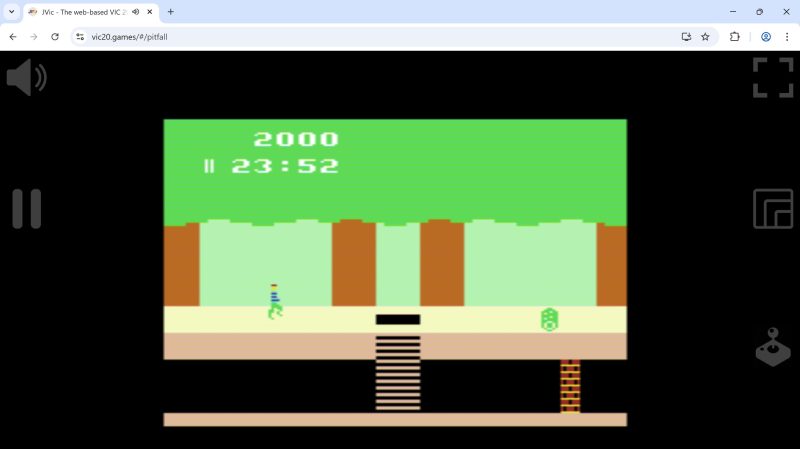
The Commodore VIC-20 was a solid microcomputer that paved the way for the legendary Commodore 64 to come. If you’re a fan of the machine and want to revisit its glory days, you could hunt one down on an auction site and hope that it’s in working order. Or you could just emulate the VIC-20 in your browser thanks to the work of [Lance Ewing].
The project is called JVic—because it’s a VIC-20 emulator written in Java. It’s primarily intended for playing old VIC-20 games, and is designed with mobile devices front of mind—so it works well on a phone screen. You can enjoy the built-in library of games, or you can even direct JVic to boot up a ROM from a ZIP file hosted on a given URL or attached to a forum post. You can also install it on your own device rather than running it online, if so desired. [Lance] provides a range of setup options for running it locally or putting it on your own web server if that’s how you like to do things. Files are on Github for those eager to dive in.
We get lots of VIC-20 hacks around these parts. Even if it’s not the most popular machine that Commodore ever built, it’s certainly up there in the rankings. If you want to learn Forth, or even build a VIC-20 from scratch, we’ve explored that before. If you’ve got your own retrocomputer hacks kicking around, don’t hesitate to let us know!
[Thanks to Stephen Walters for the tip!]











Whoa, java applets are still a thing?
TIL about libGDX keeping that abomination alive
It’s sad that even though the C-16 and Plus 4 were worse than the C64, but were still better than the VIC-20, never got to have more than about half the software base that the VIC-20 had.
And if the C-16 would have been released instead of the VIC-20, Commodore would have had to step up a little more with the C64.
Imagine if Commodore would have made the C-16 instead of the VIC-20 as its first home computer. Then all the effort that was now wasted on the C-16/Plus 4 could have gone into the C64 (no reason to work on a replacement for the C-16). And the C64 could well have been closer to the C65, and would have given Apple a tremendous run for their money.
Given the C16 came out 2 years after the C64, I doubt it would have made any difference.
My first ever computer…. 3.5kbytes of memory and by Boxing day I was already writing my first code… FOR L=255 to 12 STEP -1 : POKE 36879,L : NEXT :-)
For me, it was the two Sinclairs first, and then the Vic (with some expansion card for better multimedia, forget what it was exactly). Awesome stuff, this poke and peek.
As a kid, I would terrorize the electronics dept clerks at the local K-Mart by running the following program on the display Commodores…
10 FOR Q=0 TO 255
20 FOR W=0 TO 65545
30 POKE Q,W
40 NEXT W
50 NEXT Q
actually, I typed 10 and 20 in backwards
Some fun facts that come to mind..
a) the VIC-20 was known as VC-20 in Germany, it also was being advertised as “Volks Computer” (ugh).
Both VIC and Vixen (project name) could been mispronounced as a swear word by low-IQ users (equivalent to F*ck; if V way spoken as “F” rather than “Wee”).
That’s why German dictionary had allowed the word “Komputer” in the 80s,
to help to avoid people with poor education mispronouncing a computer as a “Zomputer”. 🙄
Pacman had same swear word problem in English speaking countries basically (originally named Puckman).
b) the default RAM was ridiculous low to be usable even back then.
More serious users installed a RAM upgrade, thus. Same situation as with C16 or ZX81.
c) the press described the VC-20 as a toy computer even back then.
The text resolution was below the already humble 40×25.
Making that thing unusable as a cheap type writer, even.
To give an idea, terminal standard of the ’70s was 80 columns at 80×24 (or 80×25 with the status line).
132 colums were considered high-end in the 1980s, by contrast.
The graphics “capabilities” of the VC-20 were somewhere next to a Intellivision, Philips G7000 or Fairchild Channel F.
The positive aspect mentioned in the press was the mechanical keyboard, though.
It was the best about the machine and consequently recycled for C64.
Which is good, because it was a waste on the VC-20 given its modest text-mode qualities (C64 could simulate 80 columns in graphics mode).
d) the buggy serial interface (floppy etc) of the C64 originated from VC-20.
With the difference that the C64 version became even more buggy by accident.
The older PET and VC-20 floppy drives were better than 1541, too.
e) there are VC-20 emulators that run on C64.
They can make older BASIC programs work on C64.
f) the VC-20 was used by hams as a RTTY terminal and to predict satellite orbits. That was an actually useful purpose.
There’s a BASIC program for VC-20 listed in the OSCAR book written by S. Karamanolis.
(Atari 400/800 were other home computers mentioned, I think.)
g) Commodore had accidently shipped the C64 with manuals that refered to i/o ports and memory locations used on the VC-20.
Probably because the conversion of the manuals from VC-20 to C64 had been rushed.
Many examples thus didn’t work for C64 users, leaving them behind being confused.
Gratefully, well written third-party books existed soon after.
I mean I can type that exact thing into googles AI Studio and it cranks one out in less than 20 seconds but cool?
Cool story thank you for contributing
Woo, VIC-20! Any new way you can run VIC software is cool.