
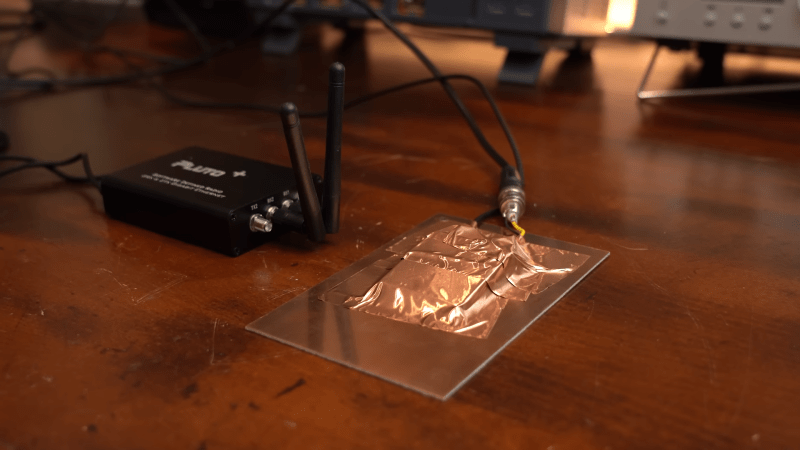
[GreatScott] has recently been tinkering in the world of radio frequency emissions, going so far as to put their own designs in a proper test chamber to determine whether they meet contemporary standards for noise output. This led them to explore the concept of shielding, and how a bit of well-placed metal can make all the difference in this regard.
The video focuses on three common types of shielding—absorber sheets, shielding tapes, and shielding cabinets. A wide variety of electronic devices use one or more of these types of shielding. [GreatScott] shows off their basic effectiveness by putting various types of shielding in between a noise source and a near-field probe hooked up to a receiver. Just placing a bit of conductive material in between the two can cut down on noise significantly. Then, a software defined radio (SDR) was busted out for some more serious analysis. [GreatScott] shows how Faraday cages (or simple shielding cabinets] can be used to crush down spurious RF outputs to almost nothing, and how his noisy buck-boost designs can be quieted down with the use of the right absorber sheets that deal well with the problematic frequencies in question. The ultimate upshot of the tests is that higher frequencies respond best to conductive shielding that is well enclosed, while lower frequency noise benefits from more absorptive shielding materials with the right permeability for the job.
Shielding design can be a complex topic that you probably won’t master in a ten minute YouTube video, but this content is a great primer if you’re new to the topic. We’ve covered the topic before, too, particularly on how a bit of DIY shielding can really aid a cheap SDR’s performance. Video after the break.












I was going to jump in and say that adding shielding is a last-ditch bandaid, and that circuit design, component selection, and PCB layout are the right ways to prevent the issue in the first place.
Then I was going to say that Great Scott is one of the few entities capable of designing, testing, and presenting these better strategies.
But, of course, they already did, and referred to it in the beginning of the video.
But my comment still stands: Shielding is a bandaid. Sometimes it is necessary, sometimes it’s to idiot-proof your design against what an end user might subject it to, but sometimes it’s just an indication that you screwed up earlier on in the design.
For those of us who play on bread boards, perf and veroboards, shielding is something that’s gotta happen. I’m not really in the radio world of things but I’ve had more than a few amplifiers pick up on room fans, line voltage through the walls, etc.
You are right. For people who can and do design circuits with rf in mind they can avoid many of the types of atrocities I have made, but for a hacker like myself, shielding is an important topic. I’d rather have my thing working in a few days with some foil than spend a month simulating traces with FEM.
I had a pretty renowned physics professor, note not an eet, back from the wire wrap days tell us something along the lines of ” if you cover it in foil and it doesn’t work, put it in a small metal trashcan, if it still doesn’t work, leave it there”.
The issue we face is we do a good low-radiated-emissions reference design and everyone using the parts we’re making does their own not-good-low-radiated-emissions designs that fit the pcb sizes/shapes they need and then they freak out about EMI and ask us how to fix their designs (but without changing the pcb, of course, because they’ve already ordered 1M of them.)
This is related to the old adage about how if you owe the bank 1M and can’t pay, you have a problem, but if you owe the bank 1B they have a problem.
anyway here’s something I’ve been doing that seems to work pretty well and I tried to get my company interested in pursuing it officially but they were all naah, so: take your pcb design, export it as a step, import that into your cad program of choice and make it a boolean cut out of a block of material, then when you’ve got the inverse shape, print that in conductive filament and plate it with copper, and you have a cheap conformal shield. It works pretty well just with the conductive filament. Make sure it’s grounded. I use PTH around the mounting screws for the shield.
Give yourself wiggle space around your inductors, though. There’s a surprising amount of variation in them, particularly if someone’s hand-soldering. And don’t forget electrical clearance rules.
Relying on shielding can also come back to bite you.
Looking at the radiated emissions, you may think the shielding you added is doing the intended job; but it may just be inverting the phase at the frequency in question and cancelling out the emission only at that frequency. If the frequency changes – because of a programing change or processor throttling, for example – you can be right back to having excessive emissions.
These days it’s easier to keep emissions low in the design stage. But back when components were bigger and multi-layer boards were a LOT more expensive, shielding was often required as a cost-saving measure. But your point is still valid; if shielding is needed it should be planned for during design, not added on after the fact as a band-aid.
I fully agree with your approch and hope more vendors adopt it. Most engineers didn’t study it or just ignore layout rules and think because they copied the circuit in the datasheet that it will work. EMI is one problem, but even more these days is the problem of switchers. A canned layout would solve a world of customer issues.
So, when did GreatScott become a ‘they’ and ‘them’?
Did he assemble a team or is he one of those confused characters with the pronouns and whatnot.