
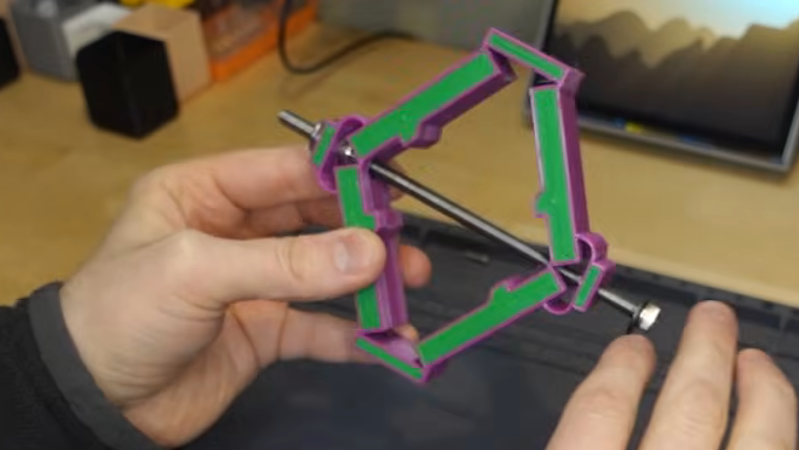
If you’re looking to jack up your car and you don’t have anything on hand, your 3D printer might not be the first tool you look towards. With that said, [Alan Reiner] had great success with a simple idea to create a surprisingly capable scissor jack with a multi-material print.
The design will look familiar if you’ve ever pulled the standard jack out of the back of your car. However, this one isn’t made fully out of steel. It relies on an M6 bolt and a rivet nut, but everything else is pure plastic. In this scissor jack design, rigid PETG arms are held in a scissor jack shape with a flexible TPU outer layer. Combined with the screw mechanism, it’s capable of delivering up to 400 pounds of force without failing. It’s an impressive figure for something made out of 80 grams of plastic. The idea came about because of [Alan’s] recent build of a RatRig VCore4 printer, which has independent dual extruders. This allowed the creation of single prints with both rigid and flexible filaments included.
[Alan] did test the jack by lifting up his vehicle, which it kind of achieved. The biggest problem was the short stroke length, which meant it could only raise the back of the car by a couple inches. Printing a larger version could make it a lot more practical for actual use… if you’re willing to trust a 3D-printed device in such use.
Files are on Printables if you wish to make your own. It’s worth paying attention to the warning upfront that [Alan] provides—”THIS CAN CREATE A LOT OF FORCE (400+ lbs!), WHICH MEANS IT CAN STORE A LOT OF ENERGY THAT MIGHT BE RELEASED SUDDENLY. Please be cautious using 3d-printed objects for high loads and wear appropriate safety equipment!”
Funnily enough, we’ve featured 3D printed jacks before, all the way back in 2015! Video after the break.












I was skeptical from the description, but after watching how it changes shape while it is tightened…it follows the rule: it has plastic in compression and steel in tension. Looks like a good demonstration of how powerful that rule is.
Is it acceptable to still get stressed out about this kind of engineering?
Pretendgineering*
Only if you also get appropriately strained
Given that even car manufacturers are not daft enough to supply plastic jacks that tells you how much you should trust your life to one of these. And those guys are happily making brake master cylinders and head dowels from glass-filled plastic.
It’s very impressive and potentially useful for a lot of things, but for the love of god please don’t get under anything supported by something you 3D printed. Always always have something else solid under there before you trust any sort of jack.
Car manufacturers go for the cheapest crankjacks they can get away with and they need to be strong enough to actually work on. You aren’t supposed to work on a car on a crank jack, you are supposed to put a jackstand under it that car manufacturers don’t give you, so they make a tiny bit better crankjack to avoid claims from being sued if it goes wrong.
Cranking up a car is perfectly fine with a dangerous crankjack as you are never supposed to work on it. As long as it can hold the car up until you put the jackstand under it, it’s fine. You should NEVER get under a car on a crankjack, even if it’s the OEM version or an even beefier version. It’s not designed for it, it’s not safe. The purpose of a crankjack is only (!) to raise the car. That’s it, nothing more than that.
Those brake master cylinders aren’t made from glass filled plastic, only parts of it are and those parts are never under any pressure. Those parts are designed to keep brake fluid in and keep moisture out. With one of my vehicles I put the reservoir for the master cylinder somewhere else to make it easier to fill. It has a rubber hose between the plastic reservoir and the alu master cylinder. Pretty common on racing applications as you are more likely to change the fluid.
I’ve never seen head dowels made from it but head dowels are designed to guide the head onto the right position before you put bolts in, so they aren’t designed to work under pressure or keep anything tight. Just keep it in the right place so you can put the bolts in, that’s all. And sometimes they are used as oil passages too.
Couldn’t agree more. That’s why I’ve just finished printing a pair of axle stands
Wait until you see the hydraulic lift I’m printing.
Neither should you trust a stamped metal “proper” jack before you get under your car.
Jacks are only for work on tires, or for putting more rigid things like axle stands (or cribbing = wooden blocks) under a sturdy point.
What about 3d printed jackstands / standing blocks?
I’m sure they’d be just fine… provided you used 100% infill and 100% of the printer’s build volume.
Emily the engineer did this on her YouTube already. Ended as expected