
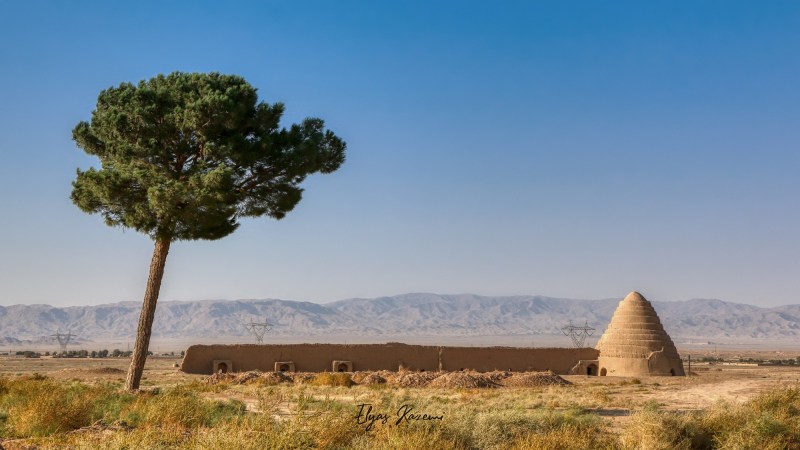
Today, we take ice for granted. But having ice produced in your home is a relatively modern luxury. As early as 1750 BC, ancient people would find ice on mountains or in cold areas and would harvest it. They’d store it, often underground, with as much insulation as they could produce given their level of technology.
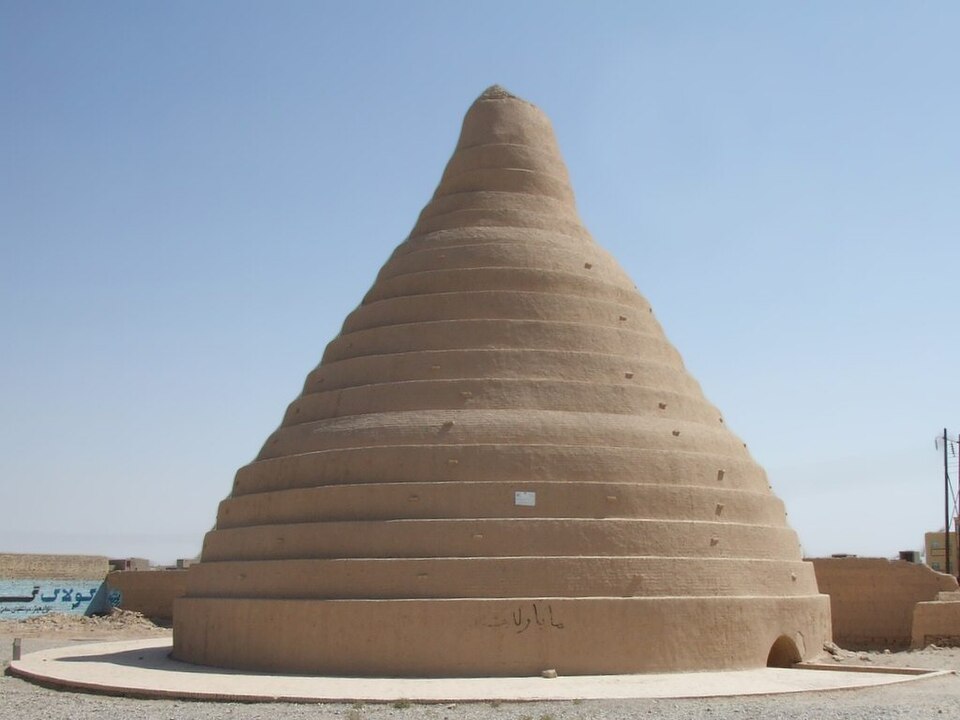
The key to Persian icemaking was yakhchāls. Not all of them were the same, but they typically consisted of an underground pit with a conical chimney structure. In addition, they often had shade walls and ice pits as well as access to a water supply.
Solar Chimney
The conical shape optimizes the solar chimney effect, where the sun heats air, which then rises. The top was typically not open, although there is some thought that translucent marble may have plugged the top to admit light while blocking airflow. yakhchālThe solar chimney produces an updraft that tends to cool the interior. The underground portion of the yakhchāl has colder air, as any hot air rises above the surface.
Insulation and Shade
The structure uses a water-resistant mortar made of sand, clay, egg whites, lime, goat hair, and ash. This has good insulating properties, although how the Persians found this recipe is a mystery. Many also had windcatcher towers that allowed for evaporative cooling in the dry air.
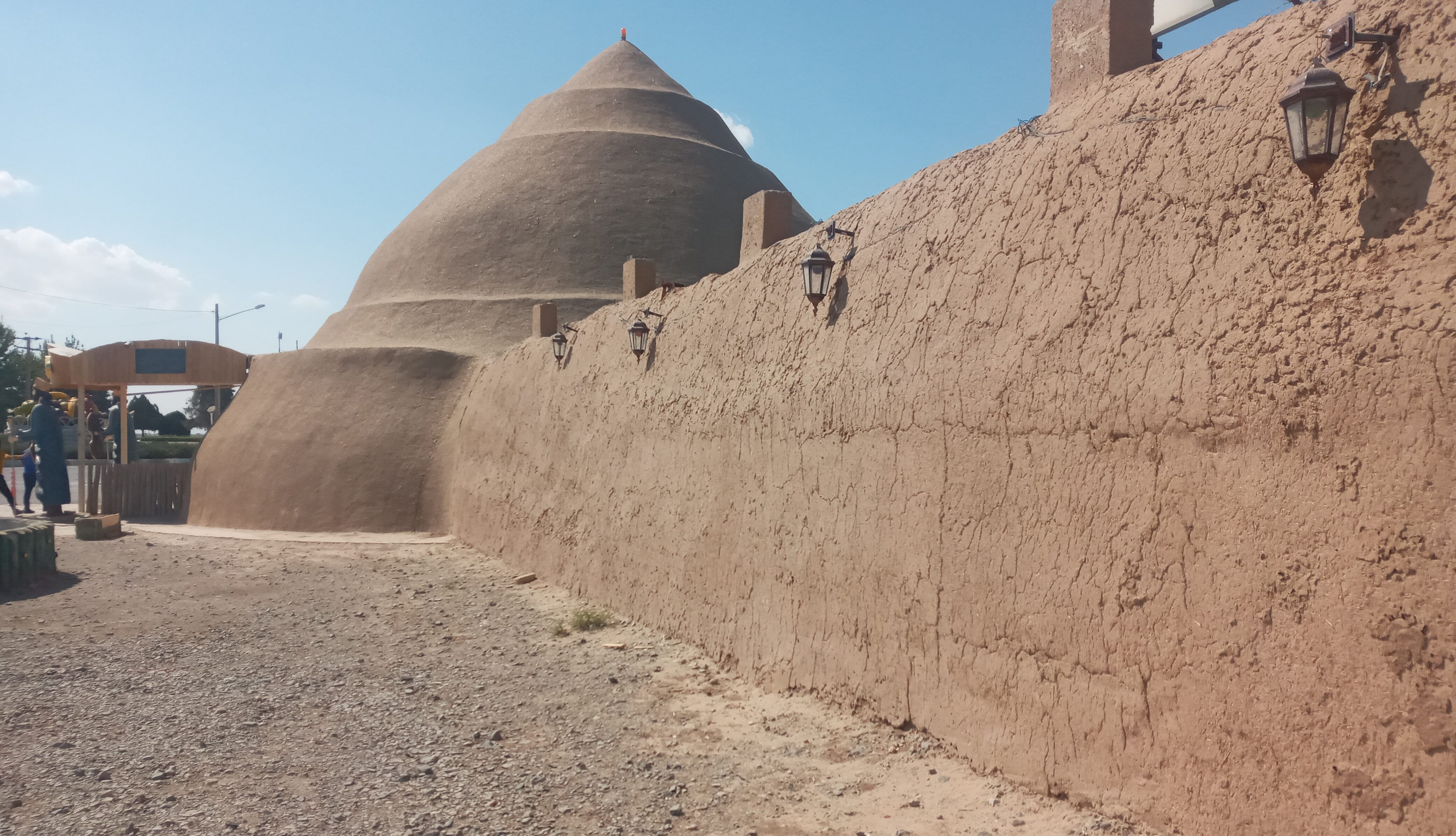
Adjacent to the yakhchāl was often a shallow ice pool protected by a shade wall to block the sun. The shade wall minimized heating from the sun. Just as the Egyptians leveraged evaporative and radiative cooling to create ice, cold nights could produce ice in the pool, which workers would harvest and store inside the yakhchāl. They could also, of course, store ice harvested from elsewhere. Even with the shade wall, though, workers had to harvest ice before sunrise.
You could think of the whole system as an RC circuit. The dome and the soil around the pit form a resistance, while the ice, cold stone, and air inside form a thermal capacitor. Thick insulating walls make a large R, and tons of ice and stone make a big capacitor. The dome shape gets less solar radiation most of the time. With a big resistor and capacitor, bleeding off charge (in this case, leaking in heat) takes a long time.
Meanwhile, ice melting effectively absorbs leftover or leaking heat. Sure, you lose some ice, although with the ice pits, on a cold and dry night, you might be able to recover at least some of it.
Why?
The Persians wanted ice for the same reasons everyone else did. They preserved food, created frozen beverages (sharbat), and even a dessert, faloodeh, that combined noodles, rose syrup, lime, and ice. There were also medical uses. Of course, having ice in the hot desert was also a status symbol.
Other Tech
In China, around 600 AD, they used saltpeter to produce ice chemically instead of simply harvesting and storing it. It would be 1748 before [William Cullen] would demonstrate producing ice using artificial means. While [Oliver Evans] described a fairly modern refrigerator in 1805, nothing like it was built until [Jacob Perkins] did it in 1834. Australian [James Harrison] was probably the first commercial ice makaer in the mid 1800s.
These days, we don’t usually ship ice around, but we still have to ship cold things. And of course, refrigerators ended the ice harvesting business.
Featured image: “kosar” by [Elyaskb]












That was pretty cool ;D
yes. a refreshing writup.
modern “geopolymers” often involve sand + clay + lime + ash (or pozzolana) and while research is ongoing, we still don´t fully understand how Romans were building self-repairing mortar and sub-marine varieties that were getting only harder and stronger with the time.
Here maybe the goat hair + binding proteins of egg provide a useful elasticity and improve insulation characteristics.
The problem has been solved:
https://news.mit.edu/2023/roman-concrete-durability-lime-casts-0106
It turns out that the Romans were mixing quicklime into their concrete instead of slaked lime. That leaves little nodes of calcium that can react to fill and heal cracks in the concrete. The high temperature from the so-called hot-mix concrete setting also played a role.
I do have to wonder if the egg whites could be a foaming agent for Aircrete? Mmmmm, concrete meringue. :-D https://hackaday.com/2025/12/28/create-aerated-concrete-using-xanthan-gum-and-dishwashing-liquid/
I was just reading about this the other day.
Makes me wonder if a similar process could be used to cool and condense the exhaust from a natural gas genset to capture water vapor; for every molecule of methane burned you get two of water. You’d have to handle the acidity from the condensed NOx and CO2 but that’s doable with catalysts and or limestone. End result would be relatively neutral pH, mineral heavy water and a lot of calcium nitrate. Might as well set up hydroponics from there.
It’d take a big generator to make it worth while, a megawatt or bigger, but if you’re already building a yakhchāl then you likely have the room for all the rest.
Oh the ideas that big corp patent and never come through on
Handle checks.
You could make pennies!
Not a lot of them.
So close but so far: during almost three years in Isfahan, I saw plenty of pigeon towers, but never made it to Yazd to see wind towers and yakhchāl.
But did you see Death? Or a gardener?
The Gardener and Death
A Persian Nobleman:
This morning my gardener, white with fright,
rushes into my dwelling: ‘Lord, Lord, just a moment!’
There, in the rose garden, I pruned shoot after shoot,
Then I looked behind me. There stood Death.
I was startled and hurried along the other side,
But just saw the threat of his hand.
Master, your horse, and let me go at full speed,
I will reach Isfahan before evening!’ –
This afternoon—long since he had hastened away—
I met Death in the cedar grove.
‘Why,’ I ask, for he waits and is silent,
‘Did you threaten my servant early this morning?’
Smiling, he answers: ‘It was no threat,
From which your gardener fled. I was surprised,
When I saw someone still quietly working here in the morning,
whom I had to pick up in Isfahan that evening.
Perhaps both, or neither, but I was young and immortal.
A variation on Incident in a Rose Garden
By Donald Justice?
“The Appointment in Samarra”
Examinations of these structures and claims pop up every couple years. Has anyone duplicated the claims of their effectiveness? Given the heat-capacity of air (roughly 1 joule per gram per degree C) versus the energy given up by liquid water changing state to ice (334 joules/gram), it is hard to imagine anything more than the morning frost sometimes found in deserts. Volume of 1g of air to 1g of water is about 770 to 1. For 1 gram of water to freeze requires 334 grams of air to increase by 1 deg C, or about 257 liters of air per gram of ice just to change state (770 cubic meters per kg). Not counting cooling the water to ambient which involves heat of vaporization, another energy intensive barrier. Not impossible but it probably takes 3 times as much cold air.
Adding potassium nitrate can remove 35kJ per mole and make all the difference. Using salt will also lower temperature somewhat.
Personally, I would like to see some demonstrations.
Using shallow metal trays on insulated surfaces or elevated above the desert floor skips the air and radiates the heat straight to space. The water cools directly, not by transferring heat through the air.
Sure, thus the frost in open desert and a clear sky. But these structures have the water basically underground in a rather massive earth and stone structure.
The dome isn’t to make the ice – it’s the warehouse. The ice is made at night in the open yard besides the dome and then carted inside.
The article isn’t very clear on what parts of it perform what function, but it’s basically a pit in the ground, lined in straw and other insulating materials, filled with ice, covered with more straw, and then a tower built on top with natural ventilation to keep heat from collecting above the stored ice.
Ah, I thought it was the same idea as the towers that draw air over pools of water in chambers in the base or below the base. I checked on the temperature of the night sky on Earth. It ranges -50 to 0 deg C. The drier and clearer the air, the lower the sky temp. IF you could shield the trays from the IR of the surroundings maybe there could be some ice.
Copper and bronze are excellent at reflecting away infrared heat.
But you really don’t need all that. Just a walled in shallow pool of water on the ground will make some ice.
You could argue that the solar chimney can be blocked during the day and the vents opened at night to draw in the cold desert air, using the stored heat in the tower to ventilate the structure and freeze water inside.
But that depends on two assumptions: that the hot dome above the ice store doesn’t itself melt the ice, and the night air is consistently below freezing.
If the dome or tower was made to be a refrigeration device, it would be built separate from the ice store and connected to it with a ventilation tunnel. That would solve problem #1. For problem #2 there is no technical solution: it is or it isn’t. The simpler explanation is that the ventilation tower is there simply to keep the building cooler during the day, and has nothing to do with making ice.
“Using shallow metal trays on insulated surfaces or elevated above the desert floor skips the air and radiates the heat straight to space.”
What does that mean?
It means exactly what it says.
A pond of water with a clear view of the sky will radiate away heat at the rate of 300 watts per square meter.
In the absence of heat gain from the surroundings that’s sufficient to produce 3 kilograms of ice per square meter per hour, assuming you start with cold water already. For the SI-naive, that’s 3 mm or 1/8 inch of ice.
The tray does not need to be metal, but it does need to be insulated from the surroundings to limit heating from ambient heat, and air above must be stratified or else somehow else not permitted to warm the water.
The pond or tray also needs to be quite shallow: the entire body of water must get below 4 C before it will stratify and let the top get cold.
Alas, even a clear sky is not an excellent transmitter of infrared. At low elevations, about 75 watts per square meter is all that can be achieved. Move the experiment above half the atmosphere (about a mile above sea level) and maybe 150 W/m^2 is possible. Yazd province elevation averages 5358 feet, Tehran is about 1200 meters (3937 feet) above sea level.
100 Watts is comparable to a mini fridge with an ice box.
The sky as seen without atmosphere is hundreds of degrees cooler than the typicak Earth temperature and everything will lose energy into space. At on the surface it will be in the infrared. But volcanoes can be putting out plenty of visible light as well. Basically at night the sky is like looking at a wall that is a few degrees above absolute zero.
However, with the atmosphere the sky looks like between zero deg C and -50 C depending on conditions. -50 will be very low humidity like a desert. So it looks like it takes very special conditions for the scheme in the story to work.
It means exactly that. If you’re out in the desert at night, and you lay down some insulation or a table and put a metal tray on top of it, water placed in the tray will tend to freeze.
The insulated metal tray amplifies the night frost effect by blocking off heat that’s coming from below, and reflecting infrared heat from the water up into the sky more efficiently than a puddle of water on the ground. Instead of just a thin crust of ice on top of water, you may freeze the whole tray solid.
Air and evaporation are not used to cool the water in this process. In fact, wind will ruin the effect by blowing off the cold air sitting on top of the tray and bringing in warm air instead.
Dude: Water is effectively opaque to the 10-12 micron wavelength radiation of interest here: Penetration depth is a fraction of a millimeter.
A metal reflector at the bottom of the tray won’t do anything to reflect the sky, as it can’t see it through the opaque water.
The metal will be a good reflector of radiant heat from below, however.
It doesn’t have to be that specific. The black body spectrum of an object near 0 C spans between 2 – 200 microns.
True, it’s broad band. A vanishingly small fraction of a percent is at wavelengths shorter than 4 microns, and a few percent of the power is at longer than 40 microns, with a long, long tail of vanishingly small power way beyond 200 microns.
But it doesn’t matter: over that entire range water is effectively opaque, with in excess of 99% opacity at 1 mm thickness over the whole range.
Although IR radiation from lower layers of water may be blocked by the upper layers, ice and liquid water have enough thermal conductivity that there won’t be much of a thermal gradient from the top to the bottom of an insulated shallow tray.
Chris: Sure, if it’s shallow. Liquid water is a pretty good thermal conductor compared to air, but is a very poor thermal conductor compared to (say) any metal.
Once the water reaches 4 C it will start to form a density gradient and stop convective cooling: Conduction is the only way to cool the now 4 C water at the bottom.
Cold water has a thermal conductivity of 0.56 Watts per meter-degree (C). A fully-stratified one meter deep pool, 0 C at the top, 4 C at the bottom, radiating 100 watts per square meter from its top surface (at 0 C) will be conducting 2.2 watts per square meter from its bottom. Not a lot.
In a shallow tray, just 10 cm deep, that turns to a more favorable 22 watts per square meter. At just 1 cm thick then, yes, it’s going to make the whole water columns basically isothermal due to its thermal conductivity.
But it doesn’t change the fact that a metal reflector on the bottom will do diddly squat, except to reduce radiant absorption from below.
Looks like someone has been watching veritasium
That’s a myth or possibly LLM hallucination.
About 12 g of KNO3 dissolved in 1 L water is needed to bring the temperature down by 1 C. That’s about as much as can be dissolved into water near zero degrees, because the solubility drops with temperature, and about 80 times more would be needed to actually freeze the water.
The effect can be used as a party trick to cool down small amounts of liquid, but making ice just doesn’t add up.
Agreed, Al should have put in some links on this, but it appears to check out:
https://cordis.europa.eu/article/id/36036-making-things-cold-a-history-of-science-technology-and-culture
Anyone actually give it a try?
That still sounds like a perpetuation of a myth just to make a “fun point”, since no further references are given. Can anyone find an actual demonstration of the process working?
Mind, what they might be talking about is a freezing mixture
https://www.engineeringtoolbox.com/freezing-mixtures-d_1614.html
These are different salts mixed with crushed ice which brings the melting point down and causes the mixture to drop far below zero Celsius, which works for refrigeration and freezing some quantity of water, but not more than the ice that you started with.
The process is used when you want to keep something frozen, like a train car full of meat, but you don’t have modern heat pumps. All you have is ice blocks.
The temperature of the ice would be at zero as it melts away, so whatever you’re trying to keep cold would remain a wet puddle somewhere above zero. But, if you sprinkle some salts on the ice, it suddenly becomes much colder by melting at a lower temperature, and draws heat from the surroundings, and your train car full of perishable foods remains frozen solid as long as you keep adding more ice and salt to the box that keeps it cold.
“it suddenly becomes much colder by melting at a lower temperature” Having trouble grasping this. Rather than getting colder isn’t it that the ice never warms up to 0 C or 32 F because it melts at a lower temperature leaving behind liquid that unlike pure water is still below 0 C or 32 F because if it melts at a lower temperature it freezes at a lower temperature. It’s no longer at that lower temperature, having melted, but it’s not 0 C or 32 F.
When the melting point of ice water slurry is lowered by salt, the ice starts melting a whole lot faster because it’s “superheated” relative to the new melting point. This forced phase change requires heat, which is absorbed from the mixture and the temperature drops until the new melting/freezing point is reached.
It takes far more energy to melt the ice than to bring the temperature down, so the temperature drops rapidly and stays at the new melting/freezing point until all the ice has turned to liquid.
When the new lower melting point is reached the process slows down, because using more heat to melt more ice would drop the temperature below the point where it freezes again. It reaches an equilibrium between melting and freezing. At this point all the heat to melt the ice is coming from the surrounding environment and not from the liquid itself, so it can be used to freeze other things or keep stuff cold in an insulated box.
Of course, you also have to keep stirring in more salt as the ice melts, because the mixture gets diluted by the liquid water and starts to separate by gravity, so the ice floats to the top and the salt goes to the bottom.
I recall the salt trick from hand cranked ice cream makers as a kid. Crushed ice became a slurry as salt was added. It was a wooden bucket and some gears that turned a smaller metal cylinder that has vanes inside to continuously scrap frozen sweat cream off the walls on the inside. (Tip: Add a packet of instant pudding for the flavor of choice.)
Ewww.
Your going to make home made, hand cranked ice cream and flavor it with instant pudding?
Nasty!
Checking the numbers again, you can dissolve about 130 grams of KNO3 into a kilogram of water at 0 degrees C, which is enough to bring it down by about 10 degrees or absorb 45 kJ of heat. Since the resulting mixture would freeze at a lower temperature, it remains a liquid below freezing. You could then use it to freeze a smaller quantity of water in a separate container.
You could produce approximately 130 grams of ice in the ideal case. It’s very close to 1:1 ratio. You need as much saltpeter as you want ice, which would also make it a rather expensive way to make ice given how difficult it was to produce back in the days.
Note that the reaction won’t work to freeze any water if the starting temperature is above 10 C. This is why the Engineering Toolbox page for freezing mixtures I linked above lists the KNO3/Sal-ammoniac mixture as starting from 8 or 10 C while the other mixtures start at 0 C because they need ice to melt for the temperature drop to happen. Not so with saltpeter and salmiac,
I was thinking the same thing. I found enough one-sentence blurbs with no sources that I started to think it was a myth. But, while I haven’t found anything for China yet, Kathryn Kane posted this about saltpeter refrigeration in the English Regency period: https://regencyredingote.wordpress.com/2013/08/09/saltpetre-regency-refrigeration/ Apparently it was a good backup to chill wine quickly in a pinch if you ran out of ice.
It seems to work by the “enthalpy change of solution” when adding saltpeter (potassium nitrate) to water. More energy is absorbed by breaking the lattice than is given by hydration. This makes it net positive (+34.9kJ/mol) AKA endothermic. Of course, this only works for short periods, even if you keep adding more saltpeter, because the solution eventually becomes saturated. Substances other than saltpeter may lower the melting point of the solution, without mixing endothermically, so ice would still be prerequisite for certain things other than saltpeter.
She goes on to talk about other “frigorific mixtures” of the era in her next article: https://regencyredingote.wordpress.com/2013/08/16/frigorific-solutions-of-the-regency/ Using the keywords “frigorific mixtures” in Google Scholar returns a large number of papers from the 18th and 19th centuries. In the first two pages of the query, only one of them is from the 20th century, and it looks really interesting: Self Operating Cooling System Using Solar Energy Small Power Experimental Plant https://scholar.google.com/scholar?cluster=16352389295954183389&hl=en
I still haven’t found anything on the China thing, though.
Yeah, making ice with this method would require some specific circumstances and a lot of saltpeter. You need water that is already very close to freezing, and then a bagful of potassium nitrate to create enough ice that you could store it for any length of time.
Granted, you can evaporate the water and re-use the potassium nitrate over and over, but that requires drying it over heat and that’s going to cost you a lot of fuel.
Also, in the story of how saltpeter was made from ashes and manure, what actually would be produced was mostly calcium nitrate since wood ash mostly contains calcium carbonate – but this was not known at the time. It would still work the same though, if slightly worse for the actual purpose of making gunpowder, as proper potassium nitrate.
The potassium nitrate from the manure piles is crystals and therefore quite pure if washed or re-crystalized in a cleaner situation. This was the method for gunpowder production.
Both potassium and calcium nitrate would be produced form the manure, and there would be a about 3:1 calcium nitrate. Separating the two wasn’t really feasible, so the mixture was used as-is. It makes gunpowder but it’s a little “unreliable” and slow burning.
The process works by the bacteria in the manure producing ammonia, and the ammonia reacting with wood ash. When bird or bat guano is used instead, there’s more potassium in the mix and the gunpowder turns out higher in quality.
My dad (born 1889) remembered ice warehouses in Altoona, PA. Men would go out to nearby lakes in the winter and saw up the ice into blocks and haul them back to town on horse drawn buggies. The ice was stored on straw and the walls of the buildings had straw insulation.
Where I live in Germany, there were small ponds (Eisweiher) outside the villages. The ponds were flooded in the fall. During the winter, the ponds froze and the ice was cut into blocks and stored in ice houses.
Many of the ponds are still visible around the villages. In the small town I live in, an old ice house (with two meter thick walls) was converted into a residential house.
International shipping of ice reportedly started with a business that harvested ice from Spy Pond in Arlington Massachusetts, developing techniques for insulating ships and icehouses. Unfortunately the attempt to keep the technology as a trade secret failed, and the attempt to lock in customers with exclusive contracts likewise, so that first business succeeded technically but failed commercially.
“A yakhchals” is not correct. یخچال
Egg whites… hmmm? I wonder if that was a foaming agent for Aircrete? Mmmmm, concrete meringue. :-D https://hackaday.com/2025/12/28/create-aerated-concrete-using-xanthan-gum-and-dishwashing-liquid/
These and zeer pots can’t make or store ice.. Even twenty-first century refined designs like used in India can’t..