
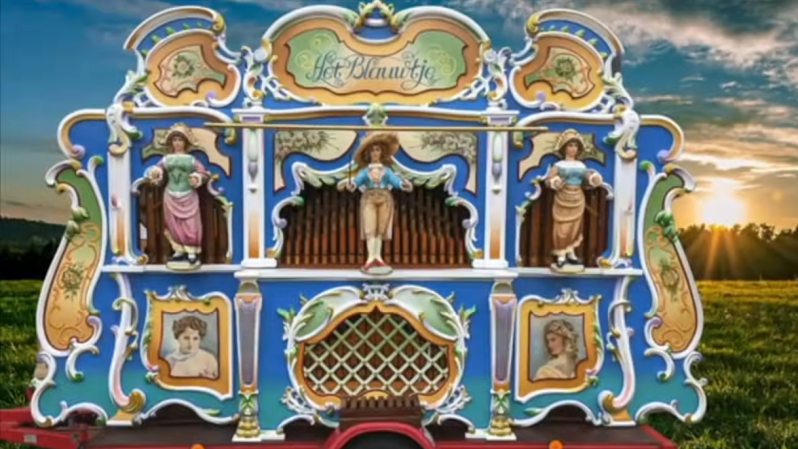
[James]’ Mechanical Organ of Dutch origin has been around longer than he has, but thanks to being rebuilt over the years and lovingly cared for, it delivers its unique performances just as well as it did back in the day. Even better, we’re treated to a good look at how it works.
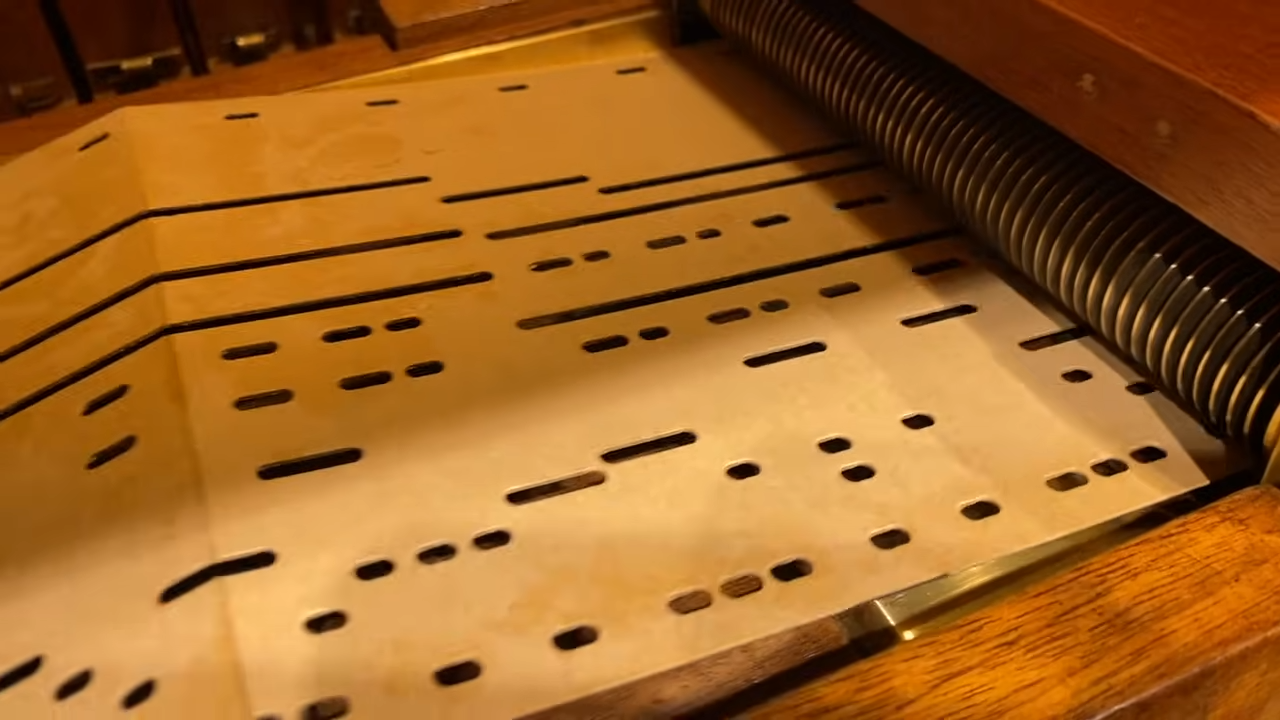
The organ produces music by playing notes on embedded instruments, which are themselves operated by air pressure, with note arrangements read off what amounts to a very long punch card. [James] gives a great tour of this fantastic machine, so check it out in the video embedded below along with a couple of its performances.
The machine is mobile and entirely self-contained. It would be wheeled out to a venue, where it would play music as long as one could keep cranking the main wheel and the perforated cardboard book containing the chosen musical arrangement hasn’t reached its end. As perforations in the card scroll by inside the machine, each hole triggers valves that operate pipes, percussion hits, and even operate animatronic figures.
The air pressure needed to do all this comes from a reservoir fed by two bellows operated by continuous rotation of a large wheel, a job that requires a fair bit of effort. Turning that crank would likely have been the responsibility of the lowest-ranking person within reach. Today, the preferred method is a belt drive and electric motor.
The perforated cardboard arrangements mean that the machine is just as programmable today as it ever was, and happily plays classics as easily as Lady Gaga, Daft Punk, and Queen. [James] has an enormous library of music, so take a moment to listen to it play “Night Fever” by the Bee Gees and Daft Punk’s “Get Lucky”.
One interesting tidbit [James] shares is that there is a bit of artistry and skill involved in arranging music for the machine. Some instruments play immediately when triggered (such as the pipes) while others trigger after a delay (like percussion), so one needs to take all this into account when punching the cardboard. There’s a bit more info on [James]’ website about his machine and its history.
In addition to being a fascinating piece of musical and mechanical history, it is another example of just how effective of a technology punched card was. Many of us might think of early computing or even music when we think of punched cards, but the original use was in running looms and knitting machines.
Thanks [Keith Olson] for the tip!












Digital came before analog. Doing a lot with less, there just 9 notes per octave but most music plays well. It’s interesting with some modern song arrangements things have to fudge a little.
I would not call a musical note digital (in the way you use digital), instruments give each note a rather wide spectrum.
But you are right that the limitations make the thing.
It’s like sports and games (and world politics and trade and economics), the rules make it work.
Analog came before digital. That’s not even a debatable thing. These things started to appear around 1875. Nothing digital about them.
Digital as in two discrete “on” or “off” states, which pipe organ notes are.
That’s not digital even if that tiny part can be considered digital. By that same logic, every steam locomotive is a digital motor as they use valves to open and close the system while running the engine. You can call it a digital state but it’s an analogue system. It’s like calling my car an EV because it has a 12V system and the gasoline engine generates electricity for my lights and such. I still can’t get a tax discount for that. A church organ for example is an analogue system and depending on what you do you can create different notes using the same pipe. It’s older than a street organ or even a barrel organ. Guitars are older than this. Analogue has always been older.
I can partially open the stops on a tracker organ and play to soften the attack too so in that way you’re right, but different notes using the same pipe only if harmonics are differentiated which isn’t done on pipe organs.
I have a “pipe” flute that I can go through harmonics to double digits without fingerholes or any moving parts on the flute. It’s notes are quantum states and hence digital.
When I said digital I’m referring to reproduction of musical sounds.
Digital is time and amplitude discrete.
Analog is time and/or amplitude continuous. (digital is technically a subset of analog, but we can assume non-digital for analog).
While the amplitude of these holes is discrete the timing is not.
You have practically infinite resolution in timing (though not infinite accuracy).
You can approximate it with digital. But it’s not digital.
The organ in my hometown (Groningen) had a little monkey (wooden, not real) with hand cymbals that would clap them. I remember as a child I was fascinated by those!
Bohemian Rhapsody on the same organ:
https://www.youtube.com/watch?v=o3VN3ZcBGO0
“Het Blauwtje” is not a Dutch organ, but an organ built by the Verbeeck company from Belgium.
If you see how they used to turn that wheel manually it was a whole body movement and a constant switching hands.
Maybe they should install them in gyms, but without the noise of course but just a heavy friction wheel attached.
These machines are still quite common on the local markets. I love the technical aspect, but the sound makes me take a wide pass around them. I may be the odd one, but the shrillness of the sound hurts my ears, no matter how loud the actual sound is. (But usually these machines are extremely loud.)
It is so weird how sound perception differs. I am /extremely/ sensitive to noise and especially high-pitched ones (I wake up from sounds lower in volume than my own breathing), I loathe sounds played over phone speakers (which others often cannot comprehend), but draaiorgels I find pleasant to listen to. But a coworker of mine hates the sound, like you do.
It’s funny. I try to avoid markets in general. Way too crowded and I don’t feel safe there. But sometimes when I’m near one and hear one of these, I go there specifically just to hear it. And yes I stay at a distance because they are loud, but I love these street organs.
I’ve worked on one of these and thought it was cool because the one I worked on had three bellows, so like three phase electrical power there was always at least a constant amount of air pressure, with ripples above that as the three phases peaked. But lots of them used a sort of pressure or vacuum accumulator to handle the ripple of a single or two phase pump system.
Utrecht has a nice museum dedicated to mechanical musical instruments, including these street organs
It would be cool if someone build a simulator for this machine. It would have to convert scans or photo’s of the punchcards to a midi file. That would be cool.